Skip to content
ScienceBlog.com
  • Featured Blogs
    • EU Horizon Blog
    • ESA Tracker
    • Experimental Frontiers
    • Josh Mitteldorf’s Aging Matters
    • Dr. Lu Zhang’s Gondwanaland
    • NeuroEdge
    • NIAAA
    • SciChi
    • The Poetry of Science
    • Wild Science
  • Topics
    • Brain & Behavior
    • Earth, Energy & Environment
    • Health
    • Life & Non-humans
    • Physics & Mathematics
    • Social Sciences
    • Space
    • Technology
  • Our Substack
  • Follow Us!
    • Bluesky
    • Threads
    • FaceBook
    • Google News
    • Twitter/X
  • Contribute/Contact

materials science

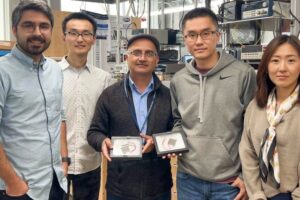
Amin Nozariasbmarz, Yu Zhang, Bed Poudel, Wenjie Li and Na Liu, left to right, researchers in the Department of Materials Science and Engineering at Penn State, display the thermoelectric modules they created. Credit: Provided . All Rights Reserved.

Breakthrough in waste heat to green energy

This image was generated using Stable Diffusion, a text-to-image generator, using the prompt “researchers working with huge piles of data.” UW–Madison’s Dane Morgan and Maciej Polak have published their solution for training ChatGPT to read academic articles, tabulate key data and check the results for accuracy, thereby saving valuable research time.

ChatGPT makes materials research much more efficient

Chemical engineering professor Dr. Jodie Lutkenhaus and chemistry assistant professor Dr. Daniel Tabor have discovered significant storage capacity in water-based batteries.

Team finds major storage capacity in water-based batteries

Superconductivity at Ordinary Temperatures

A drone used to detect radiation hovers near the tennis courts at the intermural fields on West Campus at University Park during the drone demonstration July 12, 2022, at the 2022 Interaction of Ionizing Radiation with Matter Technical Review. Credit: Jamie Oberdick/Materials Research Institute . All Rights Reserved.

Alliance works to keep America prepared for nuclear incidents

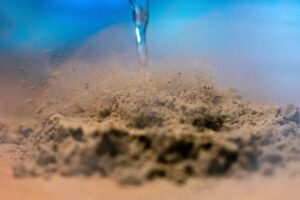
Cryoclastic flow caused by liquid nitrogen poured on lunar dust simulant.

Pffft-pffft: Liquid Nitrogen Spray Removes Pesky Moon Dust from Spacesuits

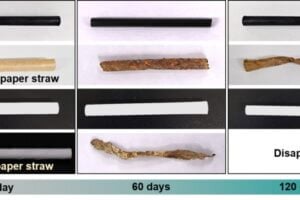
Conventional plastic straws and corn plastic straws did not decompose after 120 days under marine conditions. They have preserved their shape and lost only 5% of their total weight. In the meantime, eco-friendly straws developed by the research team lost more than 50% of their weight after 60 days and decomposed completely after 120 days.

100% biodegradable paper straws that do not become soggy

For their artificial fairy, Hao Zeng and Jianfeng Yang got inspired by dandelion seeds.

Fairy-like robot flies by the power of wind and light

University of Minnesota Twin Cities Professor Bharat Jalan is co-leading a team that has developed a new method for making nano-membranes of “smart” materials, which will allow scientists to harness their unique properties for use in devices such as sensors and flexible electronics.

New process to create freestanding membranes of ‘smart’ materials

Polar bear at the zoo

Polar bear paws hold the secret to better tire traction

Newer posts
← Previous Page1 … Page3 Page4
Substack subscription form sign up

Comments

  • Dax on The Silent Frequency That Makes Old Buildings Feel Haunted
  • Karoly Mirnics on Common Prescription Drugs May Disrupt Cholesterol Pathways in the Womb and Raise Autism Risk
  • Aizen on Laziness helped lead to extinction of Homo erectus
  • Norwood johnson on Electrons in New Crystals Behave as If They Live in Four Dimensions
  • ScienceBlog.com on Hidden Geometry Could Finally Fix Quantum Computers
© 2026 ScienceBlog.com | Follow our RSS / XML feed