Skip to content
ScienceBlog.com
  • Featured Blogs
    • EU Horizon Blog
    • ESA Tracker
    • Experimental Frontiers
    • Josh Mitteldorf’s Aging Matters
    • Dr. Lu Zhang’s Gondwanaland
    • NeuroEdge
    • NIAAA
    • SciChi
    • The Poetry of Science
    • Wild Science
  • Topics
    • Brain & Behavior
    • Earth, Energy & Environment
    • Health
    • Life & Non-humans
    • Physics & Mathematics
    • Social Sciences
    • Space
    • Technology
  • Our Substack
  • Follow Us!
    • Bluesky
    • Threads
    • FaceBook
    • Google News
    • Twitter/X
  • Contribute/Contact

neurodegenerative diseases

Truck wheels on road in motion

Tiny Particles from Traffic Pollution Disrupt Brain Cell Function

Rugby players

New Blood Test Could Predict Neurodegenerative Risk in Retired Rugby Players

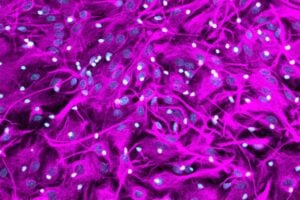
Astrocytes. Credit: Dr Alice Braga, co-author of the Nature paper

Brain’s Energy Boost Mechanism Uncovered, Offers Hope for Late-Life Cognitive Health

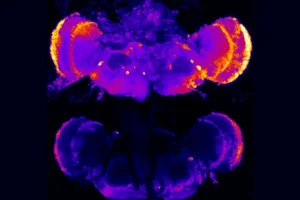
Mutations in the presenilin gene, PSEN1, causes early onset of Alzheimer’s disease in humans and in fruit flies modified to have this gene. A new study led by researchers at Penn State revels that disrupting heparan sulfate–modified proteins in fruit flies suppressed neuronal death and corrected other cell deficits common in early stages of Alzheimer’s and other neurodegenerative diseases. Pictured here are full fruit fly brains, stained with a marker that indicates cell death—brighter colors indicate higher presence of cell death. Top: A fly with deficits in the presenilin gene—a model for Alzheimer’s disease—with high levels of cell death. Bottom: A fly rescued by disrupting heparan sulfate–modified proteins.

Potential new target for early treatment of Alzheimer’s disease

brain illustration

Researchers identify vascular changes in the brain linked to Alzheimer’s disease

A lab worker holding a vial of blood

Blood Test Detects Common Forms of Frontotemporal Dementia, ALS, and PSP

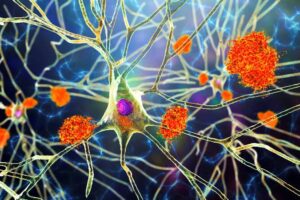
Protein clump amid neurons

The vicious cycle of protein clumping in Alzheimer’s and normal aging

A microscopic view of neurons with a glowing molecule representing the miR-519a-3p biomarker, offering hope for early Alzheimer's detection.

MicroRNA Biomarker Offers Hope for Early Alzheimer’s Detection

a human head with a transparent brain, revealing a glowing compass-like structure within the hippocampus and surrounding regions.

Scientists Discover Internal Neural Compass in the Human Brain

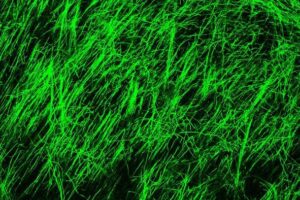
Inhibition of an ESI1 target promotes oligodendrocyte myelin production in mice, as shown as a dense curtain of green strands. This small molecule shows early promise as a potential treatment for MS, and to manage aging-related nerve sheath deterioration, according to study led by experts at Cincinnati Children's.

Breakthrough Treatment Reverses Myelin Damage in Multiple Sclerosis, Study Finds

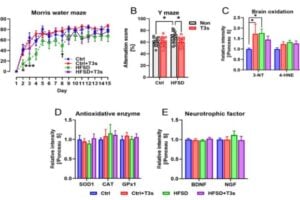
brain oxidation and tocotrienols infographic

Natural Compounds Show Promise in Protecting the Brain from Obesity-Related Cognitive Decline

garage with stored chemicals

Storing Chemicals in Attached Garages Linked to Higher Risk of ALS

RNA molecules

Lifelong RNA Molecules Hold the Key to Long-lived Brain Cells

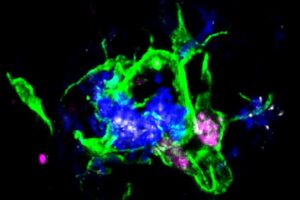
Scientists at Washington University School of Medicine in St. Louis have shown that treating mice with an antibody that blocks the interaction between APOE proteins (white) sprinkled within Alzheimer’s disease plaques and the LILRB4 receptor on microglia cells (purple) activates them to clean up damaging plaques (blue) in the brain.

New Alzheimer’s Treatment Shows Promise by Activating Brain’s Immune Cells

Older posts
Newer posts
← Previous Page1 Page2 Page3 Page4 Next →
Substack subscription form sign up

Comments

  • Kidreadytobreed on Global warming reduces available wind energy
  • James on Global warming reduces available wind energy
  • James on Global warming reduces available wind energy
  • Booklet AI on Key to online education: Test early and often
  • Karoly Mirnics on Common Prescription Drugs May Disrupt Cholesterol Pathways in the Womb and Raise Autism Risk
© 2026 ScienceBlog.com | Follow our RSS / XML feed