Skip to content
ScienceBlog.com
  • Featured Blogs
    • EU Horizon Blog
    • ESA Tracker
    • Experimental Frontiers
    • Josh Mitteldorf’s Aging Matters
    • Dr. Lu Zhang’s Gondwanaland
    • NeuroEdge
    • NIAAA
    • SciChi
    • The Poetry of Science
    • Wild Science
  • Topics
    • Brain & Behavior
    • Earth, Energy & Environment
    • Health
    • Life & Non-humans
    • Physics & Mathematics
    • Social Sciences
    • Space
    • Technology
  • Our Substack
  • Follow Us!
    • Bluesky
    • Threads
    • FaceBook
    • Google News
    • Twitter/X
  • Contribute/Contact

neurodegenerative diseases

A brain dissolving

Scientists Uncover Potential Ways to Prevent Spread of Neurodegenerative Diseases

a very fit person holding a pill

Scientists Discover Compounds That Mimic Exercise Benefits in Cells

brain rna illustration

New cause of neuron death in Alzheimer’s

cells

Improved cellular recycling could benefit patients with neurodegenerative conditions

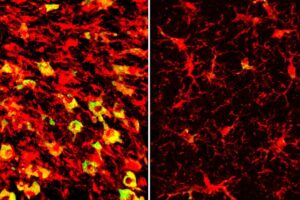
Lipid deposits (green) in brain immune cells (red) from mice with Alzheimer’s-like disease all but disappear (right) after the mice are treated with an experimental drug. Researchers at Washington University School of Medicine in St. Louis have found that a form of cholesterol known as cholesteryl esters builds up in the brains of mice with Alzheimer’s-like disease, and that clearing out the cholesteryl esters helps prevent brain damage and behavioral changes.

Lowering a form of brain cholesterol cuts Alzheimer’s-like damage in mice

The biosensor and reader are designed to be used at home or at a point of care. The system can transmit results wirelessly to physicians, patients and patient's caregivers and family.

Wireless, handheld, non-invasive device detects Alzheimer’s and Parkinson’s biomarkers

Oligodendrocyte precursor cells (OPCs) in vivo. Image by Erin Gibson.

Surprising finding links sleep, brain insulation, and neurodegeneration

A study led by Stanford Medicine researchers provides insight into aging of the brain. Adobe Stock/kulkann

Researchers identifies gene ‘fingerprint’ for brain aging

Complex sugar molecules control the formation of perineuronal nets (shown here in green) that surround neurons to help stabilize connections in the brain.

Sugars affect brain ‘plasticity,’ helping with learning, memory, recovery

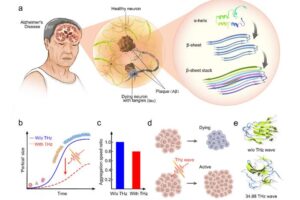
a The presence of extracellular β-amyloid deposition as neuritic plaques and the intracellular accumulation of hyperphosphorylated tau as neuro fibrillary tangles remain the primary neuropathologic features for AD diagnosis, and the amyloid deposition begins with the conversion of native monomers with more α-helices to an alternative conformation with β-sheet that self-associate into ordered assemblies. b A terahertz (THz) wave at a frequency of 34.88 THz delays the fibrosis dynamic curve. c The wave decreased the aggregation speed to 80% of the case without the wave. d The wave promotes cell proliferation. e The wave loosens the dense protein conformation with transformed β-sheets to a structure with more coil and bend regions

Potential Alzheimer’s treatment would use high-frequency terahertz radiation

brain illustration

New brain cells can replace diseased and aged cells, could help people with severe brain diseases

Espresso machine

Espresso can prevent Alzheimer’s protein clumping in lab tests

In the Alzheimer’s affected brain, abnormal collections of the tau protein accumulate and form tangles (seen in blue) within neurons, harming synaptic communication between nerve cells. Credits:Image: National Institute on Aging, NIH

How Tau tangles form in the brain

brain graphic with brainwaves emanating from the blue drawing

An early predictor of cognitive decline in Parkinson’s disease

Older posts
Newer posts
← Previous Page1 Page2 Page3 Page4 Next →
Substack subscription form sign up

Comments

  • Kidreadytobreed on Global warming reduces available wind energy
  • James on Global warming reduces available wind energy
  • James on Global warming reduces available wind energy
  • Booklet AI on Key to online education: Test early and often
  • Karoly Mirnics on Common Prescription Drugs May Disrupt Cholesterol Pathways in the Womb and Raise Autism Risk
© 2026 ScienceBlog.com | Follow our RSS / XML feed