Skip to content
ScienceBlog.com
  • Featured Blogs
    • EU Horizon Blog
    • ESA Tracker
    • Experimental Frontiers
    • Josh Mitteldorf’s Aging Matters
    • Dr. Lu Zhang’s Gondwanaland
    • NeuroEdge
    • NIAAA
    • SciChi
    • The Poetry of Science
    • Wild Science
  • Topics
    • Brain & Behavior
    • Earth, Energy & Environment
    • Health
    • Life & Non-humans
    • Physics & Mathematics
    • Social Sciences
    • Space
    • Technology
  • Our Substack
  • Follow Us!
    • Bluesky
    • Threads
    • FaceBook
    • Google News
    • Twitter/X
  • Contribute/Contact

Quasars

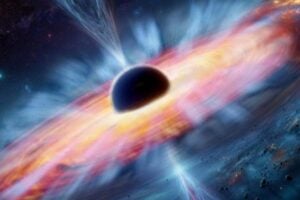
AI-generated representation of an accreting supermassive black hole, surrounded by gas spiraling toward it along the equatorial plane.

Study Reveals How Early Universe’s Giant Black Holes Grew So Quickly

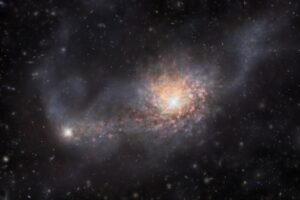
Artist’s impression of the interacting galaxies observed in this research. The gravitational interactions during the merger trigger both starburst and quasar activity.

Galaxy Merger Reveals Birth of Cosmic ‘Monster’ 12.8 Billion Years Ago

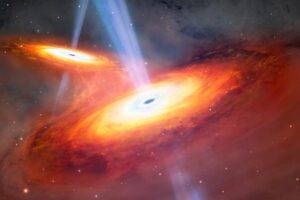
This illustration depicts two quasars in the process of merging. Using both the Gemini North telescope, one half of the International Gemini Observatory, which is supported in part by the U.S. National Science Foundation and operated by NSF NOIRLab, and the Subaru Telescope, a team of astronomers have discovered a pair of merging quasars seen only 900 million years after the Big Bang. Not only is this the most distant pair of merging quasars ever found, but also the first confirmed pair found in the period of the Universe known as Cosmic Dawn.

Astronomers Discover Earliest Known Pair of Merging Quasars, Shedding Light on Cosmic Dawn

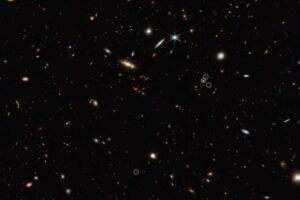
This deep galaxy field from Webb’s NIRCam (Near-Infrared Camera) shows an arrangement of 10 distant galaxies marked by eight white circles in a diagonal, thread-like line. (Two of the circles contain more than one galaxy.) This 3 million light-year-long filament is anchored by a very distant and luminous quasar – a galaxy with an active, supermassive black hole at its core. The quasar, called J0305-3150, appears in the middle of the cluster of three circles on the right side of the image. Its brightness outshines its host galaxy. The 10 marked galaxies existed just 830 million years after the big bang. The team believes the filament will eventually evolve into a massive cluster of galaxies.

NASA’s Webb identifies the earliest strands of the cosmic web

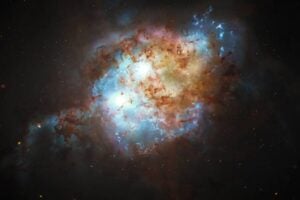
This artist's concept shows the brilliant glare of two quasars residing in the cores of two galaxies that are in the chaotic process of merging. The gravitational tug-of-war between the two galaxies ignites a firestorm of star birth.

Hubble Spots Rare Cosmic Twins: Double Quasars Caught Playing in the Early Universe

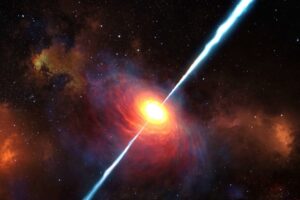
An artist's rendering of quasar P172+18

Mystery of quasars solved: Most powerful objects in the Universe ignited by colliding galaxies

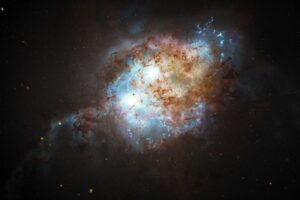
This artist's concept shows the brilliant glare of two quasars residing in the cores of two galaxies that are in the chaotic process of merging. The gravitational tug-of-war between the two galaxies ignites a firestorm of star birth.

Hubble unexpectedly finds double quasar in distant universe

Substack subscription form sign up

Comments

  • landman on Urine Test Cuts Unnecessary Prostate Biopsies by Nearly Two-Thirds in Head-to-Head Trial Against MRI
  • Marco Messina on More Than a Third of Americans Have Lost Relationships Over Politics
  • Anon on Why Fructose Behaves Less Like a Calorie and More Like a Hormone
  • Mark Mellinger on Living Plastic Can Self-Destruct on Command
  • Marie Feret on The Silent Frequency That Makes Old Buildings Feel Haunted
© 2026 ScienceBlog.com | Follow our RSS / XML feed