Skip to content
ScienceBlog.com
  • Featured Blogs
    • EU Horizon Blog
    • ESA Tracker
    • Experimental Frontiers
    • Josh Mitteldorf’s Aging Matters
    • Dr. Lu Zhang’s Gondwanaland
    • NeuroEdge
    • NIAAA
    • SciChi
    • The Poetry of Science
    • Wild Science
  • Topics
    • Brain & Behavior
    • Earth, Energy & Environment
    • Health
    • Life & Non-humans
    • Physics & Mathematics
    • Social Sciences
    • Space
    • Technology
  • Our Substack
  • Follow Us!
    • Bluesky
    • Threads
    • FaceBook
    • Google News
    • Twitter/X
  • Contribute/Contact

Renewable energy

Production of glass, iron, steel, and cement requires high-temperature heat. (Image credit: Getty Images)

Ancient Heating Tech Could Upend Clean Energy Storage

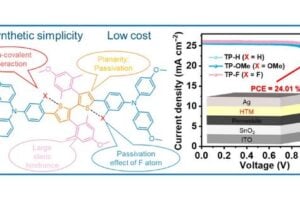
The schematic illustrates the structural benefits of three bithiophene-based hole transport materials (TP-H, TP-OMe, and TP-F) designed for perovskite solar cells (PSCs). These materials feature large steric hindrance, non-covalent interactions, and passivation effects, which simplify synthesis and reduce costs. The performance comparison graph reveals that the TP-F-based PSC achieves a power conversion efficiency (PCE) of 24.01%, surpassing TP-H and TP-OMe. The device configuration diagram shows the layer structure, including the hole transport material (HTM), which contributes to the high efficiency.

Solar Cells Breakthrough: New Materials Boost Efficiency and Cut Costs

Ohio State logo

Chemists design novel method for generating sustainable fuel

Yeast Fuel, Developed by Chula’s Faculty of Science Soon to Expand Its Production for the Aerospace

Jet Fuel from Grass: Thai Scientists Turn Microbes into Green Aviation Fuel

Small-spotted catshark egg in electromagnetic exposure experiment.

Offshore Wind Farms: Do They Pose a Threat to Sharks?

Solar panels on an industrial rooftop

California’s Solar-Powered ‘Resilience Hubs’ Could Generate 8GW, Slash Carbon Emissions

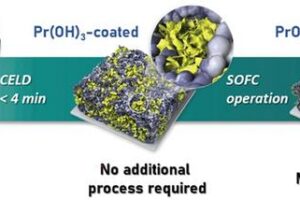
Schematic illustrations of the electrochemical coating process on LSM–YSZ electrode of SOFCs

Catalyst Coating Boosts Solid Oxide Fuel Cell Performance in Just 4 Minutes

A 3D rendered image depicting a wastewater treatment plant with a futuristic, glowing pipeline leading to a clean water droplet and a green energy symbol, representing the transformation of sewage sludge into clean water and renewable energy.

From Sewage Sludge to Clean Water and Energy

Projected income changes in 2049 compared to an economy without climate change. Income changes are committed in the sense that they are caused by historical emissions. (Image: Kotz et al., Nature)

Climate Change to Cost Global Economy 19% by 2050, Study Finds

Researchers harvest more energy from waves by moving a liquid–solid nanogenerator’s electrode to the end of the tube where the water crashes.

A simple way to harvest more ‘blue energy’ from waves

Lead author and battery researcher Gabriel Nambafu assembles a test flow battery apparatus.

New all-liquid iron flow battery for grid energy storage

water battery

New water batteries stay cool under pressure

Ohio State logo

A climate-friendly way to capture carbon dioxide in the air

Cars in front of a Japanese house

Japan’s Gas Car Ban Alone Won’t Meet CO2 Reduction Targets

Older posts
Newer posts
← Previous Page1 Page2 Page3 … Page5 Next →
Substack subscription form sign up

Comments

  • Karoly Mirnics on Common Prescription Drugs May Disrupt Cholesterol Pathways in the Womb and Raise Autism Risk
  • Aizen on Laziness helped lead to extinction of Homo erectus
  • Norwood johnson on Electrons in New Crystals Behave as If They Live in Four Dimensions
  • ScienceBlog.com on Hidden Geometry Could Finally Fix Quantum Computers
  • Theo Prinse on America Is Going Back to the Moon. This Time, It Plans to Stay
© 2026 ScienceBlog.com | Follow our RSS / XML feed