Skip to content
ScienceBlog.com
  • Featured Blogs
    • EU Horizon Blog
    • ESA Tracker
    • Experimental Frontiers
    • Josh Mitteldorf’s Aging Matters
    • Dr. Lu Zhang’s Gondwanaland
    • NeuroEdge
    • NIAAA
    • SciChi
    • The Poetry of Science
    • Wild Science
  • Topics
    • Brain & Behavior
    • Earth, Energy & Environment
    • Health
    • Life & Non-humans
    • Physics & Mathematics
    • Social Sciences
    • Space
    • Technology
  • Our Substack
  • Follow Us!
    • Bluesky
    • Threads
    • FaceBook
    • Google News
    • Twitter/X
  • Contribute/Contact

Renewable energy

Ariel view of cargo container ships at port.

Green ammonia could decarbonize 60% of global shipping when offered at just 10 regional fuel ports

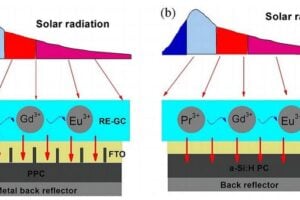
Applying a transparent Pr3+/Eu3+-doped glass-ceramic layer on top of a photovoltaic cell simultaneously protects it from damaging UV light and converts that UV radiation to visible light, thereby enhancing the light-to-energy conversion efficiency.

Boosting solar cell performance with a transparent spectral converter

Jeremy Snyder/Berkeley Lab

Analysis Confirms California’s Salton Sea Region to Be a Rich Domestic Lithium Resource

still wind indicator on a cloudy day

“Energy droughts” in wind and solar can last nearly a week, research shows

Europe’s battery charge to power a green economy

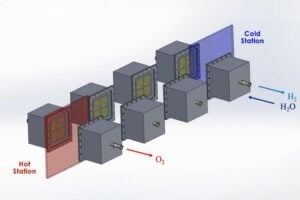
MIT engineers have developed a design for a system that efficiently harnesses the sun’s heat to split water and generate hydrogen.

MIT design would harness 40% of the sun’s heat to produce clean hydrogen fuel

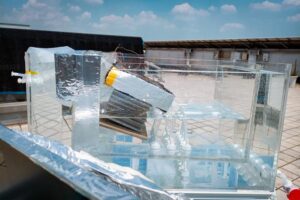
Outdoor test of the prototype under natural sunlight.

Desalination system could produce freshwater that is cheaper than tap water

Researchers uncovered how carbon dioxide can be both captured and converted through a single electrochemical process in which an electrode, like the one pictured covered in bubbles, is used to attract carbon dioxide released from a sorbent and convert it into carbon neutral products. Credits:Image: John Freidah/MIT MechE

Study suggests energy-efficient route to capturing and converting CO2

Tapping the Sun for renewable hydrogen

A sprinkler irrigating some plants

Solar powered irrigation: a game-changer for small-scale farms in sub-Saharan Africa

The push to turn climate culprit CO2 into a green force

Daubenton's bat (Myotis daubentonii) echolocating in flight.

Bat activity lower at solar farm sites, study finds

In climate fight, Europe pushes for homes to ditch boilers

From left, Stanford University researchers Ram Rajagopal, Thomas Navidi and Abbas El Gamal.

Software Coordination Could Eliminate Costly Upgrades to Future Electric Grids

Older posts
Newer posts
← Previous Page1 Page2 Page3 Page4 Page5 Next →
Substack subscription form sign up

Comments

  • Karoly Mirnics on Common Prescription Drugs May Disrupt Cholesterol Pathways in the Womb and Raise Autism Risk
  • Aizen on Laziness helped lead to extinction of Homo erectus
  • Norwood johnson on Electrons in New Crystals Behave as If They Live in Four Dimensions
  • ScienceBlog.com on Hidden Geometry Could Finally Fix Quantum Computers
  • Theo Prinse on America Is Going Back to the Moon. This Time, It Plans to Stay
© 2026 ScienceBlog.com | Follow our RSS / XML feed