Skip to content
Menu
Featured Blogs
EU Horizon Blog
ESA Tracker
Experimental Frontiers
Josh Mitteldorf’s Aging Matters
Dr. Lu Zhang’s Gondwanaland
NeuroEdge
NIAAA
SciChi
The Poetry of Science
Wild Science
Topics
Brain & Behavior
Earth, Energy & Environment
Health
Life & Non-humans
Physics & Mathematics
Social Sciences
Space
Technology
Our Substack
Follow Us!
Bluesky
Threads
FaceBook
Google News
Twitter/X
Contribute/Contact
Robotics
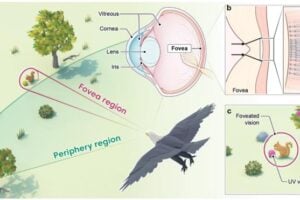
Innovative bird-eye-inspired camera developed for enhanced object detection
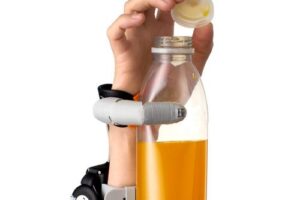
Public have no difficulty getting to grips with an extra thumb, study finds
Artificial Intelligence could help cure loneliness
AI poised to usher in new level of concierge services to the public
Microrobots Clean Microplastics and Bacteria from Water
Robots Still Lag Behind Animals in Foot Races
How ancient sea creatures can inform soft robotics
Scientists design a two-legged robot powered by muscle tissue
Speaking in a local accent might make social robots seem more trustworthy and competent
Feathered Dinosaurs’ Surprising Purpose: Scaring, Not Flying
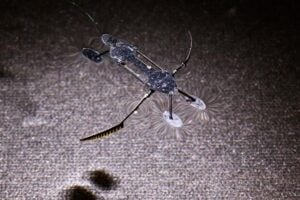
Mini-robots modeled on insects may be smallest, lightest, fastest ever developed
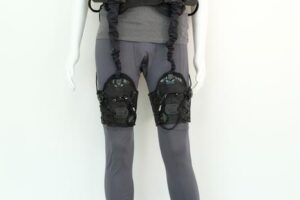
Soft robotic, wearable device improves walking for individual with Parkinson’s disease
Fire Ant ‘Rafts’ Inspire Engineering Research
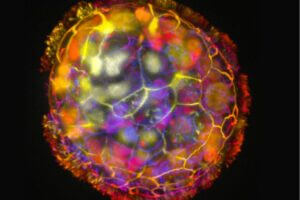
Scientists build tiny biological robots from human cells
Older posts
Newer posts
←
Previous
Page
1
Page
2
Page
3
…
Page
5
Next
→



![Figure 1. (A) Reconstructed Caudipteryx © Christophe Hendrickx. Used under the terms of the Creative Commons license (CC BY-SA 3.0). Licensing details: [https://creativecommons.org/licenses/by-sa/3.0/deed.en]. (B) Robopteryx, imitating the morphology of Caudipteryx, positioned in front of a grasshopper in the field (marked by a red arrow). (C) Grasshopper tested in the experiments.](https://scienceblog.com/wp-content/uploads/2024/01/tiny-feathered-dinosaur-300x200.jpg)