Skip to content
ScienceBlog.com
  • Featured Blogs
    • EU Horizon Blog
    • ESA Tracker
    • Experimental Frontiers
    • Josh Mitteldorf’s Aging Matters
    • Dr. Lu Zhang’s Gondwanaland
    • NeuroEdge
    • NIAAA
    • SciChi
    • The Poetry of Science
    • Wild Science
  • Topics
    • Brain & Behavior
    • Earth, Energy & Environment
    • Health
    • Life & Non-humans
    • Physics & Mathematics
    • Social Sciences
    • Space
    • Technology
  • Our Substack
  • Follow Us!
    • Bluesky
    • Threads
    • FaceBook
    • Google News
    • Twitter/X
  • Contribute/Contact

Space exploration

Urine collection cups for the Maximum Absorbency Garment for men

Dune-inspired upgrade for spacesuits allow astronauts to recycle urine into water

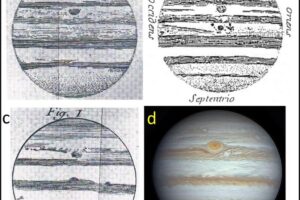
Illustrations by the 17th-century astronomer Cassini (a-c), compared with Jupiter's current Great Red Spot as captured by Eric Sussenbach in 2023.

Jupiter’s Great Red Spot Formed Less Than 200 Years Ago, Study Suggests

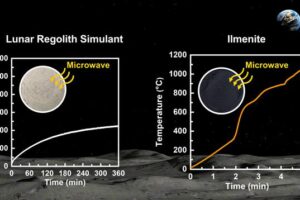
Ilmenite has a greater ability to absorb microwave and convert it to heat energy than KLS-1.

Koreans Develop Efficient Method for Building Lunar Bases Using Moon Soil

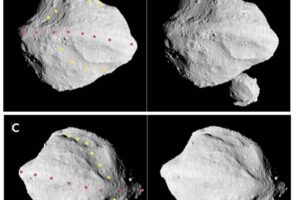
Panels a, b, and c each show stereographic image pairs of the asteroid Dinkinesh taken by the NASA Lucy Spacecraft’s L’LORRI Instrument in the minutes around closest approach on Nov. 1, 2023. The yellow and rose dots indicate the trough and ridge features, respectively. These images have been sharpened and processed to enhance contrast. Panel d shows a side view of Dinkinesh and its satellite Selam taken a few minutes after closest approach. Credit: NASA/SwRI/Johns Hopkins APL/NOIRLab.

Lucy Spacecraft Discovers Unexpected Contact Binary Orbiting Asteroid Dinkinesh

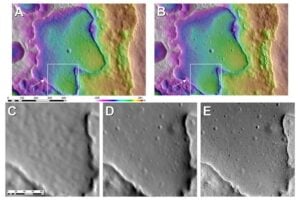
Pre-existing models for the Ina irregular mare patch (A, C, D) compared to more detailed and sharper shape-from-shading models from the study (B, E).

New technique offers more precise maps of the Moon’s surface

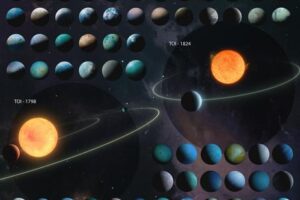
Artist conception of 126 planets in the latest TESS-Keck Survey catalog is based on data including planet radius, mass, density, and temperature. Question marks represent planets requiring more data for full characterization.

NASA’s TESS-Keck Survey Unveils 126 Diverse Worlds, Offering Insights into Planet Formation, Habitability

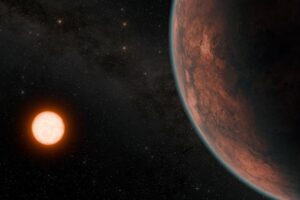
gliese 12 b

Astronomers Discover Potentially Habitable Earth-like Exoplanet Just 40 Light-Years Away

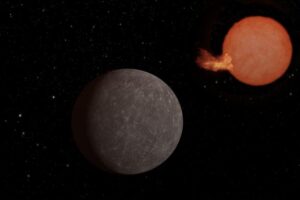
Earth-sized exoplanet orbiting the ultracool dwarf star SPECULOOS-3

Astronomers Unveil New Earth-Sized Exoplanet Orbiting Ultra-Cool Dwarf Star

Volcanic exoplanet illustration.

NASA’s TESS Discovers Fiery, Lava-Covered Exoplanet in Distant Star System

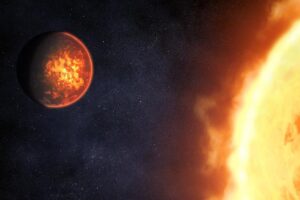
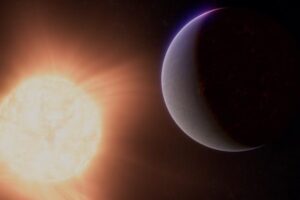
This artist's concept shows what the exoplanet 55 Cancri e could look like based on observations from NASA’s James Webb Space Telescope and other observatories. Observations from Webb’s NIRCam and MIRI suggest that the planet may be surrounded by an atmosphere rich in carbon dioxide (CO2) or carbon monoxide (CO). Researchers think the gases that make up the atmosphere could have bubbled out of an ocean of magma that is thought to cover the planet’s surface.

NASA’s James Webb Space Telescope Detects Possible Atmosphere on Hot Rocky Exoplanet 55 Cancri e

Artist rendering of the view on a Hycean world.

Distant Planet’s Potential Life Signal Challenged, But Hope Remains

Probing the effects of interplanetary space on asteroid Ryugu

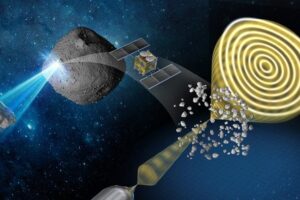
Asteroid Ryugu’s Secrets Revealed: Space Weathering, Micrometeoroids, and the Early Solar System

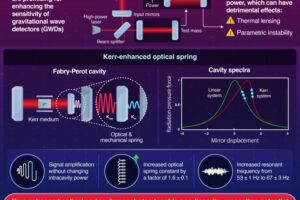
Kerr-enhanced optical spring demonstrates tunable non-linearity, presenting potential applications for enhancing GWD sensitivity and in various optomechanical systems.

Revolutionizing Gravitational Wave Detection: The Kerr-Enhanced Optical Spring

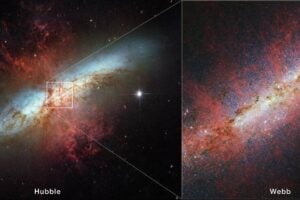
On the left is the starburst galaxy M82 as observed by NASA’s Hubble Space Telescope in 2006. The small box at the galaxy’s core corresponds to the area captured so far by the NIRCam (Near-Infrared Camera) instrument on NASA’s James Webb Space Telescope. The red filaments as seen by Webb are the polycyclic aromatic hydrocarbon emission, which traces the shape of the galactic wind. In the Hubble image, light at .814 microns is colored red, .658 microns is red-orange, .555 microns is green, and .435 microns is blue (filters F814W, F658N, F555W, and F435W, respectively). In the Webb image, light at 3.35 microns is colored red, 2.50 microns is green, and 1.64 microns is blue (filters F335M, F250M, and F164N, respectively). NASA, ESA, CSA, STScI, A. Bolatto (University of Maryland)

NASA’s James Webb Space Telescope Uncovers Secrets of Starburst Galaxy

Older posts
Newer posts
← Previous Page1 Page2 Page3 … Page6 Next →
Substack subscription form sign up

Comments

  • James on Global warming reduces available wind energy
  • Booklet AI on Key to online education: Test early and often
  • Karoly Mirnics on Common Prescription Drugs May Disrupt Cholesterol Pathways in the Womb and Raise Autism Risk
  • Aizen on Laziness helped lead to extinction of Homo erectus
  • Norwood johnson on Electrons in New Crystals Behave as If They Live in Four Dimensions
© 2026 ScienceBlog.com | Follow our RSS / XML feed