Skip to content
ScienceBlog.com
  • Featured Blogs
    • EU Horizon Blog
    • ESA Tracker
    • Experimental Frontiers
    • Josh Mitteldorf’s Aging Matters
    • Dr. Lu Zhang’s Gondwanaland
    • NeuroEdge
    • NIAAA
    • SciChi
    • The Poetry of Science
    • Wild Science
  • Topics
    • Brain & Behavior
    • Earth, Energy & Environment
    • Health
    • Life & Non-humans
    • Physics & Mathematics
    • Social Sciences
    • Space
    • Technology
  • Our Substack
  • Follow Us!
    • Bluesky
    • Threads
    • FaceBook
    • Google News
    • Twitter/X
  • Contribute/Contact

Space exploration

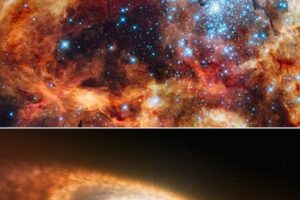
The ULLYSES program studied two types of young stars: super-hot, massive, blue stars and cooler, redder, less massive stars than our Sun. The top panel is a Hubble Space Telescope image of a star-forming region containing massive, young, blue stars in 30 Doradus, the Tarantula Nebula. Located within the Large Magellanic Cloud, this is one of the regions observed by ULLYSES. The bottom panel shows an artist's concept of a cooler, redder, young star that's less massive than our Sun. This type of star is still gathering material from its surrounding, planet-forming disk.

Hubble Telescope’s Ambitious Survey Provides Unprecedented Insights into the Lives of Stars

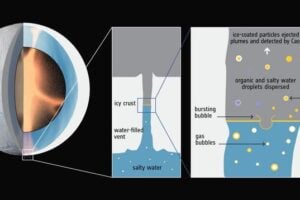
The drawing on the left depicts Enceladus and its ice-covered ocean, with cracks near the south pole that are believed to penetrate through the icy crust. The middle panel shows where authors believe life could thrive: at the top of the water, in a proposed thin layer (shown yellow) like on Earth’s oceans. The right panel shows that as gas bubbles rise and pop, bacterial cells could get lofted into space with droplets that then become the ice grains that were detected by Cassini.

New Study Reveals Potential for Detecting Life on Icy Moons of Saturn and Jupiter

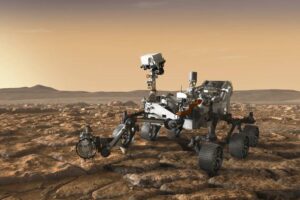
MIT geologists determined the original orientation of many of the bedrock samples collected on Mars by the Perseverance rover, depicted in this image rendering. The findings can give scientists clues to the conditions in which the rocks originally formed. Credits:Image: NASA/JPL-Caltech

Study determines the original orientations of rocks drilled on Mars

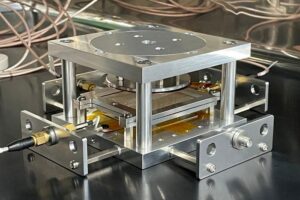
Photograph of photoelectric current measurement unit

Reproducing the Moon’s surface environment on Earth

Big asteroid

Can astronomers use radar to spot a cataclysmic asteroid?

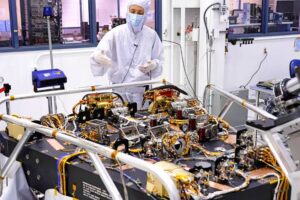
JPL scientist Vanessa Bailey stands behind the Nancy Grace Roman Coronagraph, which has been undergoing testing at JPL. About the size of a baby grand piano, the Coronagraph is designed to block starlight and allow scientists to see the faint light from planets outside our solar system. Credit: NASA/JPL-Caltech

NASA Puts Next-Gen Exoplanet-Imaging Technology to the Test

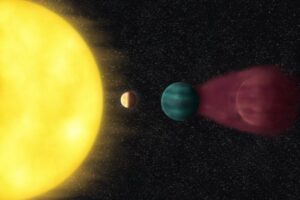
Young, hot, Earth-sized planet HD 63433d sits close to its star in the constellation Ursa Major, while two neighboring, mini-Neptune-sized planets — identified in 2020 — orbit farther out.

Earth-sized planet discovered in ‘our solar backyard’

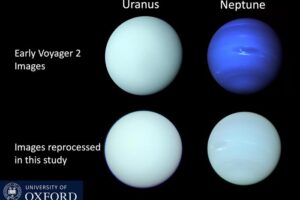
Voyager 2/ISS images of Uranus and Neptune released shortly after the Voyager 2 flybys in 1986 and 1989, respectively, compared with a reprocessing of the individual filter images in this study to determine the best estimate of the true colours of these planets.

New images reveal what Neptune and Uranus really look like

Space meal salad

Designing the ‘perfect’ meal to feed long-term space travelers

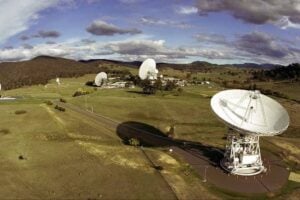
The radio antennas of the NASA’s Canberra Deep Space Communications Complex are located near the Australian capital. It’s one of three Deep Space Network complexes around the world that keep the agency in contact with over 40 space missions. The DSN m... Credit: NASA/JPL-Caltech

NASA’s Deep Space Network Turns 60 and Prepares for the Future

Top space telescope from Europe seeks to solve riddles of the universe

Color composite of galaxy AzTECC71 from multiple color filters in the NIRCam instrument on the James Webb Space Telescope. Credit: J. McKinney/M. Franco/C. Casey/University of Texas at Austin.

Ghostlike dusty galaxy reappears in James Webb Space Telescope image

Contrail fro rocket. Pixabay

Failure to launch: Does spaceflight increase men’s risk of erectile dysfunction?

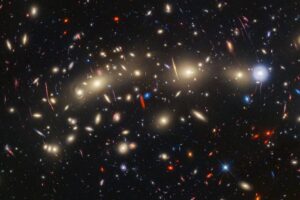
Panchromatic view of MACS0416, a galaxy cluster about 4.3 billion light-years from Earth. The image was created by combining infrared observations from NASA’s James Webb Space Telescope with visible-light data from NASA’s Hubble Space Telescope. The resulting prismatic panorama of blues and reds give clues to the distances of the galaxies.

NASA’s Webb, Hubble telescopes combine to create most colorful view of universe

Older posts
Newer posts
← Previous Page1 Page2 Page3 Page4 … Page6 Next →
Substack subscription form sign up

Comments

  • Kidreadytobreed on Global warming reduces available wind energy
  • James on Global warming reduces available wind energy
  • James on Global warming reduces available wind energy
  • Booklet AI on Key to online education: Test early and often
  • Karoly Mirnics on Common Prescription Drugs May Disrupt Cholesterol Pathways in the Womb and Raise Autism Risk
© 2026 ScienceBlog.com | Follow our RSS / XML feed