Skip to content
ScienceBlog.com
  • Featured Blogs
    • EU Horizon Blog
    • ESA Tracker
    • Experimental Frontiers
    • Josh Mitteldorf’s Aging Matters
    • Dr. Lu Zhang’s Gondwanaland
    • NeuroEdge
    • NIAAA
    • SciChi
    • The Poetry of Science
    • Wild Science
  • Topics
    • Brain & Behavior
    • Earth, Energy & Environment
    • Health
    • Life & Non-humans
    • Physics & Mathematics
    • Social Sciences
    • Space
    • Technology
  • Our Substack
  • Follow Us!
    • Bluesky
    • Threads
    • FaceBook
    • Google News
    • Twitter/X
  • Contribute/Contact

Space

Aguas Zarcas meteorite with irregular surface features. This 146g stone is on loan to the Buseck Center for Meteorite Studies from Michael Farmer.

In the pinball world of asteroids, a mudball meteorite avoided collisions

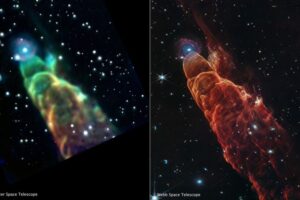
This side-by-side comparison shows a Spitzer Space Telescope Infrared Array Camera image of HH 49/50 (left) versus a Webb image of the same object (right) using the NIRCam (Near-infrared Camera) instrument and MIRI (Mid-infrared Instrument). The Webb image shows intricate details of the heated gas and dust as the protostellar jet slams into the material. Webb also resolves the “fuzzy” object located at the tip of the outflow into a distant spiral galaxy. The Spitzer image shows 3.6-micron light in blue, the 4.5-micron in green, and the 8.0-micron in red (IRAC1, IRAC2, IRAC4). In the Webb image, blue represents light at 2.0-microns (F200W), cyan represents light at 3.3-microns (F335M), green is 4.4-microns (F444W), orange is 4.7-microns (F470N), and red is 7.7-microns (F770W).

NASA’s Webb Telescope Unmasks True Nature of the Cosmic Tornado

Colorized microscopic image of sodium carbonate deposit on Ryugu sample

Ancient Space Salt Reveals Solar System’s Watery Past

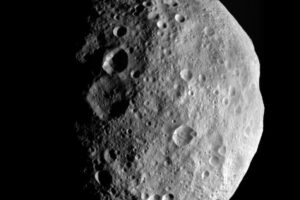
NASA’s Dawn spacecraft captured this image of Vesta as it left the giant asteroid’s orbit in 2012. The framing camera was looking down at the north pole, which is in the middle of the image. Credit: NASA/JPL-Caltech/UCLA/MPS/DLR/IDA

How Table Salt Could Explain Mysterious Gullies on Asteroid Vesta

homer in space

Space Station Study Shows Astronauts Process Tasks More Slowly, But Maintain Accuracy

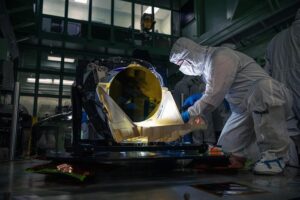
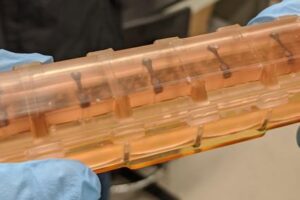
The prototype LISA telescope undergoes post-delivery inspection in a darkened NASA Goddard clean room on May 20. The entire telescope is made from an amber-colored glass-ceramic that resists changes in shape over a wide temperature range, and the mirror’s surface is coated in gold.

NASA reveals prototype telescope for gravitational wave observatory

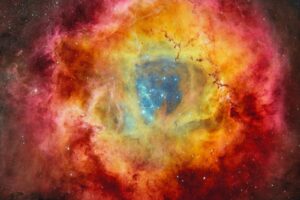
Cradled within the fiery petals of the Rosette Nebula is NGC 2244, the young star cluster which it nurtured. The cluster’s stars light up the nebula in vibrant hues of red, gold and purple, and opaque towers of dust rise from the billowing clouds around its excavated core. This image, captured by 570-megapixel Department of Energy-fabricated Dark Energy Camera (DECam), mounted on the U.S. National Science Foundation Víctor M. Blanco 4-meter Telescope at Cerro Tololo Inter-American Observatory, a Program of NSF NOIRLab, is being released in celebration of NOIRLab’s fifth anniversary.

Radiant Stars at the Heart of a Cosmic Rose

Heart tissues within one of the launch-ready chambers.

Space Weakens Heart Muscle Cells, Johns Hopkins Study Reveals

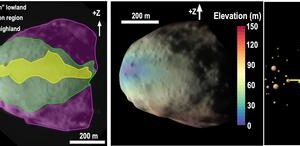
The geological features observed on Didymos provided key insights into its origins. The asteroid's triangular ridge (shown in the first panel from the left), along with the smooth region and the older, rougher "highland" region (depicted in the second panel from the left), can be explained by slope processes influenced by elevation (illustrated in the third panel from the left). The fourth panel demonstrates the impact of spin-up disruption, which likely played a role in the formation of Dimorphos.

DART Mission Reveals Ancient Origins and Fragile Structures of Asteroids

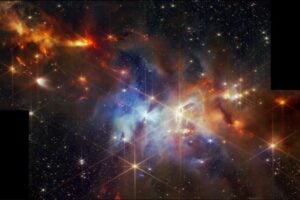
NASA's Webb telescope captures a stunning image of the Serpens Nebula, revealing a cluster of baby stars in the top left corner. These stars are still forming and shooting out powerful jets of gas in a surprising, aligned pattern. Unlike some nebulae, Serpens doesn't create its own light. Instead, it glows by reflecting light from nearby stars.

Webb Telescope Sees “Baby Stars” Blasting Jets in Perfect Alignment

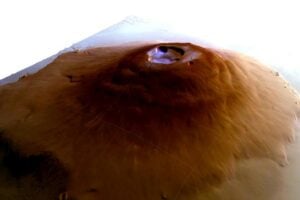
This simulated perspective oblique view shows Olympus Mons, the tallest volcano not only on Mars but in the entire solar system. The volcano measures some 600 km across.

In a significant first, researchers detect water frost on solar system’s tallest volcanoes

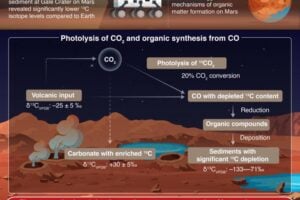
Tracing the origins of organic matter in Martian sediments

Decoding Mars’ Organic Mysteries

Dr Serge Krasnokutski

Cosmic Dust Particles May Hold Key to Life’s Building Blocks

Our solar system's giant planets

Asteroid fragments narrow down timeframe for giant planets’ current orbits

Older posts
Page1 Page2 Page3 Next →
Substack subscription form sign up

Comments

  • Karoly Mirnics on Common Prescription Drugs May Disrupt Cholesterol Pathways in the Womb and Raise Autism Risk
  • Aizen on Laziness helped lead to extinction of Homo erectus
  • Norwood johnson on Electrons in New Crystals Behave as If They Live in Four Dimensions
  • ScienceBlog.com on Hidden Geometry Could Finally Fix Quantum Computers
  • Theo Prinse on America Is Going Back to the Moon. This Time, It Plans to Stay
© 2026 ScienceBlog.com | Follow our RSS / XML feed