Skip to content
ScienceBlog.com
  • Featured Blogs
    • EU Horizon Blog
    • ESA Tracker
    • Experimental Frontiers
    • Josh Mitteldorf’s Aging Matters
    • Dr. Lu Zhang’s Gondwanaland
    • NeuroEdge
    • NIAAA
    • SciChi
    • The Poetry of Science
    • Wild Science
  • Topics
    • Brain & Behavior
    • Earth, Energy & Environment
    • Health
    • Life & Non-humans
    • Physics & Mathematics
    • Social Sciences
    • Space
    • Technology
  • Our Substack
  • Follow Us!
    • Bluesky
    • Threads
    • FaceBook
    • Google News
    • Twitter/X
  • Contribute/Contact

Space

astronaut suffering a space headache

Astronauts Experience Migraine and Tension Headaches During Long Space Flights, Study Finds

Ohio State logo

Study delivers detailed photos of galaxies’ inner structures

Dramatic plumes spray water ice and vapor from many locations along the famed "tiger stripes" near the south pole of Saturn's moon Enceladus. The tiger stripes are four prominent, approximately 84-mile- (135-kilometer-) long fractures that cross the moon's south polar terrain. Credit: NASA/JPL-Caltech/Space Science Institute

A New Way to Characterize Habitable Planets

uranus

NASA’s Webb rings in holidays with ringed planet Uranus

Nitrogen illustration

Meteorites likely source of nitrogen for early Earth

Illustration of Saturn rings

Using eclipses to calculate the transparency of Saturn’s rings

Nebula

NASA rocket to see sizzling edge of star-forming supernova

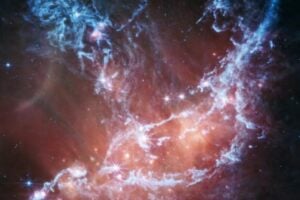
This new infrared image of NGC 346 from NASA’s James Webb Space Telescope’s Mid-Infrared Instrument (MIRI) traces emission from cool gas and dust. In this image blue represents silicates and sooty chemical molecules known as polycyclic aromatic hydrocarbons, or PAHs. More diffuse red emission shines from warm dust heated by the brightest and most massive stars in the heart of the region. Bright patches and filaments mark areas with abundant numbers of protostars. This image includes 7.7-micron light shown in blue, 10 microns in cyan, 11.3 microns in green, 15 microns in yellow, and 21 microns in red (770W, 1000W, 1130W, 1500W, and 2100W filters, respectively).

NASA’s Webb captures an ethereal view of NGC 346

This raw image from the Curiosity Rover shows the hexagon-shaped mudcracks filled with salt.

New insights into the potential for early steps of biological evolution on Mars

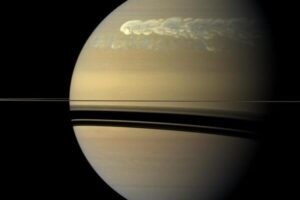
A huge storm dominates the rather featureless surface of Saturn in an image taken by the Cassini spacecraft on Feb. 25, 2011, about 12 weeks after the powerful storm was first detected in the planet's northern hemisphere. The megastorm is seen overtaking itself as it encircles the entire planet. Astronomers have found deep in the atmosphere the aftereffects of megastorms that occurred hundreds of years ago. The dark stripes are the shadows of Saturn's rings.

Hundred-year storms? That’s how long they last on Saturn.

This artist’s concept shows stars, black holes, and nebula laid over a grid representing the fabric of space-time. Ripples in this fabric are called gravitational waves. The NANOGrav collaboration detected evidence of gravitational waves created by black holes billions of times the mass of the Sun. Credit: NANOGrav collaboration; Aurore Simonet

15 Years of Radio Data Reveals Evidence of Space-Time Murmur

Image of the asteroid Dimorphos, with compass arrows, scale bar, and color key for reference. The north and east compass arrows show the orientation of the image on the sky. Note that the relationship between north and east on the sky (as seen from below) is flipped relative to direction arrows on a map of the ground (as seen from above).

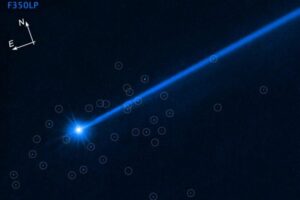
Hubble sees boulders escaping from asteroid dimorphos

Bands of rocks may have been formed by a very fast, deep river – the first such evidence found for on Mars

Wild river on Mars emerges from images, rock evidence

The Hubble Space Telescope has captured an image of an object in the ultraviolet part of the spectrum, which appears similar in size to our Milky Way. Researchers have been puzzled by this object for some time, but recently found similarities between it and a nearby galaxy known as IC 5249, which lacks a bulge and is observed edge-on. The images in ultraviolet and visible light of both objects are strikingly similar and suggest that the object could be a galaxy without a bulge viewed edge-on. Credit for the images goes to HST.

Starry Trail Not a Fleeing Black Hole After All

Older posts
Newer posts
← Previous Page1 Page2 Page3 Next →
Substack subscription form sign up

Comments

  • Karoly Mirnics on Common Prescription Drugs May Disrupt Cholesterol Pathways in the Womb and Raise Autism Risk
  • Aizen on Laziness helped lead to extinction of Homo erectus
  • Norwood johnson on Electrons in New Crystals Behave as If They Live in Four Dimensions
  • ScienceBlog.com on Hidden Geometry Could Finally Fix Quantum Computers
  • Theo Prinse on America Is Going Back to the Moon. This Time, It Plans to Stay
© 2026 ScienceBlog.com | Follow our RSS / XML feed