Skip to content
ScienceBlog.com
  • Featured Blogs
    • EU Horizon Blog
    • ESA Tracker
    • Experimental Frontiers
    • Josh Mitteldorf’s Aging Matters
    • Dr. Lu Zhang’s Gondwanaland
    • NeuroEdge
    • NIAAA
    • SciChi
    • The Poetry of Science
    • Wild Science
  • Topics
    • Brain & Behavior
    • Earth, Energy & Environment
    • Health
    • Life & Non-humans
    • Physics & Mathematics
    • Social Sciences
    • Space
    • Technology
  • Our Substack
  • Follow Us!
    • Bluesky
    • Threads
    • FaceBook
    • Google News
    • Twitter/X
  • Contribute/Contact

Space

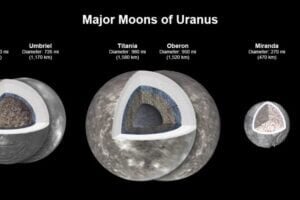
New modeling shows that there likely is an ocean layer in four of Uranus’ major moons: Ariel, Umbriel, Titania, and Oberon. Salty – or briny – oceans lie under the ice and atop layers of water-rich rock and dry rock. Miranda is too small to retain enough heat for an ocean layer. Credit: NASA/JPL-Caltech

Uranus Moons Hide Watery Secrets

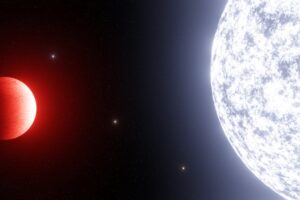
Illustration: Bibiana Prinoth

Scientists discover rare element terbium in exoplanet’s atmosphere

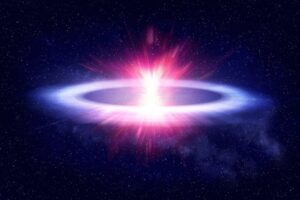
A big ol explosion somewhere out there

Scientists observe flattest explosion ever seen in space

Part of the set-up for creating medium-density amorphous ice

Discovery of new ice may change understanding of water

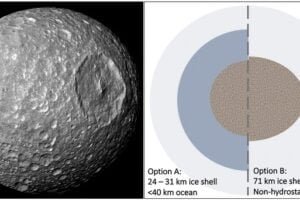
Mimas’ heavily cratered surface (left) suggests a cold history, but its librations rule out a homogeneous interior. Rather, Mimas must have a rocky interior and outer hydrosphere, which could include a liquid ocean (Option A) or be fully frozen with an irregularly shaped core (Option B). An ocean provides a better fit to the phase of the libration but is difficult to reconcile with Mimas’ geology.

More evidence that Saturn’s moon Mimas is a stealth ocean world

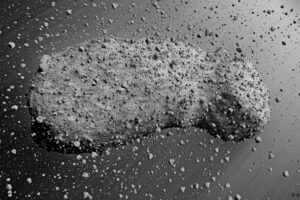
Asteroid Itokawa

Nukes needed to save Earth from common killer asteroid

This artist’s conception shows a late-stage galaxy merger and its two newly-discovered central black holes. The binary black holes are the closest together ever observed in multiple wavelengths.

Doomed pair of supermassive black holes the closest to collision ever seen

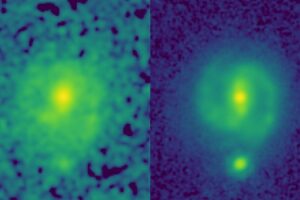
The power of JWST to map galaxies at high resolution and at longer infrared wavelengths than Hubble allows it look through dust and unveil the underlying structure and mass of distant galaxies. This can be seen in these two images of the galaxy EGS23205, seen as it was about 11 billion years ago. In the HST image (left, taken in the near-infrared filter), the galaxy is little more than a disk-shaped smudge obscured by dust and impacted by the glare of young stars, but in the corresponding JWST mid-infrared image (taken this past summer), it’s a beautiful spiral galaxy with a clear stellar bar.

Milky Way-like galaxies found in young universe

Series Title: Algorithms for Construction of Reality in Physics - Vol. 2 Schrödinger’s Cat Smile Volume 2

All in our heads? Physics book calls for better description of reality

Newer posts
← Previous Page1 Page2 Page3
Substack subscription form sign up

Comments

  • Karoly Mirnics on Common Prescription Drugs May Disrupt Cholesterol Pathways in the Womb and Raise Autism Risk
  • Aizen on Laziness helped lead to extinction of Homo erectus
  • Norwood johnson on Electrons in New Crystals Behave as If They Live in Four Dimensions
  • ScienceBlog.com on Hidden Geometry Could Finally Fix Quantum Computers
  • Theo Prinse on America Is Going Back to the Moon. This Time, It Plans to Stay
© 2026 ScienceBlog.com | Follow our RSS / XML feed