

Key Takeaways
- The review paper discusses how impact-generated hydrothermal systems, like those from asteroid impacts, could be plausible origins of life on Earth.
- These systems, created by events such as the Chicxulub impact, provide stable, warm, and chemically rich environments for prebiotic chemistry.
- Unlike deep-sea vents, impact-generated systems lack ongoing energy renewal but can sustain hydrothermal reactions for long periods.
- Evidence gathered from multiple impact sites offers a compelling case that life may have arisen in various craters rather than a single location.
- The research suggests that life could have originated simultaneously in multiple places on early Earth, highlighting the need for further investigation into impact-generated hydrothermal environments.
When a large asteroid hits rock, the first thing it does is kill everything. The heat is immediate, total, sterilising. Shockwaves evacuate the crater like an explosion in reverse, and the surrounding landscape is scoured to bare mineral. Then the impactor is gone and the crater begins, slowly, to cool. Water seeps in through cracks in the shattered rock. Minerals dissolve. Temperature gradients form. And in the warm, chemical darkness of the newly filled basin, something begins to happen that looks, in certain respects, rather like the inside of a hydrothermal vent on the ocean floor.
That transition, from catastrophic impact to chemical nursery, is the subject of a new review paper by Shea Cinquemani and Richard Lutz at Rutgers University. The paper, published in the Journal of Marine Science and Engineering, argues that impact-generated hydrothermal systems have been largely overlooked in the long debate over where life first emerged on Earth, and that the evidence supporting them as plausible origin environments is now substantial enough to take seriously.
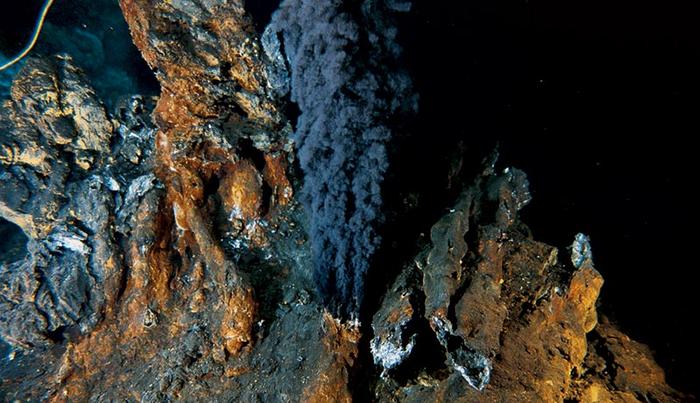
The conventional setting in this debate is the deep-sea hydrothermal vent: a crack in the ocean floor where superheated water, laden with hydrogen sulfide and dissolved metals, pours into the near-freezing sea. These systems were discovered on the Galápagos Rift in 1977, and the ecosystems found clustered around them, alive without sunlight and sustained entirely by chemical energy, prompted the obvious question. If life could thrive here in the present, might it have started somewhere like this in the past? Lutz, now a Distinguished Professor at Rutgers, was among the first biologists to descend to these vents in the research submersible Alvin, watching tubeworms and blind crabs assemble themselves around a process nobody had thought to look for. He has spent decades arguing that “life may have originated at deep-sea hydrothermal vents.” The debate has been running ever since.
Not for the dinosaurs, obviously. But the Chicxulub impact generated a hydrothermal system that may have persisted for up to 2 million years, and the chemistry inside that crater, warm, mineral-rich, and chemically active, resembles environments that researchers consider plausible for prebiotic reactions. The paper examines Chicxulub alongside two other impact craters as evidence that such systems deserve more attention in origin-of-life research.
Deep-sea vents are powered by ongoing volcanic or tectonic activity and can operate for very long periods, though their chemistry fluctuates. Impact-generated systems run on the stored heat from the impact itself, so they cool on a fixed schedule with no energy renewal. They also tend to occur in shallow, freshwater crater lakes rather than the deep, salty ocean, which changes the chemistry available and creates the possibility of wet-dry cycling, a process some researchers think essential for certain prebiotic reactions to occur.
Serpentinisation is a chemical reaction between water and certain iron-and-magnesium-rich rocks called ultramafic rocks, which produces hydrogen gas and generates heat without requiring any volcanic activity. Hydrogen is a key electron donor in many metabolic pathways, and the reaction also produces methane and formate, all of which are relevant to early biochemistry. It drives the Lost City hydrothermal field in the mid-Atlantic, one of the leading candidate environments for the origin of life, and can also occur in impact craters when the collision excavates buried ultramafic rock and water later fills the basin.
Possibly, and the paper raises this as a genuine open question. During the Late Heavy Bombardment, impacts were common enough that hydrothermal systems would have been forming and dissipating across Earth’s surface over hundreds of millions of years. If the right chemistry can occur in a crater lake as well as at a deep-sea vent, there is no particular reason to assume it happened only once, in one location. The earliest microbial fossils in the geological record are already complex enough to suggest life had been around for a while before they were preserved.
What impact-generated systems bring to the argument is, in a sense, the same chemistry made available at the surface. When a large meteor hits, the central zone of the crater collapses and rebounds, sometimes exhuming deep ultramafic rock, the kind that reacts with water to produce hydrogen in a process called serpentinisation. The same reaction powers some deep-sea vents.
Cinquemani examined three well-studied impact structures at very different points in Earth’s history. The youngest is Lonar Lake in Maharashtra, India, where a relatively small impact some 50,000 years ago left a 1.8-kilometre crater that still holds water. Core samples from its sediment contain 44 unique bacterial groups and 13 archaeal types, including methane-producing organisms of the kind that appear frequently in early-Earth hypotheses. The problem, as Cinquemani acknowledges, is that the impact is too recent; Earth was already saturated with microbial life by that point, so contamination cannot be ruled out. The samples are interesting rather than conclusive. Perhaps more so, those unique DNA structures found only in Lonar’s cores remain unexplained.
The Haughton Impact Structure in the Canadian Arctic, formed roughly 31 million years ago, offers cleaner evidence. Mineral deposition patterns in the crater record a sustained hydrothermal system that took several thousand years to cool below 50 degrees Celsius, long enough, modelling suggests, for simple chemical cycles to become established. And the Chicxulub crater, buried under Mexico’s Yucatán Peninsula and famous as the wound left by the asteroid that finished off the non-avian dinosaurs 65 million years ago, hosted a hydrothermal system that may have persisted for up to 2 million years, driven by the residual heat stored in roughly 130 metres of impact melt rock.
That timescale matters because one of the recurring problems with origin-of-life chemistry is pace. The molecular steps between a warm mineral broth and a replicating protocell are slow, involve multiple converging pathways, and require a relatively stable environment to persist. Two million years of warm, iron-and-sulfur-rich chemistry in a sealed crater lake is considerably longer than the active lifetimes of many deep-sea vent systems, which are interrupted by shifts in tectonic activity and whose chemistry fluctuates accordingly. The impact-generated systems run on stored heat with no renewal mechanism, so they cool on a fixed trajectory, but the largest craters apparently store enough thermal energy to sustain hydrothermal circulation for geological timescales that look, in origin-of-life terms, practically generous. They also tend to be freshwater, shallow, and open to atmospheric chemistry in ways that deep-sea environments are not, which matters for a competing hypothesis involving wet-dry cycling, where evaporation concentrates fragile biomolecules and allows certain reactions to proceed that are impossible in continuous water.
There is a second argument buried in the paper that has nothing to do with timescales. Experiments with meteorite samples added to formamide, a compound thought to have existed in the early atmosphere, produced nucleobases, carboxylic acids and amino acids with notable efficiency. The impactor itself, in other words, may carry catalysts that accelerate prebiotic chemistry. The crater environment and the incoming rock are not separate contributors to the origin question; they could be working together.
Cinquemani came to all of this sideways. The paper began as an undergraduate assignment in Lutz’s hydrothermal vents course, where she was asked to assess whether such systems on Mars could support life. “How does something come from nothing?” was, she has said, the question she kept returning to. After graduation, she expanded the assignment into a full review that went through five rounds of peer review and fifteen pages of reviewer comments before acceptance. Not a typical undergraduate trajectory.
The implications extend well beyond Earth. Both Europa, one of Jupiter’s moons, and Saturn’s Enceladus show evidence of active subsurface hydrothermal systems. Mars, where liquid water is now absent from the surface, bears geological signatures of impact-generated hydrothermal activity during its early Noachian period, when it was wetter and warmer. A Martian meteorite recovered from Antarctica, the Allan Hills 84001, contains magnetite crystal formations with morphological similarities to those produced by aquatic bacteria on Earth, though the interpretation remains contested. If impact craters can generate the right conditions for life’s chemistry, they become priority targets in any search for biology beyond this planet.
The deeper question the paper raises is whether the origin of life was a single event or several, in one location or many. Early Earth, during what geologists call the Late Heavy Bombardment between roughly 4.1 and 3.8 billion years ago, was peppered with impacts. Hydrothermal systems would have been forming, running, and cooling all over the surface, sometimes for centuries, sometimes for millions of years. The ingredients for prebiotic chemistry were presumably available in each of them. It seems at least plausible that life did not begin in one special place but bubbled up, tentatively, in dozens of warm craters before anything stuck.
Whether any of that will ever be confirmed is another matter. The geological record from 3.5 billion years ago is fragmentary and contested, and the chemistry of the first cell is sufficiently complex that researchers are still arguing about which molecules came first. But the case for impact-generated systems as a serious candidate, rather than a footnote to the deep-sea vent hypothesis, has now been made with enough rigour to demand an answer.
DOI / Source: https://doi.org/10.3390/jmse14050486