

Key Takeaways
- TOI-5205b is a ‘forbidden’ Jupiter-sized planet that exists around a low-mass red dwarf star, defying traditional models of planet formation.
- The James Webb Space Telescope (JWST) successfully analyzed TOI-5205b’s atmosphere, revealing unusual chemical properties including methane and hydrogen sulfide, but lacking detectable water.
- The planet’s atmosphere has a lower metallicity than its host star, suggesting a decoupling between the interior and atmosphere, which challenges standard planetary formation theories.
- Future observations using JWST’s emission spectroscopy will further investigate the strange chemistry and atmospheric composition of TOI-5205b.
- Understanding TOI-5205b’s formation and atmosphere could provide insights into habitability for smaller, rocky worlds in similar systems.
The James Webb Space Telescope splits starlight. That is, in a sense, all it does: a spectrograph aboard the observatory disperses incoming photons by wavelength, spreading them into a rainbow fine enough to read. When a planet crosses in front of its host star and some of that light passes through the planet’s atmosphere, different molecules leave their mark at characteristic wavelengths, and the instrument records the dips. The trick works for gas giants orbiting our own sun. It works, in principle, for gas giants orbiting other stars entirely. What nobody quite expected was for it to work on TOI-5205b, a planet that by most theoretical reckonings should not be there at all.
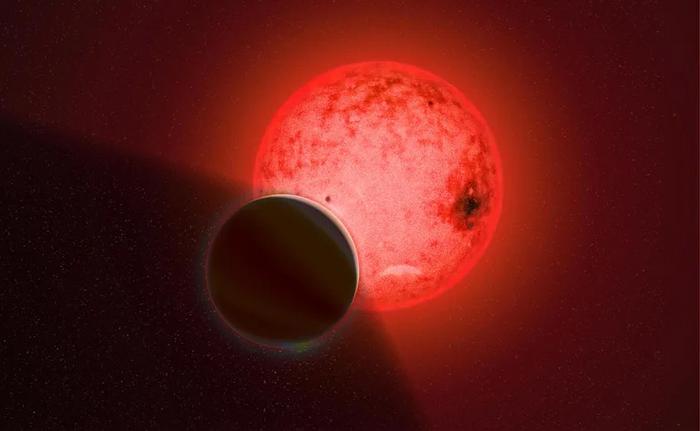
TOI-5205b is a Jupiter-sized world circling a red dwarf so small that the planet itself blocks roughly six percent of the star’s light each time it passes. Shubham Kanodia of Carnegie Science, who first confirmed the planet’s existence in 2023, describes it as a “forbidden” planet: the star is about forty percent the mass of the sun, and the protoplanetary disk around such a star should contain, at best, four or five Earth masses of raw material. That is not nearly enough, by the dominant models of how planets form, to build a Jupiter. And yet here it is, completing an orbit every thirty-nine hours.
Now Kanodia and an international team led by Caleb Cañas of NASA Goddard have pointed JWST at the planet three times and examined what happens to starlight threading through its atmosphere. The results, published this week in The Astronomical Journal, are strange enough that the researchers spent considerable effort confirming they were not simply reading the star’s own surface back at themselves.
That last concern is not trivial. TOI-5205’s host star is heavily spotted, and starspots, being cooler than the surrounding photosphere, absorb light differently. Because the planet transits across an unspotted region of the stellar disk, those spots leave an imprint on the transmission spectrum even though the planet never crosses them: a phenomenon called the transit light source effect, or TLS. At shorter wavelengths, the contamination overwhelmed the planetary signal almost entirely. The team had to model the star’s spot distribution for each of the three transits separately, a painstaking procedure involving anywhere from two to four spot features per visit, before the planet’s atmosphere could be isolated. Different software pipelines, run independently, gave consistent results. The planet was genuinely there, underneath the stellar noise.
What emerged from that noise is an atmosphere that looks, in certain respects, like nothing previously observed in a gas giant. Methane turned up clearly, as perhaps you would expect: TOI-5205b orbits close enough to its star to be warm but not scorching, with an equilibrium temperature around 742 kelvin, and at that temperature carbon prefers to sit in methane rather than carbon monoxide. More surprising was the detection of hydrogen sulfide. But the deepest puzzle is in what the atmosphere lacks. There is no robust detection of water. No oxygen-bearing molecules of any kind registered above the noise. The retrieval analyses, running through hundreds of thousands of model combinations, consistently favoured an atmosphere with a carbon-to-oxygen ratio well above solar: carbon-rich, oxygen-poor, essentially the opposite of what you would naively predict for a planet that formed in the same dusty disk as its star.
The metallicity picture is stranger still. The host star itself is metal-rich, with an iron abundance perhaps half a dex above solar. Its planet’s atmosphere has a metallicity below the sun’s. That inversion, a planet atmospherically poorer in heavy elements than the star it formed around, appears to be unique among the gas giants studied to date. “Its interior and atmosphere are not mixing,” Kanodia said. Interior models constructed at the University of Zurich, using the planet’s mass and radius to infer what must be buried inside, put the bulk metallicity at roughly seventeen percent, far higher than the atmosphere implies. The heavy elements are there; they are simply not where you can see them.
The host star is only about forty percent the mass of the sun, which means the disk of gas and dust it formed from was correspondingly small. Standard planet formation models estimate that disk contained at most four or five Earth masses of solid material, not nearly enough to trigger the runaway gas accretion that builds a Jupiter-mass planet. TOI-5205b should not exist by those models, yet it completes an orbit every thirty-nine hours.
When the planet crosses in front of its star, a tiny fraction of starlight passes through the outer atmosphere and carries chemical fingerprints to the telescope. JWST’s NIRSpec instrument is sensitive enough to detect those signatures across a wide wavelength range in a single observation. No previous telescope could have made these measurements for such a faint system.
For a well-mixed planet, the atmosphere should reflect the overall composition of the interior. TOI-5205b’s atmosphere appears to have far fewer heavy elements than its mass and radius imply are actually present. The most plausible interpretation is that heavy elements accreted during formation sank toward the core and have not mixed back up, meaning the planet’s interior and its visible outer layers are effectively chemically isolated from one another.
The team spent considerable effort ruling this out. Starspots do contaminate the transmission spectrum, particularly at shorter wavelengths, and the researchers modelled them carefully. The methane and hydrogen sulfide detections come from the infrared portion of the spectrum, where stellar contamination is weaker, and both signals were recovered consistently across three separate transits and two independent data reduction pipelines. The absence of water is genuinely ambiguous, but the carbon and sulfur detections appear robust.
JWST has already been allocated time to observe TOI-5205b in emission rather than transmission: instead of looking at the star through the planet’s atmosphere, it will catch heat rising from the planet itself. This largely sidesteps the starspot problem and should either confirm or challenge the low atmospheric metallicity and high carbon-to-oxygen ratio found in this study.
This kind of interior-atmosphere decoupling is actually familiar from our own solar system, where Jupiter and Saturn are thought to have stratified interiors rather than uniform compositions all the way down. What makes TOI-5205b peculiar is the degree of the mismatch and the circumstances of its formation. Interior models predict that heavy elements accreted during formation should be distributed throughout the planet or partially mixed upward over time. For the atmosphere to be this depleted, either the planet grew in a region of the disk unusually poor in oxygen (perhaps a carbon-rich gas reservoir generated by evaporating methane-rich pebbles, as some disk chemistry models suggest), or the heavy elements sank and stayed, inhibited from rising by some process that effectively switched off convective mixing between core and envelope.
The absence of water complicates interpretation considerably. Water is the standard metallicity tracer for hot Jupiters orbiting sun-like stars, and even for the somewhat cooler population TOI-5205b belongs to it should, in theory, be detectable. It isn’t, at least not with this dataset. Whether that reflects a genuinely oxygen-depleted atmosphere or simply an unfortunate overlap between the water absorption bands and the spectral contamination from those starspots remains genuinely open. The team is cautious on this point. Future observations using JWST’s MIRI instrument in emission spectroscopy mode, already scheduled as part of the telescope’s cycle four programme, should help untangle the two possibilities.
What is not in question is that planets like TOI-5205b keep turning up, despite models that say they should not. The GEMS survey (giant exoplanets around M dwarf stars) has identified a small but stubborn population of Jupiter-mass worlds around low-mass red dwarfs, and “Red Dwarfs and the Seven Giants,” the JWST programme that produced this work, is now making its way through seven of them. TOI-5205b is the first to have its atmosphere characterised. The remaining six should, over the coming cycles, reveal whether its strange chemistry is an individual quirk or a property the whole class shares.
The answer matters beyond planetary science. Giant planets around M dwarfs are probably influencing whether smaller, rocky worlds can form and persist nearby, by perturbing the orbital architecture of their systems in ways that determine habitability. Understanding how these planets form, and whether their atmospheres record the chemistry of the disks they emerged from, connects to questions about where Earth-like planets can exist at all. TOI-5205b may not be habitable. It may not even be explicable yet. But whatever formation process made it is apparently quite good at hiding its tracks.
The next step is emission spectroscopy: catching the planet’s own heat radiation on the far side of its orbit rather than reading atmospheric absorption against the star. That geometry largely bypasses the stellar contamination problem. It also offers a different pressure-altitude window into the atmosphere, potentially reaching deeper layers than transmission spectroscopy can access. If the carbon-to-oxygen ratio and low metallicity survive that second look, the picture becomes considerably harder to explain away.
A Jupiter in the orbit of Mercury, around a star smaller than some planets. Its atmosphere has less metal than its star. Its interior has more than either. The models that describe gas giant formation were not designed with anything like it in mind.
DOI / Source: https://doi.org/10.3847/1538-3881/ae4976