

Key Takeaways
- Inhalation of quaternary ammonium compounds (QACs) poses significantly higher risks, causing 100-fold more lung injury compared to ingestion.
- QACs are commonly found in disinfectants, fabric softeners, and even mouthwash, but their safety assessments have focused mainly on ingestion.
- Research shows that inhaled QACs stay in lung tissue longer, increasing the potential for harm, especially when comparing benzalkonium chloride (BAC) to didecyl dimethylammonium chloride (DDAC).
- Male mice showed higher sensitivity to QACs than female mice, raising questions about sex-specific risks in humans.
- Given overlaps in blood QAC levels between mice and humans, researchers urge reconsideration of the safety evaluations for aerosol disinfectants.
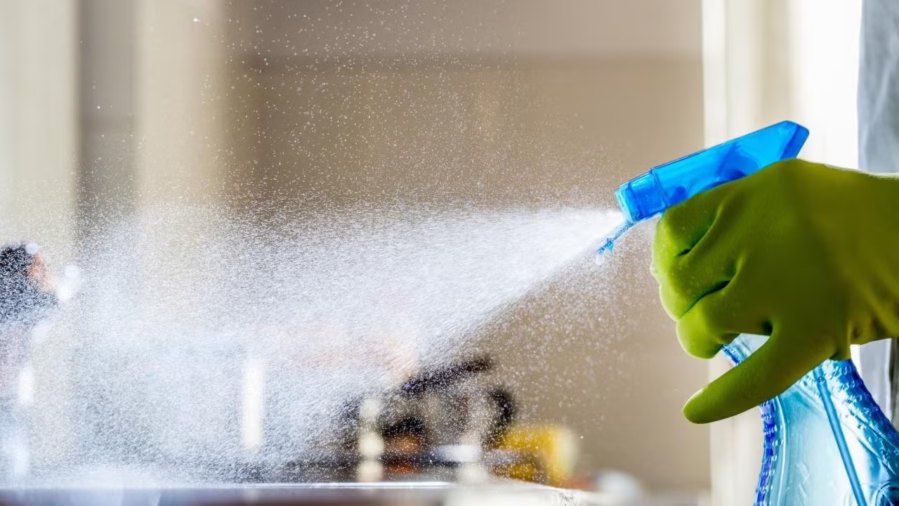
Next time you reach for the disinfectant spray to wipe down your counters, consider what happens in the seconds after you pull the trigger. A fine mist fills the air, you breathe it in, and chemicals that were designed to kill bacteria are now moving through your airways. You probably don’t think about this. Most people don’t. But Gino Cortopassi, a biochemist and pharmacologist at the University of California, Davis, has been thinking about little else for the better part of a decade, and his team’s latest results suggest we’ve been dramatically underestimating the risk.
The chemicals in question are quaternary ammonium compounds, QACs for short, a family of antimicrobials that have been staples of industrial and domestic cleaning since the 1940s. They’re the active ingredients in many Lysol products and in dozens of hospital-grade disinfectants. They’re also in fabric softeners, dryer sheets, mouthwash, nasal sprays, some eye drops. They’re everywhere, basically.
What safety testing existed for QACs assumed that swallowing a small amount was the main route of concern. Gut penetration of these compounds is low, under 10%. Skin absorption is even lower. So the conventional wisdom held that unless you were drinking the stuff, your body burden of QACs would be negligible. That assumption has been quietly unraveling for a few years now. A 2021 study from the same UC Davis group found detectable QAC concentrations in the blood of roughly 80% of a sample of human volunteers, which was a jolt. The gut and skin weren’t explaining those levels. Breathing seemed the obvious culprit, but nobody had tested it rigorously. Until now.
Quaternary ammonium compounds are a family of antimicrobial chemicals used as disinfectants since the 1940s. They appear in spray cleaners, hospital disinfectants, fabric softeners, dryer sheets, mouthwash, nasal sprays, and some eye drops. Benzalkonium chloride and didecyl dimethylammonium chloride are among the most widely used variants.
According to the UC Davis mouse study, inhaled QACs are roughly 100 times more lethal and 500 times more injurious to the lungs than the same compounds taken orally. The airways absorb these chemicals far more efficiently than the gut, and QACs tend to accumulate in lung tissue rather than clearing quickly.
At doses that produced significant lung injury in mice, blood QAC concentrations ranged from about 1 to 150 nanomolar. Studies of human volunteers have found blood QAC levels in roughly the same 1-40 nanomolar range, suggesting the doses required to injure mouse lungs are not far removed from the exposures humans are already experiencing.
The study found DDAC caused approximately twice the lung injury and twice the lethality of BAC at equivalent doses. The difference appears related to how slowly DDAC moves from lung tissue into the bloodstream: compounds that linger in the lung have more opportunity to cause damage. Both are widely used, but they may not be equivalent in terms of respiratory risk.
The study is in mice, and the researchers are careful to note that acute inhalation in a laboratory is not the same as the chronic low-level exposure most people experience at home. The findings do, however, raise serious questions about whether current safety assessments, which focus on ingestion rather than inhalation, are adequate for aerosol-format cleaning products.
The new study, published in Environmental Science and Technology, exposed mice to two of the most widely used QACs: benzalkonium chloride (BAC, found in Lysol and many hospital disinfectants) and didecyl dimethylammonium chloride (DDAC, common in commercial cleaning products). The team delivered both compounds directly to mouse airways, mimicking inhalation, and compared the results with published data on oral dosing. The difference was not subtle.
“The surprising result of this study was that these compounds, when inhaled, caused 100-fold more lung injury and 100-fold more lethality compared to oral ingestion,” Cortopassi said.
A hundredfold. The median lethal dose when QACs reach the lung was around 2 milligrams per kilogram of body weight. Via the gut, you’d need more than 200 mg/kg to reach the same lethality. Lung injury appeared at doses roughly 500-fold lower by the inhaled route than the swallowed one. The airways, it turns out, are spectacularly efficient at absorbing these compounds into the body, in a way the gut simply isn’t. And once QACs reach lung tissue, they tend to stay there. Measurements in rats from earlier work suggested that lung concentrations run about 10-fold higher than blood concentrations after inhalation, meaning blood tests underestimate what’s actually happening inside the airways.
The mechanism behind this toxicity probably isn’t the one early researchers assumed. QACs are structurally similar to acetylcholine, so the first hypothesis was that they interfere with neuromuscular signaling at cholinergic receptors, a kind of curare-like lung paralysis. That does happen, but only at very high concentrations, in the 0.5-1 millimolar range. What the UC Davis group has shown in previous work is that QACs are potent mitochondrial inhibitors, disrupting the energy-generating machinery inside cells at concentrations about 1,000-fold lower. The lung damage seen in mice fits that picture. QACs are lipophilic cations, a chemical class that tends to concentrate inside mitochondria, which may explain why airways are particularly vulnerable.
Not every QAC is equally dangerous, which was another finding from this study. DDAC caused roughly twice as much lung injury and twice as many deaths as BAC at identical doses, a difference the researchers attribute to slower movement of DDAC from lung tissue into the bloodstream. If a compound lingers in the lungs rather than being cleared to blood, it has more time to do damage. That finding has practical implications: BAC and DDAC are often treated interchangeably in product formulations, but they may not carry the same risk.
There was also a pronounced sex difference, one that the researchers describe as “sex-specific toxicity.” Male mice died at significantly lower doses than females, roughly 2-fold more sensitive across both compounds. At 1.875 mg/kg of BAC, 100% of female mice survived; only 17% of males did. The team’s best explanation is that female mice clear fluid from lung to blood faster, perhaps due to estrogen-mediated effects on lung barrier function, a phenomenon that’s also been observed in human women with acute lung injury. Whether this translates to meaningful sex-based differences in human risk from cleaning products is genuinely unknown.
The most pointed finding, from a public health standpoint, is the blood concentration overlap. When mice breathed in enough QAC to cause significant lung injury, the QAC levels measured in their blood ranged from roughly 1 to 150 nanomolar. In a 2021 study of 43 human volunteers, half had total blood QAC concentrations between 1 and 40 nanomolar. The ranges overlap. That’s not proof of harm, but it’s the kind of finding that should give regulators pause. “We have to question whether we really want to have all of these QAC-based disinfectant sprays in the environment given their proven lung toxicity in mice,” Cortopassi said.
Epidemiological evidence from occupational settings points in the same direction. Studies of nurses working in hospitals where QAC-based disinfectants are used heavily have found elevated rates of asthma and chronic obstructive pulmonary disease, with risk of asthma running 7.5-fold higher among nurses who manually mixed BAC solutions. In South Korea, deaths from interstitial lung disease in children were linked to DDAC exposure from disinfectants used in humidifiers. The mouse data are now providing a mechanistic account of what those epidemiological signals might represent.
QACs aren’t going away. Their use expanded sharply after 2015, when the FDA banned triclosan and triclocarban, and expanded again during the Covid-19 pandemic when disinfectant sprays became a fixture of daily life. The question the UC Davis findings force is whether safety assessments built around swallowing, rather than breathing, are fit for purpose when the product format is a spray. Spray bottles, by design, create aerosols. And aerosols, apparently, are a far more efficient delivery system than anyone had been comfortable admitting.