

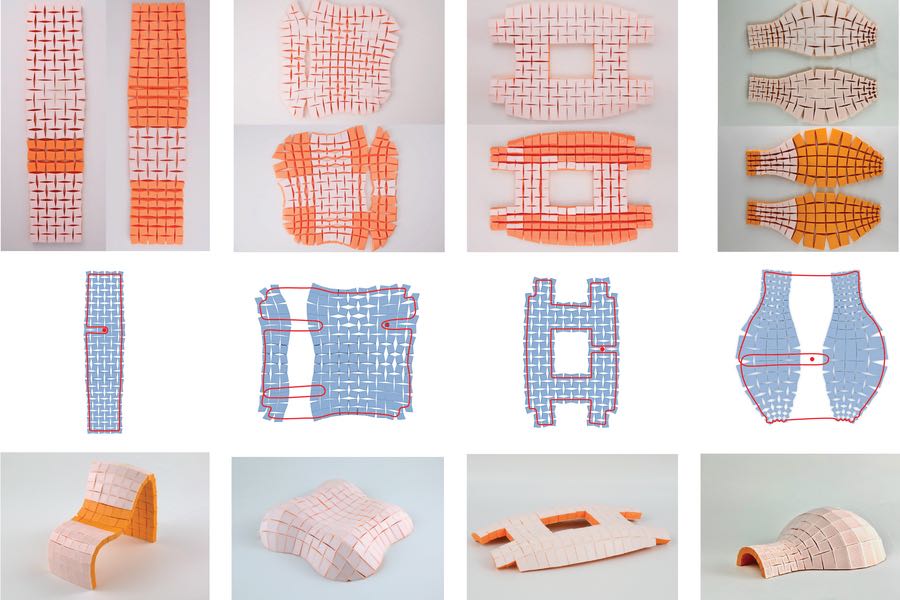
A coastal town floods. Aid workers drop shipping containers filled with what look like floor tiles. Someone finds the cord, pulls hard, and a rigid shelter snaps into shape in under ten seconds. No tools. No instructions. Just tension traveling through a grid of hinges that know exactly how to move.
MIT engineers have built a system that encodes three-dimensional structures into flat panels. The panels deploy with a single string pull, transforming from something you could slide under a door into a curved, load-bearing object. The method works at any scale—the physics that assemble a fingernail-sized medical implant are identical to those that could raise a building frame.
The trick is treating the entire structure as one mechanical linkage. A 3D design gets broken into quadrilateral tiles connected by rotating hinges. When you pull the string, tension propagates through the whole system at once. There is no step two. The string follows a pre-calculated path that lifts specific points in sequence, and the rest of the geometry follows by necessity.
Why disaster zones need this now
Storage and transport costs dominate emergency logistics. A flat splint takes up less cargo space than a pre-formed one, and you can carry fifty collapsed shelters where you might fit ten traditional tents. The team has already prototyped backpack-sized medical braces that deploy in seconds—useful for field medics who need custom-fitted support structures but cannot carry bulky inventory.
The same logic applies to space missions. Robotic arms could pull pre-shipped panels into modular habitats on Mars, avoiding the complexity of multi-step assembly in partial gravity. The tiles can be made with standard fabrication methods—3D printing for prototypes, injection molding for mass production, CNC milling for metal frames.
“Our method can facilitate autonomous robotic assembly of structures, as the single string pull actuation mechanism is a much simpler motion planning task than assembling individual modules,” Mina Konaković Luković, Assistant Professor at MIT CSAIL, explains.
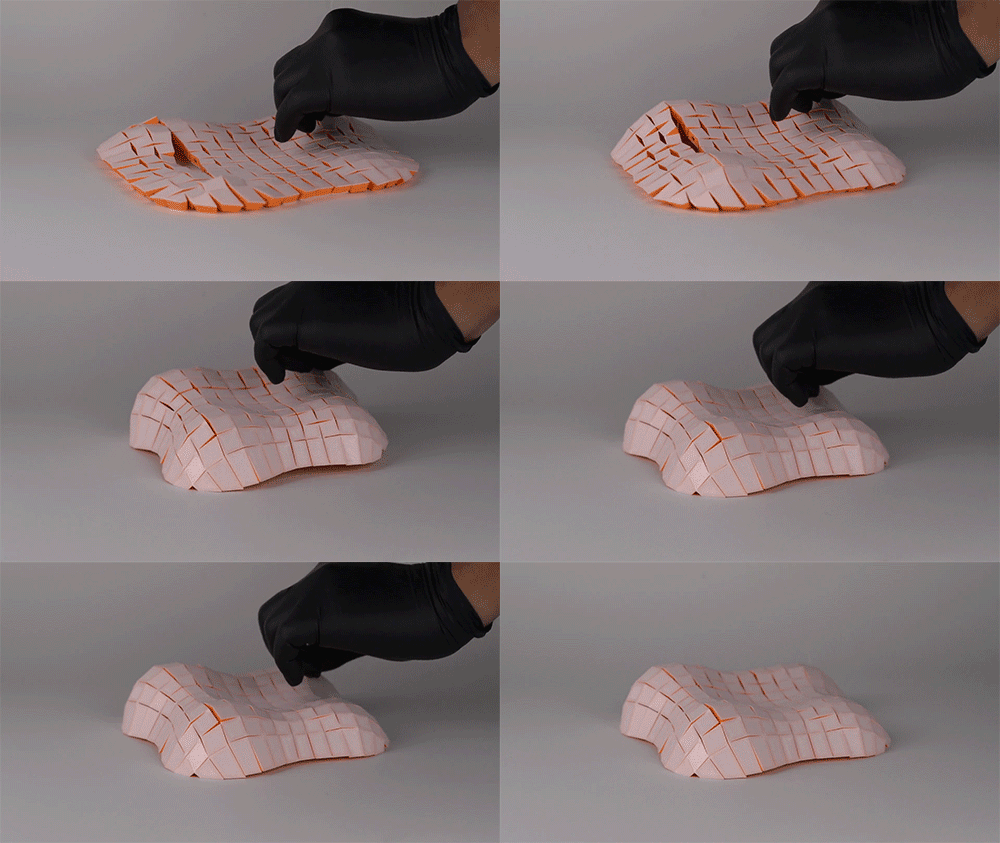
In lab tests, one person assembled and collapsed a full-sized chair repeatedly without fatigue. The structure locks into place under tension, then releases when the string goes slack.
Credit: Courtesy of the researchers
The algorithm that prevents snags
The hard part is not the pulling—it is making sure the string does not bind. An algorithm calculates which points must be lifted to form the target shape, then finds the shortest path between them while minimizing friction. The string slides through channels carved into the tiles, and the path optimization is what makes the deployment smooth instead of jerky.
The design draws from kirigami cutting patterns that create auxetic behavior—materials that expand in multiple directions when stretched. This property lets a flat sheet adopt complex curves, the kind you need for helmet contours or ergonomic seating.
The team presented the work at SIGGRAPH Asia, showing examples from miniature curved objects to furniture-scale assemblies. But questions remain about load limits. How much weight can these hinges handle before they fail? How thick does the cable need to be for a structure tall enough to walk through? The researchers are still mapping those boundaries, and the answers will determine whether this moves from lab demonstration to cargo plane.