

IT IS the ultimate biological “ghost in the machine”. Inside your neurons and cardiac tissue, trillions of tiny valves are working frantically to manage the electrical surges that allow you to think, move and keep your heart beating. Most of these valves, known as ion channels, act like macroscopic gates: they physically slam shut to stop the flow of charged particles.
But one of the most important players in this electrical orchestra, the “big potassium” or BK channel, doesn’t have a door. Instead, it relies on a trick of physics that shouldn’t, strictly speaking, be perfect. And we have just discovered that it isn’t.
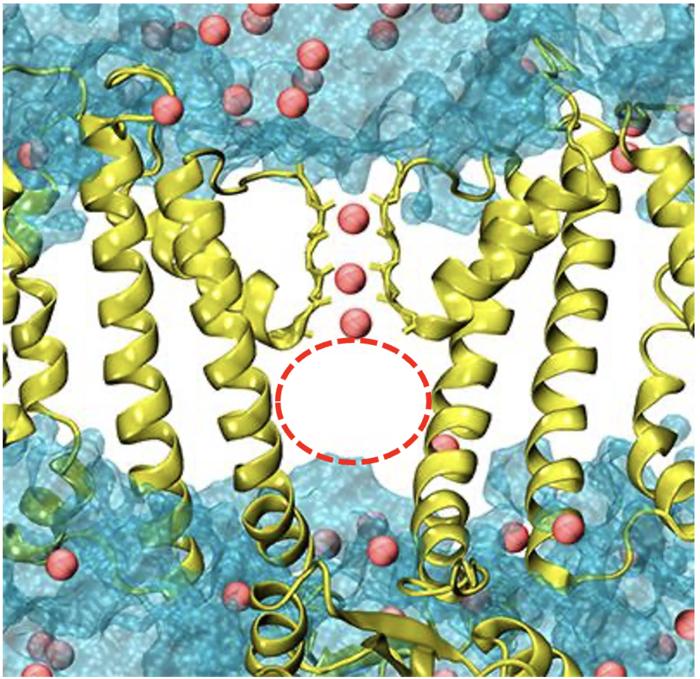
“In 2018, we showed that BK channels have a unique property,” says Jianhan Chen at the University of Massachusetts Amherst. Most channels use a physical protein barrier to block ions, but the BK channel uses a “soft gate”—a literal bubble of nothingness.
The channel’s inner pore is remarkably hydrophobic, or water-repellent. Chen likens the effect to a simple piece of wax paper. “If you drip a drop of water on it, it doesn’t absorb but beads up into a droplet. Now roll that wax paper into a tube,” he says, “and you have a BK channel’s pore.”
When the channel narrows, the water inside doesn’t just get squeezed; it vanishes. The hydrophobic walls drive out the liquid, creating a microscopic vapor barrier. Because the potassium ions that power our nerves are always “clothed” in water molecules, they cannot pass through this dry gap. The electricity simply stops.
Or at least, it’s supposed to. New research by Chen and his colleague Zhiguang Jia, published in PRX Life, has revealed that this vapor barrier is “inherently leaky”. It turns out that physics doesn’t allow for a perfect seal when your gate is made of air.
Even when the channel is supposed to be fully deactivated, the laws of thermodynamics dictate that there is always a tiny, non-zero chance of an ion slipping through. The team found that the barrier only creates a finite energy hurdle. In the quantum-adjacent world of molecular biology, “finite” means “passable”.
“We’ve discovered that this vapor barrier is inherently leaky, determined by the laws of physics,” says Chen. The channel remains “intrinsically open” with a limiting probability of about one in 10 million (Po∼10−7), even at extreme negative voltages. It is a persistent hum in a system we thought could be turned to total silence.
Why does this “leak” matter? Because when the body’s electrical infrastructure goes haywire, the results are catastrophic. Maladies like epilepsy and hypertension are often rooted in these channels failing to regulate ionic flows correctly.
By understanding the exact physics of this leakage, researchers can finally start to see the “absence of something”. You can’t easily grab a vapor barrier with a drug molecule, but you can manipulate the leak. The team found that mutations in the pore or changes to the channel’s physical shape predictably altered the leakiness.
This gives us a new diagnostic lens. If we can measure how the “ghost gate” fails, we might eventually learn how to tune it—tightening the seal in a brain prone to seizures or loosening it to ease high blood pressure.
For now, the discovery serves as a reminder that our biological machinery is never quite as tidy as a textbook diagram. We are powered by a system that is, by its very design, slightly broken. And it is that exact, tiny imperfection that might be the key to keeping the whole system flowing smoothly.
Study link: https://journals.aps.org/prxlife/abstract/10.1103/m89c-6vv7