

Most materials throw in the towel when temperatures plunge toward absolute zero. Their useful properties fade, their structures weaken, and engineers are left scrambling for alternatives. But strontium titanate, a crystal so ordinary it has been used as fake diamond in costume jewelry, does something unexpected: it gets better.
A team at Stanford University has discovered that this “textbook” material, studied for decades but never in a cryogenic context, outperforms every other known substance when subjected to the brutal cold required for quantum computers and space technology. At 5 degrees Kelvin (that is, negative 450 degrees Fahrenheit), strontium titanate’s ability to manipulate light using electric fields becomes roughly 40 times stronger than lithium niobate, the current industry standard. It also triples the performance of barium titanate, previously the best cryogenic option.
The findings, published in Science, suggest that engineers have been overlooking a star performer hiding in plain sight.
Electric Fields Meet Light Waves
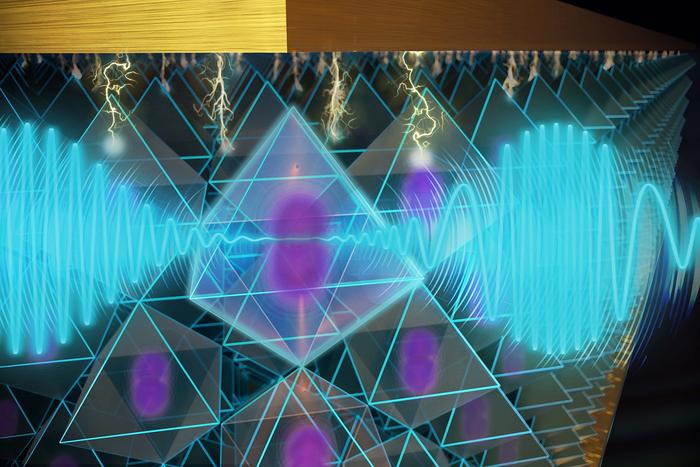
Strontium titanate (STO, as researchers call it) belongs to a class of materials with “non-linear” optical properties. Apply an electric field, and STO bends, redirects, and reshapes light in ways most substances cannot. This electro-optic effect allows engineers to build switches, modulators, and frequency converters for lasers and quantum systems.
But here is the twist: while most materials lose their mojo in extreme cold, STO becomes a virtuoso.
“Strontium titanate has electro-optic effects 40 times stronger than the most-used electro-optic material today. But it also works at cryogenic temperatures, which is beneficial for building quantum transducers and switches that are current bottlenecks in quantum technologies.”
That is Jelena Vuckovic, a professor of electrical engineering at Stanford and the study’s senior author. Her lab was not hunting for exotic compounds or rare-earth elements. They were looking for something practical.
Christopher Anderson, a co-first author and former postdoctoral scholar in Vuckovic’s lab (now at the University of Illinois, Urbana-Champaign), explained that the choice was almost obvious once they mapped out the ideal ingredients. STO checked every box. When they tested it, the results matched their expectations, which is rare in experimental physics.
A Material With Two Talents
STO does not stop at light manipulation. It is also piezoelectric, meaning it physically expands and contracts when voltage is applied. This mechanical responsiveness, combined with its optical prowess, makes it a double threat for cryogenic applications. Imagine sensors for space telescopes, actuators in rocket fuel tanks, or mechanical switches in quantum circuits. All of these could benefit from a material that stays functional in the cold void of space or the frigid guts of a dilution refrigerator.
The research team went further. They swapped out some of the oxygen atoms in STO’s crystal lattice with heavier isotopes, a delicate tweak that nudged the material closer to a phenomenon called quantum criticality. The result? Performance jumped by another factor of four.
“By adding just two neutrons to exactly 33 percent of the oxygen atoms in the material, the resulting tunability increased by a factor of four. We precisely tuned our recipe to get the best possible performance.”
That quote, also from Anderson, hints at the elegance of the work. This was not a brute-force materials search. It was strategic chemistry.
Giovanni Scuri, a postdoctoral scholar in Vuckovic’s lab and co-first author, emphasized that STO is neither rare nor expensive. It has been mass-produced for years as a substrate for growing other materials and as a diamond substitute in jewelry. Yet despite being thoroughly documented in materials science textbooks, no one had seriously tested it in cryogenic, electrically controlled optical systems until now.
The implications stretch across multiple industries. Quantum computers, which require temperatures near absolute zero to maintain coherence in their qubits, could use STO-based switches to route information between processors and communication channels. Space agencies might deploy STO sensors in satellites or deep-space probes, where temperatures naturally hover near cryogenic levels. Even terrestrial applications, like advanced laser systems and precision measurement tools, could see performance gains.
Vuckovic noted that the study received funding from Samsung and Google’s quantum computing team, both of which are actively searching for materials that can handle the demands of next-generation devices. The fact that STO can be synthesized, modified, and processed using standard semiconductor fabrication equipment makes it even more attractive for large-scale adoption.
The Stanford team is now moving from discovery to development, working on actual devices built from strontium titanate. Whether those devices will live up to the material’s remarkable lab performance remains to be seen. But if they do, the humble crystal that once played second fiddle as a diamond knockoff might finally get its moment in the spotlight, even if that spotlight shines at negative 450 degrees.