

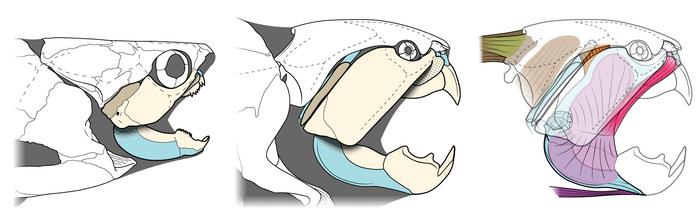
Cleveland’s legendary armored predator has been hiding a secret in its skull for nearly a century, and the truth is stranger than the myth. A new anatomical reconstruction of Dunkleosteus terrelli reveals a creature built from unexpected combinations of cartilage, bone, and muscle, a marine giant that broke almost every rule of its own armored fish family.
The research, published in The Anatomical Record by scientists from Case Western Reserve University and international collaborators, delivers the first modern reevaluation of Dunkleosteus jaw anatomy since 1932. By examining rare, exceptionally preserved fossils from the Cleveland Museum of Natural History and comparing them with three dimensional arthrodire specimens from Australia and elsewhere, the team uncovered a predator that was dramatically more specialized than previously known. Their analysis shows that nearly half the skull consisted of cartilage, that major jaw muscles attached in shark like positions, and that the massive bladed jaws reflect a distinct evolutionary pathway among arthrodires.
This revision fills a ninety year gap. Past researchers had limited comparative material and relied heavily on flattened skulls from older museum collections. The new study draws on better preserved specimens and modern anatomical insight to clarify where muscles anchored, how the jaw hinged, and how the upper and lower plates moved relative to one another. The result is a portrait of a Late Devonian macropredator whose anatomy reveals both deep evolutionary patterns and striking convergences with other large jawed fishes.
Revealing the Structure Beneath the Armor
“The last major work examining the jaw anatomy of Dunkleosteus in detail was published in 1932, when arthrodire anatomy was still poorly understood,” said Russell Engelman. “Most of the work at that time focused on just figuring out how the bones fit back together.”
Arthrodires typically fossilize as bony armor plates, leaving their cartilage based internal architecture missing or crushed. But Cleveland’s black shale preserves unusually complete Dunkleosteus specimens, including attachment scars and rare impressions of cartilaginous elements. Engelman and colleagues found that the upper jaw’s palatoquadrate had an asymmetrical shape never recognized before and that it likely served as the origin point for the major jaw closing muscle. A large external groove across the suborbital plate points to a powerful preorbital muscle, while the elongate submarginal plate suggests a loose, flexible cheek structure not seen in most relatives.
These features reshape long standing interpretations about how Dunkleosteus fed. Earlier models proposed suction feeding, but the new anatomy contradicts that idea. The rigid lower jaw joint, reinforced symphyseal cartilage, and sharpened bone blades all support a bite built for shearing through large vertebrate prey.
An Evolutionary Outlier Built for Big Prey
“These discoveries highlight that arthrodires cannot be thought of as primitive, homogenous animals, but instead a highly diverse group of fishes that flourished and occupied many different ecological roles during their history,” Engelman said.
The new reconstruction places Dunkleosteus within a broader evolutionary trend among dunkleosteoids toward specialized macropredation. Its bladed plates, reinforced jaws, and convergent similarities with other Late Devonian predators reflect ecological pressures driving repeated evolution of cutting systems in unrelated lineages. Many prior estimates of bite force, the authors note, will need reexamination now that muscle origins and jaw mechanics have been revised.
For a fossil as famous as Dunkleosteus, the update is profound. Behind the museum mounts and iconic silhouette was an animal even stranger, more specialized, and more anatomically complex than the public image suggests. By returning to the bones themselves, the researchers have given Cleveland’s sea monster a sharper, more accurate identity, proving that even the best known giants of prehistory can still surprise us.