

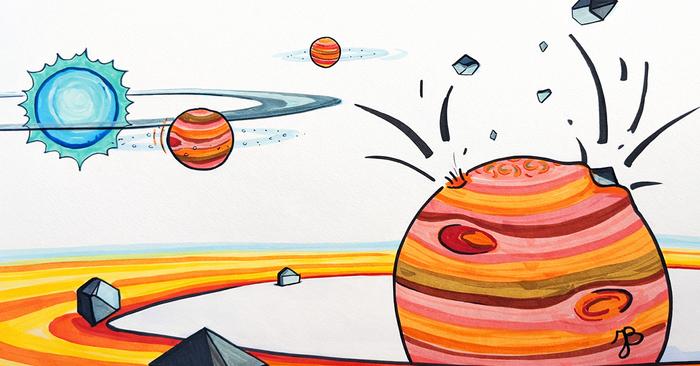
The planets orbiting the star HR 8799 are, by any reasonable measure, enormous. Each one clocks in at five to ten times the mass of Jupiter, and they swing around their star at vast distances, the closest still 15 times farther out than Earth is from the sun. For years, astronomers looked at this system, roughly 133 light years away in the constellation Pegasus, and couldn’t quite work out how it got there. The planets were too big, too far away. Something about their origin story didn’t add up.
Now, thanks to a whiff of rotten eggs, we might finally have an answer.
A team led by Jean-Baptiste Ruffio at the University of California, San Diego, has used the James Webb Space Telescope to sniff out hydrogen sulphide in the atmospheres of three of HR 8799’s four gas giants. It is the first time this stinky molecule has been detected in directly imaged exoplanets at such distances from their star, and the implications are rather significant. The presence of sulphur, published this week in Nature Astronomy, strongly suggests these worlds formed the same way Jupiter did, by gradually hoovering up rocky and icy material until their cores grew massive enough to pull in surrounding gas. That process is called core accretion, and it wasn’t supposed to work out here.
The trouble is that core accretion takes time. Classical models predict the process scales with the cube of a planet’s distance from its star, which means forming gas giants at the orbital separations seen in HR 8799 should be agonisingly slow. Too slow, perhaps, for the planets to bulk up before the young star blows away the surrounding disc of gas and dust. The alternative explanation, gravitational instability (where a chunk of the gas disc simply collapses under its own weight to form a massive object), seemed to fit better. It’s quick. It’s dramatic. And for a while, it looked like the more plausible option.
But sulphur tells a different story. Unlike carbon and oxygen, which exist in both the gas and solid phases of a protoplanetary disc, sulphur is what astronomers call a refractory element. It stays locked in solid material throughout most of the disc. So if you find it enriched in a planet’s atmosphere, that planet must have gobbled up a lot of solids during its formation. “With the detection of sulfur, we are able to infer that the HR 8799 planets likely formed in a similar way to Jupiter despite being five to ten times more massive, which was unexpected,” says Ruffio.
Getting to that detection wasn’t straightforward. These planets are about 10,000 times fainter than their host star, and JWST’s near-infrared spectrograph wasn’t originally designed for this sort of high-contrast work. Ruffio had to develop new data analysis techniques to tease the faint planetary signal from the overwhelming stellar glare. Jerry Xuan, a fellow at UCLA who built the atmospheric models used to interpret the data, found himself pushing against the limits of existing tools. “The quality of the JWST data is truly revolutionary and existing atmospheric model grids were simply not adequate,” he says. “In the end, we detected several molecules in these planets … some for the first time, including hydrogen sulfide.”
The team didn’t just find sulphur. They picked up water, carbon monoxide, methane, carbon dioxide, and even rare isotopes of carbon monoxide, including ¹³CO and C¹⁸O. Across all three inner planets (the outermost, HR 8799 b, was observed separately and isn’t part of this analysis), the enrichment pattern looked strikingly uniform. Carbon, oxygen and sulphur were all elevated compared with the star, and the relative ratios between them stayed roughly consistent. It’s a pattern that bears a strong resemblance to what we see in Jupiter and Saturn.
That uniformity is telling. If these planets had formed via gravitational instability, you’d expect their compositions to look more or less like their star’s, perhaps slightly enriched but not by this much. The team estimates that HR 8799 c and d contain around 148 and 272 Earth masses of heavy elements respectively. Added up across all four planets, the system holds something like 600 Earth masses of metals, a truly staggering amount that probably came from the dust in the primordial disc. Even for the youngest known discs, that’s near the top end of what’s been observed.
The system is young, only about 30 million years old (our solar system, by comparison, is 4.6 billion), which is actually a help here. Younger planets are hotter and brighter, making their atmospheres easier to study. HR 8799 was the first multi-planet system ever detected through direct imaging, back in 2008, and it has been a sort of laboratory for planet formation theories ever since.
“There are many models of planet formation to consider. I think this shows that older core accretion models are outdated,” says Quinn Konopacky, a professor of astronomy and astrophysics at UC San Diego. “And of the newer models, we are looking at ones where gas giants can form solid cores really far away from their star.” One possibility the team explores is that most of the carbon in the disc was tied up not in volatile carbon monoxide ice but in less volatile forms like carbon dioxide or organic molecules, which would have remained solid at the planets’ orbital distances and could explain the uniform enrichment pattern.
The findings also raise an intriguing question about where planets end and something else begins. Brown dwarfs, those in-between objects sometimes called failed stars, are thought to form differently, more like a collapsing gas cloud than a slowly growing core. But if core accretion can build worlds five to ten times Jupiter’s mass at these distances, where exactly is the dividing line? “I think the question is, how big can a planet be?” says Ruffio. “Can a planet be 15, 20, 30 times the mass of Jupiter and still have formed like a planet? Where is the transition between planet formation and brown dwarf formation?”
We don’t yet have a clean answer. But future JWST observations of other giant exoplanets should be sensitive to sulphur as well as additional refractory elements like iron, sodium and potassium. If the uniform enrichment pattern seen in HR 8799 turns up elsewhere, it could point towards a universal feature of how giant planets form at large orbital distances. For now, the work continues, one star system at a time, and the smell of sulphur might just be the most useful clue we’ve got.
Study link: https://www.nature.com/articles/s41550-026-02783-z