

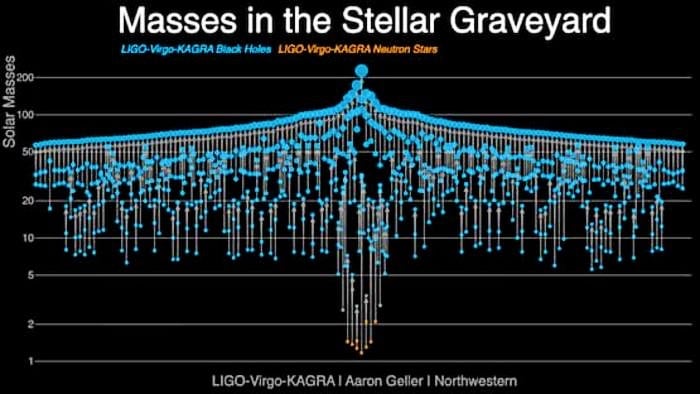
The count stands at 267. That is the number of confirmed gravitational-wave events pulled from detector data stretching back nearly a decade, 267 separate moments when two massive objects collided somewhere in the observable universe and sent ripples across spacetime that arrived at Earth as barely-detectable distortions smaller than a proton. For years, each detection was its own occasion, its own announcement. Something has changed. The catalog has grown large enough that astronomers are no longer cataloging curiosities; they are doing demography, and the picture emerging from that census is complicated in exactly the ways the universe tends to be.
The LIGO-Virgo-KAGRA collaboration released its fifth major gravitational-wave catalog this week, and what the new dataset most clearly shows is that black holes, at least the kind that form in pairs and eventually spiral into each other, do not all come from the same place. There seem to be several distinct assembly processes at work, each leaving identifiable fingerprints in the masses and spin rates of the objects left behind.
The clearest fingerprint belongs to spin. Most merging black holes spin relatively slowly, with so-called dimensionless spin magnitudes below about 0.5 on a scale where 1 represents the theoretical maximum. But a subset of the population clearly does not fit that pattern. The analysis identifies a subpopulation of black holes spinning at roughly 0.7 on that scale, a rate that sounds abstract until you translate it into something more tangible. “The sun rotates once every 25 days,” says Sharan Banagiri, a research fellow at Monash University who led the population analysis. “If it became a black hole and started spinning as quickly as the ones we discovered, it would be rotating several thousand times every second.” Where these fast-spinning objects come from is, the researchers argue, the key diagnostic question. The leading answer involves a kind of cosmic recycling that physicists call hierarchical mergers.
Black Holes That Ate Other Black Holes
The hierarchical scenario goes roughly like this. In dense stellar environments, globular clusters packed with hundreds of thousands of stars, black holes can accumulate. Two merge. The resulting object, rather than being flung out by the recoil, is retained within the cluster’s gravitational well. It then wanders until it encounters another black hole, and the process repeats. These second-generation objects inherit high spin, a known signature of the merger process itself, because the collision of two compact objects almost inevitably imparts strong angular momentum to the remnant. So a rapidly-spinning black hole is, in at least some cases, a black hole that was itself once the product of a prior collision.
The GWTC-5.0 data supports this interpretation in a specific and, to the researchers, somewhat unexpected way. The rapidly-spinning subpopulation does not cluster at a single mass scale. It shows up at two separate ranges: primary masses between roughly 10 and 20 times the mass of the sun, and again above about 45 solar masses. The gap between them (the 20-to-45 solar mass region) shows comparatively little sign of the high-spin signature. This double-peaked structure is consistent with the idea that hierarchical mergers are contributing at more than one point in the mass spectrum, for reasons that probably relate to the underlying mass distribution of the first-generation black holes they’re built from. But it’s a pattern the field will need to explain rather than simply point at.
The catalog also shows something interesting happening at the high-mass end more generally. Above roughly 40 solar masses, the lighter member of each pair, the secondary, drops away in abundance faster than the heavier primary. Binaries in this mass range tend toward unequal pairings, which is itself a signature consistent with what you’d expect from hierarchical mergers: one very massive second-generation object paired with a comparatively lightweight first-generation companion. Banagiri’s team infers the onset of this high-mass subpopulation at around 46 solar masses, give or take about 12.
What Spin Tells You About Birthplace
Reading the spin distribution across the full catalog turns out to be something like reading tea leaves, but with better statistics. The effective inspiral spin (a combined, mass-weighted measure of how aligned each black hole’s spin axis is with the orbital plane) is slightly asymmetric toward positive values across the whole population. That asymmetry carries information. If black holes formed entirely through random dynamical processes in clusters, their spins would be oriented in random directions and the effective spin distribution would be symmetric around zero. The observed skew toward positive values indicates that at least some of the mergers involve systems where the spins have a preferred alignment with the orbit; estimates from the catalog put this at roughly 9 to 40 percent of all mergers. These are probably systems that formed in relative isolation, two massive stars that lived and died together without the gravitational chaos of a cluster scrambling the geometry. On the other hand, somewhere between 30 and 46 percent of all mergers show negative effective inspiral spin, meaning at least one black hole is rotating backwards relative to the orbital plane, which is hard to explain without dynamical formation channels of some kind.
“This set of nearly 400 gravitational-wave detections from LIGO and Virgo provides us with a clear indication that the binary black hole mergers we see are forming in several different ways,” Banagiri says. “Some might form as one giant cloud of gas that collapses to give two massive stars that then become black holes. Others might be black holes that wander into each other in dense environments called clusters that are packed with stars. While others are the product of a previous generation of mergers between two black holes.”
Sylvia Biscoveanu of Princeton University, a co-author on the analysis, noted that the new catalog marks the largest single increase in the gravitational-wave event count to date, and pointed to individual detections that stand out as particularly diagnostic. Among them is GW241127, which involves a pair of black holes with strikingly different masses and visibly wobbling orbits, the kind of precessing geometry that arises when spins are strongly misaligned with the orbital plane. Events like that one, embedded in the statistical context the full catalog provides, are what allow the subpopulation claims to stick.
One feature that does not appear in the data is also worth noting. Stellar evolution theory predicts a so-called pair-instability gap, a range of masses where very massive stars should not be able to produce black holes through normal stellar collapse. Roughly speaking, this gap is expected somewhere above about 40-50 solar masses and below a few hundred. The GWTC-5.0 primary mass distribution, however, shows no clear evidence of this gap: it steepens at high masses but continues smoothly past 100 solar masses. This does not mean the gap is absent. It may simply be that hierarchical mergers are populating it from above, filling in exactly the range where ordinary stellar evolution cannot reach.
A Census, Not a Story
“We are no longer just looking at individual anomalies, instead, we are seeing a true kaleidoscope of cosmic collisions,” says Eric Thrane, a professor at Monash University and chief investigator at the OzGrav centre. “We are pushing the edges of what we know, seeing things that are more massive, spinning faster, and more unusual than ever before.” The shift from collecting specimens to profiling populations opens new questions faster than it closes them. Does the mix of formation channels evolve with cosmic time? The catalog already shows hints of spin distributions broadening at higher redshifts, possibly a signature of hierarchical mergers becoming more common in the denser early universe. Another 68-plus events are expected in GWTC-6.0, and with each addition, the demographic picture sharpens.
https://dcc.ligo.org/LIGO-P2600045/public
Frequently Asked Questions
What is a gravitational wave, and how does LIGO detect one?
Gravitational waves are ripples in spacetime produced when massive objects accelerate, most powerfully when two compact objects like black holes spiral together and merge. LIGO detects them using laser interferometers: two beams of light travel down perpendicular tunnels four kilometres long and are reflected back. When a gravitational wave passes through, it stretches spacetime in one direction and compresses it in the other, producing a tiny difference in the two beam lengths that shows up as a shift in the interference pattern. The displacements involved are extraordinarily small, far smaller than the diameter of a proton, which is what makes the detectors among the most sensitive instruments ever built.
What does a hierarchical black hole merger actually mean?
A hierarchical merger is one in which at least one of the black holes involved was itself the product of a previous merger, rather than a stellar remnant formed by the collapse of a massive star. When two black holes merge, the resulting object carries a characteristic high spin, typically around 70 percent of the theoretical maximum. If this remnant is retained within a dense stellar cluster rather than being ejected by the recoil kick, it can go on to merge again, carrying its high spin into the next generation. Spotting these objects statistically, by looking for the high-spin signature at specific mass scales, is one of the key goals of the GWTC-5.0 population analysis.
Why do some black holes spin backwards relative to their orbit?
A black hole’s spin direction relative to its binary orbit is set early in its history and is hard to change after the fact. In isolated binary evolution, two stars that form together tend to have their spins aligned with the orbital plane, because the whole system inherits angular momentum from the original gas cloud. But in dynamical environments like globular clusters, black holes pair up through chance encounters rather than common birth, so there’s no reason their spins should be aligned with the resulting orbit. Black holes with spins tilted beyond 90 degrees relative to the orbit, spinning in the opposite sense, are therefore a signature of dynamical assembly. The catalog finds this property in roughly a third of all mergers.
What is the pair-instability mass gap, and why doesn’t LIGO see it clearly?
Stellar evolution theory predicts that very massive stars, those with core masses in a certain range, cannot produce black holes through collapse because the extreme temperatures trigger pair production of electrons and positrons, causing the star to explode completely rather than leaving a remnant. This should produce a gap in the black hole mass spectrum, roughly between about 40-50 solar masses and a few hundred solar masses. The GWTC-5.0 data does not clearly show this gap in the primary mass distribution, which extends smoothly to high masses. The most likely explanation is that hierarchical mergers are populating the gap from the inside, producing high-mass black holes through successive collisions rather than direct stellar collapse.
How many more gravitational-wave detections are expected, and what will they tell us?
The LIGO-Virgo-KAGRA collaboration expects the forthcoming GWTC-6.0 catalog to add at least 68 further detections based on public alert counts. Each new event contributes to the statistical picture, making subpopulation boundaries sharper and correlations between mass, spin, and redshift more precise. With enough events, the collaboration hopes to track how the mix of formation channels changes across cosmic time, testing whether hierarchical mergers were more common in the denser early universe and whether the pair-instability gap becomes visible as a feature in the secondary mass distribution once the catalog is large enough to see it clearly.