

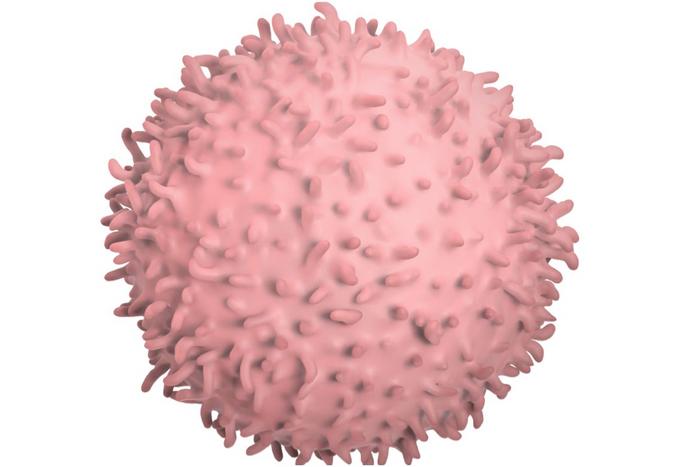
IT’S a peculiar kind of assassination. After your immune system has killed off SARS-CoV-2, the leftover chunks don’t just disappear. They go hunting. But these viral fragments aren’t looking for just any target. They’re after immune cells with a specific geometry, cells that bristle with spikes or sprout tentacles across their surfaces.
A team of nearly three dozen researchers across five countries has now shown that digested pieces of the COVID-19 spike protein can selectively target and kill certain immune cells based purely on their shape. It’s a discovery that might finally explain some of the pandemic’s most stubborn mysteries, from why certain immune cells vanish in severe COVID to why omicron, despite its ferocious transmissibility, somehow pulled its punches.
“One might expect this effect to involve a specific interaction with receptor proteins on cells surfaces, as is often the case with targeting mechanisms,” says Gerard Wong, a professor of bioengineering at UCLA who led the international collaboration. “Instead, these fragments target a specific kind of curvature on the membranes of cells. Cells that are spiky, that are star-shaped or that have lots of tentacles end up getting preferentially suppressed.” He pauses, then offers an analogy: “It’s analogous to an uncanny ability to detect and preemptively defeat certain Pokémon monsters, such as Starmie, based just on their spiky shapes.”
Hardly the virus behaviour you’d find in textbooks. The findings, published in the Proceedings of the National Academy of Sciences, emerge from work combining theoretical physics, computer simulations, X-ray measurements and experiments with freshly isolated human immune cells. What they reveal is a targeting system that bypasses the usual lock-and-key molecular recognition entirely and instead exploits pure geometry.
The geometry in question is called negative Gaussian curvature, the saddle-shaped bend you see where a neck meets a body, or at the base of cellular protrusions. Plasmacytoid dendritic cells, those crucial early-warning sentinels of viral infection, have star-shaped surfaces rich in this curvature. So do activated T cells, their surfaces covered with finger-like microvilli. When protein fragments from SARS-CoV-2 encounter these shapes, they accumulate at precisely those curved regions and punch holes through the membrane.
Haleh Alimohamadi, who worked on the research as a UCLA postdoctoral fellow and is now at UC Irvine, puts it simply: “The fragments are drawn to cells with the right membrane ‘terrain’ and then exploit that terrain to breach the membrane.”
The team tested three different spike protein fragments, each just 20 or so amino acids long, and watched what happened when they encountered small spherical vesicles designed to mimic cell membranes. Using synchrotron X-ray scattering at Stanford and in Shanghai, they could see the fragments reorganizing lipids into elaborate cubic structures riddled with the negative curvature necessary for forming pores. The estimated pore size — between 1.48 and 1.86 nanometres across — is comparable to what other pore-forming peptides create when they kill bacterial cells or, more ominously, when rogue histone fragments cause lytic death in human endothelial cells during atherosclerosis.
But the real test came with actual human immune cells, freshly isolated from healthy donors’ blood. When exposed to these viral fragments, plasmacytoid dendritic cells died at over 68 times the rate of untreated cells. CD4+ and CD8+ T cells followed a similar fate, dying at 6.4 and 5.4 times the normal rate respectively. Monocytes and neutrophils, which have smoother, more spherical surfaces? They sailed through largely unscathed.
“The viral fragments kill exactly the important types of immune cells that get clobbered in serious COVID-19,” Wong says. “Doctors actually measure those specific T cell numbers to determine how bad the disease is. Patients with severe cases will have low numbers; patients who bounce back will have robust numbers.”
This selective vulnerability might help explain why severe COVID so often features a paradox: despite a virus raging through the body, the very cells needed to coordinate an effective immune response — the dendritic cells that sound the alarm, the T cells that hunt infected cells — simply vanish from circulation. These cells can remain depleted for months, sometimes seven months or more after the initial infection clears. Meanwhile, monocytes and neutrophils, with their simpler shapes, stick around and often become overactive, fuelling the inflammatory damage that characterises severe disease.
Enter omicron, with its 37 mutations scattered across the spike protein. Yue Zhang, now at Westlake University in Hangzhou and first author on the study, tested whether these mutations changed the fragments’ killing ability. They tested a piece from the original spike known to be quite effective at puncturing two types of immune cells, then compared it with the equivalent stretch from omicron’s spike — one carrying a single mutation that adds an extra positive charge.
The omicron version destroyed only a small fraction of dendritic cells and had little effect on T cells at all. The X-ray data showed why: omicron fragments induced smaller amounts of the key membrane curvature and generated smaller, less stable pores. “Omicron exhibits lots of mysterious behaviors,” Zhang says. “No one could really explain why it replicated as fast as the original strain but generally did not cause infections that were as serious. We found that pieces of the omicron spike were much less able to kill these important immune cells — suggesting that a patient’s immune system is not going to be as depleted.”
The mechanism suggests something rather unsettling: variations in how different people’s enzymes break down viral proteins might partly determine who gets severely ill. We each have slightly different versions of the proteases that chop up foreign proteins, and these enzymes work at different speeds and cut at different points. Some people’s enzyme profiles might generate more of the dangerous fragments or break them down less efficiently. Add in pre-existing inflammatory conditions that provide their own membrane-damaging molecules, and the viral fragments could synergise with the body’s own inflammatory arsenal.
“The way that the virus tends to break up creates lots of different fragments, with multiple forms of activity,” Wong says. “If you already have certain inflammatory conditions, it’s likely to synergize with this emerging population of viral fragments.”
The research may also explain parts of long COVID’s persistent mysteries, particularly the lingering immune dysfunction some patients experience. Viral proteins have been found circulating in patients’ blood for months after infection clears, even showing up in heart tissue in some myocarditis cases. If these proteins continue to be processed into membrane-active fragments, they could represent a slow, ongoing drain on precisely the immune cells needed for full recovery.
Wong and his colleagues are now investigating whether viral fragments play roles in COVID’s cardiovascular damage, skin lesions, and symptoms resembling lupus and rheumatoid arthritis. The implications stretch beyond SARS-CoV-2. “Viruses do so many things that we don’t understand,” he says. “It is important to learn how the virus infects and replicates, but that knowledge alone isn’t going to tell you everything about how the virus affects us. We want to understand what all the leftover viral matter does to us, both during COVID and after.” He leans forward slightly. “With these viral fragments, all of a sudden there’s a whole new range of possibilities to consider.”
There’s an irony here worth noting. Antimicrobial peptides — the inspiration for calling these fragments “xenoAMPs” — are part of our ancient immune defences, molecules that punch holes in bacterial membranes to kill invaders. The virus appears to have generated peptide-like fragments that turn this same hole-punching mechanism against us, targeting the very cells equipped to fight it.
Less than five years since COVID-19 emerged, we’re still uncovering how the virus undermines human defences. The proteolytic destruction of SARS-CoV-2 proteins, once thought to simply clear viral debris, now looks more like the opening act of a secondary drama — one where the virus’s remains reshape the battlefield long after the initial invasion ends.
Study link: https://www.pnas.org/doi/10.1073/pnas.2521841122