

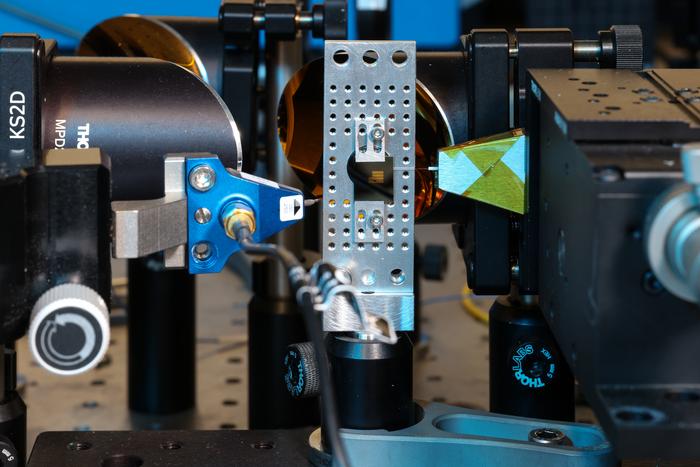
In a lab in Lausanne, a chip no bigger than a fingernail is pulling off a difficult trick.
It can take ultrafast pulses of light, turn them into elusive terahertz waves, and then reverse the process, all without leaving its miniature footprint. This two-way conversion between the optical and terahertz domains, achieved by researchers at EPFL and Harvard University, could be the key to shrinking powerful communication, sensing, and radar systems into devices small enough to fit in your pocket.
Terahertz: The Overlooked Frontier
Terahertz (THz) waves occupy a slice of the spectrum between microwaves and infrared light. They can carry enormous amounts of data, penetrate materials for non-destructive imaging, and reveal the unique “spectral fingerprints” of molecules. But for decades, engineers have struggled to link THz waves with the optical networks that move most of our information. The equipment to do so has been bulky, power-hungry, and inefficient.
The EPFL team’s answer lies in a thin-film crystal of lithium niobate, a material prized in photonics for its ability to mix light frequencies with extraordinary efficiency. In 2023, they used it to generate tunable THz waves from a laser beam. Now, they have taken the next step: building a chip that both emits and detects THz pulses with record performance.
“In addition to demonstrating the first detection of THz pulses on a lithium niobate photonic circuit chip, we generated THz electric fields over 100 times stronger and increased the bandwidth by a factor of five,” said Cristina Benea-Chelmus, head of the Laboratory of Hybrid Photonics.
The Secret is in the Transmission Lines
Lead author and PhD student Yazan Lampert explains that the advance comes from embedding micron-scale metallic transmission lines into the photonic chip. These act like miniature radio cables, guiding THz signals alongside lithium niobate waveguides that carry light. The tight proximity lets the two types of waves interact directly, with minimal energy loss.
By carefully matching the speed of the light pulses to the THz waves, a process called phase matching, the team expanded the working range from 680 gigahertz to 3.5 terahertz. This is critical for applications like spectroscopy, where both high sensitivity and broad bandwidth matter.
- Bandwidth expanded to 3.5 THz
- THz field strength boosted over 100×
- First on-chip THz detection in lithium niobate
- Compatible with existing photonic components
From Radar to 6G
Terahertz waves are short enough to measure distances with sub-millimeter precision. That means a THz radar chip could help self-driving cars map obstacles more accurately than current sensors. In high-speed 6G networks, where sensing may be as important as data transmission, a compact light–THz converter could be embedded in handheld devices. Other uses could include portable scanners for medical diagnostics or security screening, and even quantum computing architectures that exploit THz frequencies.
“We can control both optical and THz pulses on the same platform simply through our miniaturized circuit design,” Lampert said. “Our approach combines photonic circuits and THz circuits on a single device with unprecedented bandwidth.”
Pushing the Physics
The team did more than just link two domains. They demonstrated THz strip-line cavities on the chip, which can store and shape terahertz signals. By adjusting the length of these cavities and the placement of tiny antennas, they could selectively generate discrete THz modes. This level of control opens the door to custom-tailored THz signals for specialized sensing or communications.
They also showed that the chip’s THz output could be modulated on the fly using a standard fiber-based electro-optic modulator, pointing toward future all-optical THz signal processing.
What Comes Next
Amirhassan Shams-Ansari, co-first author and now Principal Laser Engineer at DRS Daylight Solutions, sees a wider horizon: “Thin-film lithium niobate has proven to be a powerful platform for integrated photonics, enabling a new generation of applications and devices. It is truly exciting to see this technology advancing into the highly promising yet underexplored THz domain.”
The researchers are now working to miniaturize the design further and integrate it seamlessly with existing photonic hardware. They believe the design rules they have developed will guide the next wave of terahertz devices, from chip-scale radars to quantum-grade spectrometers.
As Benea-Chelmus put it, “We anticipate that the design guidelines we propose will become crucial in future terahertz applications such as high-speed 6G communications, where sensing and ranging will be an essential component of the communication network.”
Journal
Nature Communications — https://doi.org/10.1038/s41467-025-62267-y