

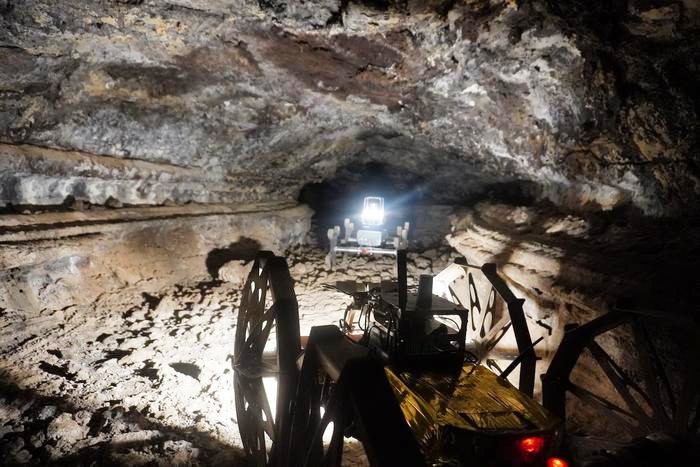
The Moon’s surface may look barren and lifeless, but beneath its dusty exterior lies a network of natural shelters that could house future astronauts. European researchers have just demonstrated how a trio of robots could work together to explore these mysterious underground lava tubes, bringing humanity one step closer to establishing lunar outposts.
In a field test that reads like science fiction, scientists from the University of Malaga and their European partners deployed three specialized robots on the volcanic island of Lanzarote, Spain, to simulate what lunar cave exploration might look like. The results, published in Science Robotics, showcase a carefully choreographed robotic ballet designed for one of space exploration’s most challenging environments.
A Four-Act Robotic Performance
The mission unfolds like a well-rehearsed theater production. First, the robotic team maps the area around a cave entrance, identifying the optimal entry point. Then comes the dramatic second act: a sensor-packed cube gets ejected into the darkness below, collecting initial data as it tumbles through the void.
The third phase brings genuine tension as a scout rover rappels down into the cave like a mechanical mountaineer. Finally, the robots conduct detailed interior mapping, building a three-dimensional model of spaces that have remained hidden for potentially billions of years.
“The natural shielding that these caves offer against radiation and small meteorites makes them well suited for preserving exobiological signatures and protecting human-made facilities,”
the researchers explain in their paper.
These aren’t just any caves. Lava tubes form when molten rock flows beneath a hardened crust, leaving behind hollow tunnels once the lava drains away. On Earth, they’re geological curiosities. On the Moon, they represent prime real estate for future settlements.
The February 2023 Lanzarote demonstration proved the concept works in conditions that mirror lunar challenges. The volcanic island’s harsh terrain and cave systems provided an ideal testing ground for technology that must eventually function in the vacuum of space, where a single malfunction could end a multimillion-dollar mission.
Why Robots Make Better Cave Explorers
Human exploration of lunar caves presents obvious challenges. Astronauts would need specialized equipment, extensive safety protocols, and backup plans for environments where rescue missions border on impossible. Robots, by contrast, can take calculated risks that would be unacceptable for human crew members.
The European consortium, led by the German Research Center for Artificial Intelligence with participation from the University of Malaga and Spanish company GMV, designed their robotic team specifically for autonomous operation. The robots don’t wait for instructions from Earth, where communication delays could prove fatal in rapidly changing cave environments.
Each robot brings specialized capabilities to the mission. While one handles surface mapping and coordination, another manages the technical challenge of controlled descent, and the third focuses on detailed interior exploration. This division of labor mirrors how human exploration teams assign roles based on individual expertise.
The Space Robotics Laboratory at the University of Malaga has spent years developing algorithms that increase rover autonomy, working closely with the European Space Agency on planetary exploration challenges. Their students regularly train on projects that could directly contribute to future Moon and Mars missions.
“The results obtained demonstrate the proposed mission concept’s feasibility, including three next-generation planetary exploration rovers that were coordinated to obtain meaningful information about the lava cave’s external and internal morphology,”
the research team reports.
The implications extend beyond mere technological achievement. These caves could preserve evidence of early solar system processes, protect scientific equipment from the Moon’s temperature extremes, and provide natural radiation shielding for extended human presence.
Current lunar missions focus primarily on surface operations, but the Moon’s underground spaces represent an untapped frontier. As space agencies plan permanent lunar installations, understanding these natural shelters becomes increasingly crucial for mission success and crew safety.
The Lanzarote tests represent just the beginning. Future iterations will need to handle even more extreme conditions, longer communication delays, and the unique challenges of operating in lunar gravity. But for now, three robots working together on a Spanish island have opened a window into humanity’s underground future on the Moon.