

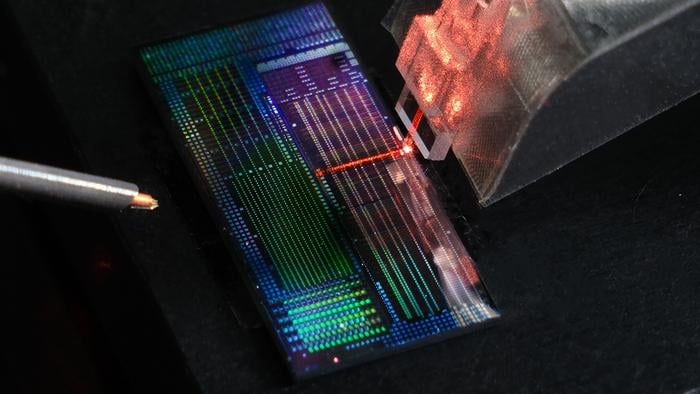
Imagine a computer so powerful its essential control components take up an entire warehouse. Not just one room, but a massive space filled with dozens of optical tables. That’s the reality for one of the most promising types of quantum machines right now. To scale up quantum computing from a few experimental bits to a practical machine with millions of qubits, scientists must first figure out how to shrink that warehouse down to the size of a postage stamp.
That’s the exact problem a team of researchers from the University of Colorado at Boulder and Sandia National Laboratories just solved. Led by Jake Freedman, an incoming PhD student, and Professor Matt Eichenfield, the team has unveiled a new device that’s almost 100 times smaller than the diameter of a human hair. Their breakthrough, an optical phase modulator, was just published in Nature Communications. It’s a crucial step toward building the massive quantum computers we’ll need in the future.
These modulators are the essential pieces of hardware required to precisely control the lasers that “talk” to the atoms inside a trapped-ion or trapped-neutral-atom system. These atoms are the qubits, the basic units of quantum information. To operate them, researchers communicate with precise laser beams. Each laser’s frequency must be tuned with extreme accuracy, often to within billionths of a percent or even smaller. Current technology simply can’t handle that kind of scale.
The Bottleneck of Bulk and Heat
Today’s quantum labs rely on bulky, table-top devices to create and tune those precise laser beams. These devices use significant amounts of microwave power. They work well enough for small lab experiments. They can manage quantum computers with a small number of qubits. But these setups hit a massive bottleneck when trying to scale up to the tens or hundreds of thousands of optical channels that future quantum computers will require.
Professor Eichenfield put the problem into sharp perspective.
“You’re not going to build a quantum computer with 100,000 bulk electro-optic modulators sitting in a warehouse full of optical tables.” – Matt Eichenfield, professor and the Karl Gustafson Endowed Chair in Quantum Engineering
It’s a matter of practicality, size, and efficiency. The existing components require too much space. They also produce too much heat. The new microchip-scale device tackles all of these issues at once. It can generate new frequencies of light through efficient phase modulation. Crucially, it consumes roughly 80 times less microwave power than many commercial modulators.
Less power means significantly less heat. Less heat means many more channels can be placed closer together, even on a single chip. Together, these features make the chip a powerful and scalable system. It manages the complex dance that atoms must perform to make quantum computations.
The tiny chip, a sliver almost invisible on a fingertip, works its magic by harnessing ultra-fast, microwave-frequency vibrations. It hums internally, oscillating billions of times per second, yet generates 80 times less heat than its clumsy ancestors. Researchers watch a focused laser beam, perfectly stable, obey the chip’s invisible command. The device uses these ultra-fast vibrations to manipulate the laser light’s phase with extraordinary accuracy. This gives the team direct control over the phase of a laser beam. It allows the chip to generate new laser frequencies with high stability and efficiency. It’s all essential for building not just the computers, but also next-generation quantum sensing and networking technologies.
Scaling Up Like Silicon and Smartphones
A major reason the team is so confident in the device’s potential for mass production rests on how it was built. The device was produced entirely in a “fab” or foundry. This is the same type of facility that manufactures advanced microelectronics for our cell phones and computers.
Professor Eichenfield explained why this method is so important. He said, “CMOS fabrication is the most scalable technology humans have ever invented.” The CMOS process is behind virtually everything powered by electricity, from phones to home appliances, even toasters. Every microelectronic chip in a cell phone or computer has billions of essentially identical transistors on it. By using CMOS fabrication for their photonic devices, the team can produce thousands or even millions of identical versions in the future. That’s exactly what a million-qubit quantum computer will need.
The researchers purposefully avoided complex, custom builds in favor of this standard, high-volume process. Nils Otterstrom, a co-senior author from Sandia National Laboratories, noted the revolutionary nature of the shift. Freedman’s work targets a critical need in the industry.
“Creating new copies of a laser with very exact differences in frequency is one of the most important tools for working with atom- and ion-based quantum computers.” – Jake Freedman, incoming PhD student in the Department of Electrical, Computer and Energy Engineering
Otterstrom explained that they’ve taken modulator devices which were previously expensive and power hungry and made them more efficient and less bulky. He argues that they’re helping to push optics into its own “transistor revolution,” moving away from the optical equivalent of vacuum tubes and toward scalable integrated photonic technologies.
Their next efforts focus on developing fully integrated photonic circuits. These new circuits will combine frequency generation, filtering, and pulse-carving all on the same chip, bringing a complete operational system much closer to reality. They’ll also be collaborating with quantum computing companies to test versions of these chips inside state-of-the-art trapped-atom and trapped-neutral-atom quantum computers.
Jake Freedman concluded that this development is one of the final pieces of the puzzle. He believes the field is getting close to a truly scalable photonic platform capable of controlling very large numbers of qubits. This project was supported by the U.S. Department of Energy through the Quantum Systems Accelerator program.