

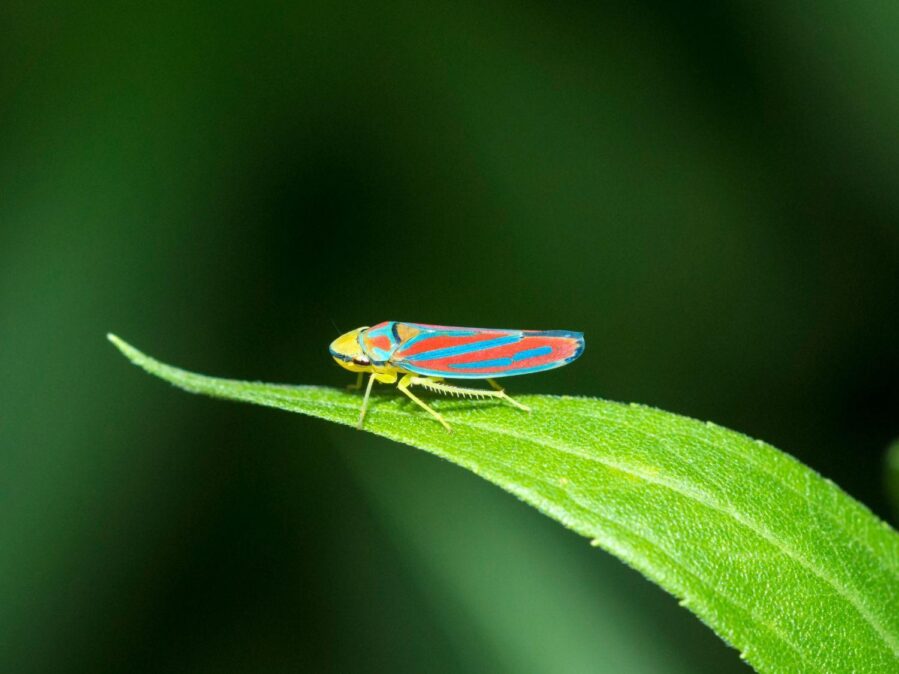
Leafhoppers have been hiding in plain sight, literally. These garden insects coat themselves with microscopic particles that scatter visible light and absorb ultraviolet wavelengths, creating an effective invisibility shield against predators with UV vision. Engineers at Penn State have now cracked the code on manufacturing synthetic versions of these particles at scale, producing more than 100,000 per second.
The particles, called brochosomes, are among the most complex nanostructures in nature. Each one resembles a hollow soccer ball covered in precisely arranged nanoscale pores, smaller than a speck of pollen yet geometrically intricate. For nearly a decade, researchers could recreate them in labs but only in small batches, too limited for any real-world application.
That constraint just lifted. Tak-Sing Wong’s team at Penn State built a droplet-based microfluidic system that mimics how leafhoppers manufacture brochosomes inside specialized organs called Malpighian tubules. The process uses amphiphilic block copolymers (molecules with both water-loving and water-repelling properties) that self-assemble as solvent evaporates from tiny droplets. By adjusting molecular composition and flow conditions, the researchers can precisely control particle diameter, pore geometry, and wall thickness.
Why a Garden Bug Outperforms Modern Optics
The dual-function design is what makes brochosomes remarkable. The pores are tuned to absorb UV light, which birds and reptiles use for hunting. Simultaneously, the particles scatter visible light in multiple directions, eliminating glare from leafhopper wings. Natural antireflective coatings exist elsewhere in biology (moth eyes are a famous example), but brochosomes achieve both UV absorption and visible light scattering in a single, self-assembled structure.
Wong’s group tested synthetic brochosome coatings and found they reduce reflected light across UV and visible wavelengths, matching the performance of natural coatings. The applications extend well beyond camouflage. High-performance optical devices need antireflective surfaces. Chemical sensors require high surface area structures. Catalysts benefit from precisely porous geometries. All of these depend on having vast quantities of nearly identical nanoparticles, which conventional fabrication methods struggle to deliver.
“Each brochosome is smaller than a speck of pollen yet has astonishingly intricate architecture, looking like a perfectly patterned soccer ball covered with nanoscale pores,” Wong explains.
From Biological Curiosity to Industrial Reality
The production rate matters because industrial adoption requires consistency at volume. A lab producing a few thousand particles per hour can demonstrate proof of concept. A platform generating 100,000 particles per second can supply commercial production lines. The researchers demonstrated five distinct particle architectures, each with tunable properties, all manufactured through the same core process.
Jinsol Choi, a postdoctoral scholar working on the project, points out that many proposed applications for synthetic brochosomes have stalled precisely because no one could make enough of them. Optical pigments, advanced coatings, precision sensors: these technologies need billions of particles with exacting specifications. The microfluidic approach finally provides a pathway to that scale.
True invisibility cloaks remain speculative, but the gap between biology and engineering just narrowed significantly. Leafhoppers solved a complex optical problem millions of years ago. Now their solution is available at industrial scale, ready for technologies the insects never needed to evolve.