

What happens when speaking up feels like stepping into danger? A new study from Arizona State University and the University of Michigan suggests that silence itself can become a rational act of survival, rather than mere fear. Published in the Proceedings of the National Academy of Sciences, the research models how individuals decide whether to voice dissent or self-censor when punishment looms.
The study, led by ASU computer scientists Stephanie Forrest and Joshua J. Daymude with political scientist Robert Axelrod, offers a rare, quantitative look into the delicate balance between courage and caution that governs public expression under threat. Using simulations, they showed how societies evolve toward silence when surveillance and punishment intensify, even without overt coercion.
The Science Behind Silence
In their paper, “Strategic Analysis of Dissent and Self-Censorship,” the researchers developed a mathematical model capturing how individuals adapt to risk and how authorities adjust enforcement to minimize dissent and cost. Daymude explains that modern tools of control are deeply intertwined with these dynamics.
“Modern technologies, from facial recognition to algorithmic content moderation, have transformed the landscape of dissent,” Daymude said. “Our goal was to move beyond intuition and provide a formal way to understand when and how self-censorship emerges.”
The model revealed that self-censorship arises not only from fear but also from rational calculation. When punishments are sweeping and indiscriminate, silence spreads quickly. When penalties scale with the severity or frequency of offenses, small acts of dissent may persist. The researchers observed that once widespread silence takes hold, it can be extremely difficult to reverse.
When Fear Shapes the Future
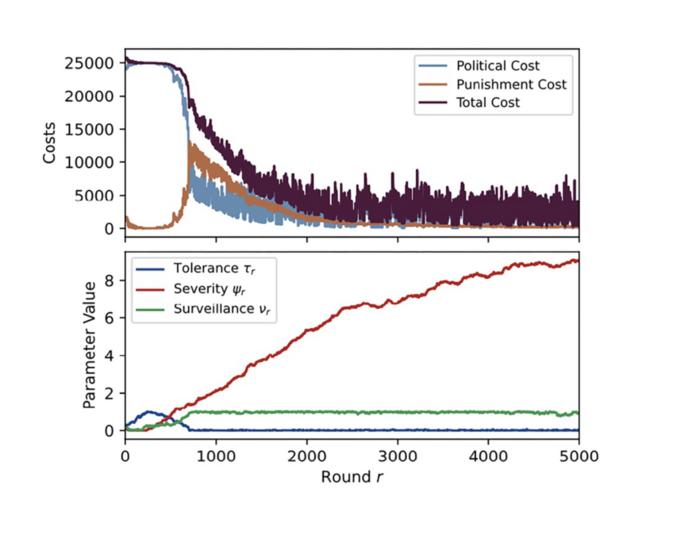
The simulations reflected a haunting pattern: regimes that began leniently often evolved into stricter control systems, mirroring real-world episodes like Mao Zedong’s “Hundred Flowers Campaign.” Over time, surveillance grew, tolerance fell, and self-censorship deepened until dissent virtually disappeared. Still, populations with higher “boldness” values (those willing to risk punishment) proved far more resistant to suppression.
“A population’s willingness to speak out early on, and suffer the negative consequences, has an outsized effect on how long it takes an authority to suppress all dissent,” Forrest said. “This is because the cost of punishing an entire population simultaneously is too high.”
By uniting computer science, political theory, and behavioral modeling, the researchers illuminated how individual psychology interacts with systemic control. Forrest and Daymude, both affiliated with ASU’s Biodesign Center for Biocomputing, Security and Society, argue that understanding this feedback loop is critical to preserving free expression in a digital age.
The work serves as both warning and guide: that silence is not merely absence of speech but a form of social coordination shaped by power and perception. It underscores the importance of collective courage, especially as modern technology blurs the boundary between public and private thought.
Proceedings of the National Academy of Sciences: 10.1073/pnas.2508028122