

The diffraction pattern shouldn’t exist. Physicists have long wondered if positronium, that fleeting marriage of electron and positron, could produce the telltale stripes and bands that confirm wave-like behaviour in free space. The thing is, positronium barely lingers long enough to measure, annihilating in a burst of gamma rays after just 142 nanoseconds. You can’t exactly set up elegant interference experiments when your subject matter keeps exploding.
But Yugo Nagata and his colleagues at Tokyo University of Science reckoned they’d found a way round this. Their approach involved creating positronium through laser photodetachment of negative ions, accelerating the resulting atoms to several thousand electron volts, then firing them at graphene sheets just two or three atomic layers thick. After 210 hours of painstaking data collection at 3.3 keV, then another 370 hours at 2.3 keV, they found it: a clear diffraction peak at exactly 8.4 millimetres from the beam centre, matching predictions for positronium behaving as a single quantum entity.
This matters because positronium is fundamentally weird. It’s the simplest possible atom made from equal-mass constituents, and until recently, no one had observed it diffracting as a matter wave. Electrons diffract, neutrons diffract, even hefty molecules diffract. But positronium? The question wasn’t just academic. If the electron and positron comprising positronium diffracted independently rather than as a bound system, the pattern would appear roughly twice as far from the beam centre due to their longer individual de Broglie wavelengths. The researchers saw no such thing. The peak sat precisely where theory predicted for coherent diffraction of the composite particle.
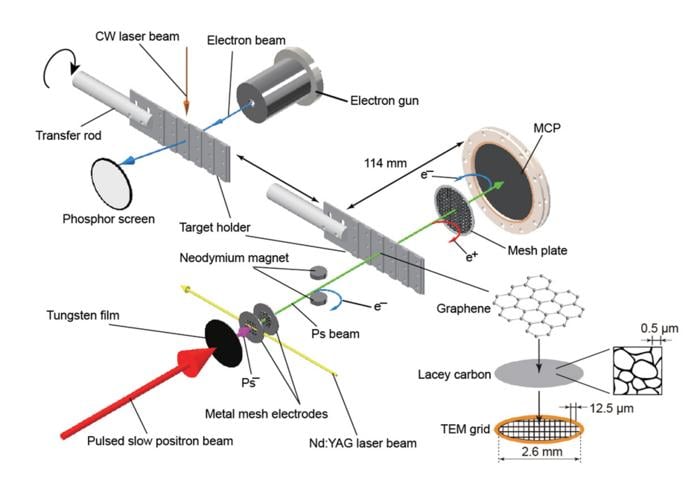
The experiment demanded extraordinary precision. Nagata’s team generated positronium by first trapping positrons from a radioactive sodium-22 source, then firing them at a tungsten film coated with sodium on its downstream surface. This produced negative positronium ions, each harbouring an electron, a positron, and one extra electron. A pulse from a neodymium YAG laser then stripped away the spare electron, leaving fast-moving neutral positronium atoms travelling towards the graphene target 114 millimetres away.
Several complications threatened to swamp the signal. When positronium atoms hit graphene, some break apart, sending electrons and positrons careering towards the detector. Gamma rays flood the apparatus from multiple sources: positrons annihilating in the tungsten film without forming positronium, self-annihilation of emitted positronium, and ‘pickoff’ annihilation when atoms collide with chamber electrodes. The researchers eliminated electrons by applying negative 2 kilovolts to the detector front face, whilst a positively biased mesh plate caught positrons. Time-of-flight selection, using laser pulse timing as the start signal, discriminated genuine positronium from gamma-ray background noise.
Even then, the diffraction efficiency proved remarkably low: about 0.3 per cent. Compare that to electron diffraction at similar velocities, which clocks in around 4.5 per cent. The reason lies in quantum mechanics. For positronium scattering from a static potential, the first-order elastic amplitude cancels out because electrons and positrons have equal masses but opposite charges. The leading non-zero elastic contribution only appears at higher order. Meanwhile, inelastic processes like internal excitation, breakup, or annihilation all contribute at first order, naturally suppressing the coherent elastic signal the researchers needed to detect.
The graphene required careful maintenance throughout. Every few hours, Nagata’s group heated the sample using a continuous-wave laser at 976 nanometres wavelength to remove surface adsorbates that accumulated even in ultra-high vacuum. Without this treatment, diffraction efficiency gradually declined as contaminants built up. The solid neon moderator also degraded periodically, requiring regeneration every few days.
At 2.3 keV, the diffraction peak shifted outward to 10 millimetres, consistent with positronium’s larger de Broglie wavelength at lower energy. No second-order peaks appeared in either measurement, unlike electron diffraction where higher-order features typically show similar intensities. This puzzled the researchers somewhat, though they note that halving the intensity would render the peak comparable to statistical scatter. Working with monolayer graphene rather than their two-to-three-layer samples would demand substantially higher beam intensity.
What makes this more than just confirming textbook quantum mechanics is positronium’s unique properties as a purely leptonic system. Because it’s electrically neutral, its trajectory isn’t perturbed by charged or magnetic surfaces that would wreak havoc with charged particle beams. This could enable non-destructive analysis of insulator surfaces, a longstanding challenge. Positrons produced through beta decay are spin-polarised, and positronium beams should inherit this polarisation, opening routes to spin-resolved studies of magnetic materials.
The really tantalising prospect involves testing gravity’s pull on antimatter. No direct gravitational measurement has ever been performed on leptons, even ordinary electrons, because gravitational effects are utterly dwarfed by electromagnetic forces. But positronium interferometry could change that. Because positronium contains equal amounts of matter and antimatter in a neutral package, precision measurements of its behaviour in Earth’s gravitational field might reveal whether antimatter falls upward rather than down, as some exotic theories predict.
More immediately, the work represents a step towards creating a Bose-Einstein condensate of positronium. That would require both matter-wave coherence, now demonstrated, and ultracold temperatures. Recent breakthroughs in laser cooling of positronium using chirped pulse trains have reduced velocities dramatically. Combine that with the coherence Nagata’s group has now confirmed, and you’ve got the essential prerequisites for condensing positronium into quantum degeneracy.
The researchers are candid about what comes next. To enable applications like crystal structure analysis, they’ll need higher beam intensity, reduced angular divergence, and smaller beam diameter. A Mach-Zehnder interferometer built around their photodetachment technique could measure gravitational acceleration of antimatter with unprecedented sensitivity. Further theoretical work is required to properly understand positronium-graphene interactions at kiloelectronvolt energies, where current models break down.
For now, though, the simple observation stands: positronium diffracts as a single quantum object, its wave function spreading and interfering with itself just as de Broglie envisioned a century ago. That the most ephemeral of atoms, annihilating before you could blink, still manages to exhibit the wave-particle duality that underpins quantum mechanics feels somehow appropriate. Matter and antimatter, bound together for 142 nanoseconds, dancing through graphene as waves before winking out of existence.