

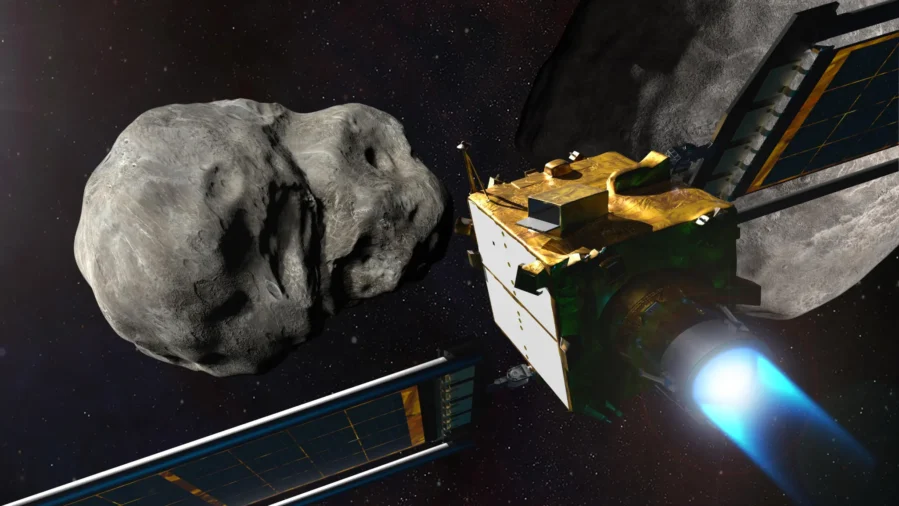
When NASA’s DART spacecraft slammed into asteroid Dimorphos in 2022, it didn’t just nudge the space rock off course—it obliterated massive boulders on the surface, flinging fragments the size of small cars through space at speeds reaching 52 meters per second.
Scientists analyzing images from the Italian CubeSat LICIACube have tracked 104 individual boulders ejected from the impact, revealing a violent demolition that exceeded all expectations.
The findings suggest that surface features on asteroids may be more vulnerable to impact than previously understood, with implications for both planetary defense strategies and our understanding of how space rocks evolve over billions of years.
Caught in the Act of Destruction
LICIACube, trailing behind DART by just 167 seconds, captured unprecedented footage of cosmic demolition in action. The tiny spacecraft photographed boulder clusters streaming away from Dimorphos in two distinct directions—a discovery that surprised researchers who expected more random debris patterns.
Analysis revealed these weren’t random chunks blasted from the crater. Instead, they appear to be the shattered remains of two prominent boulders that flanked the impact site: Atabaque to the south and Bodhran to the north. DART’s solar panels struck these house-sized rocks milliseconds before the main spacecraft body hit the surface, fragmenting them into the projectiles LICIACube observed.
“The clustering suggests that these objects were ejected in preferred directions,” the research team notes. The largest tracked fragment measured 3.6 meters in radius—roughly the size of a small house—while carrying enough momentum to escape Dimorphos entirely and enter independent orbits around the Sun.
Physics of High-Speed Demolition
The boulder trajectories tell a remarkable story of impact physics at work. Most fragments followed two distinct paths:
- Southern cluster: 74 high-speed boulders traveling 30-50 m/s at shallow angles
- Northeastern group: Slower fragments moving 10-20 m/s at steeper trajectories
- Scattered individuals: A few isolated boulders, including the largest specimens
- Total momentum: More than three times that of the DART spacecraft itself
The southern boulder stream carries the most dramatic implications. These fragments were ejected at angles just 4-25 degrees above the local surface—essentially skipping across space like stones across water. Their combined momentum points almost due south from Dimorphos, perpendicular to the asteroid’s orbital motion.
This directional bias means the boulder ejection may have tilted Dimorphos’s orbital plane by up to one degree—a subtle but measurable change that the upcoming European Space Agency Hera mission should detect when it arrives at the asteroid system in 2026.
Momentum That Moves Moons
While DART succeeded in its primary mission of changing Dimorphos’s orbital period by 33 minutes, the boulder analysis reveals the impact delivered far more momentum than initially calculated. The 104 tracked boulders alone carry 1.1 × 10⁷ kilogram-meters per second of momentum—enough to significantly perturb the asteroid’s rotation and orbital plane.
Scientists estimate this momentum transfer could send Dimorphos into a tumbling state, with its rotation axis wobbling chaotically rather than spinning smoothly. Such complex rotation patterns can persist for thousands of years in the low-gravity environment of the asteroid belt.
The boulder ejection represents roughly 0.02% of Dimorphos’s total mass, equivalent to a sphere 4.6 meters in radius. However, this calculation includes only the fragments large enough for LICIACube to track—dozens of smaller boulders were observed but couldn’t be followed through multiple images.
Implications for Planetary Defense
These findings carry profound implications for future planetary defense missions. The DART experiment proved that kinetic impactors can deflect asteroids, but the boulder analysis suggests the deflection mechanisms are more complex than anticipated.
Surface boulders act as secondary projectiles, amplifying the momentum transfer in unexpected directions. For a real planetary defense scenario, this could either enhance or complicate deflection efforts, depending on the target asteroid’s surface features and internal structure.
The research also demonstrates that small spacecraft can provide crucial scientific data. LICIACube, weighing just 14 kilograms, delivered observations impossible to obtain from Earth-based telescopes or even the Hubble Space Telescope.
When Hera reaches Dimorphos in late 2026, it should find an asteroid system fundamentally altered by DART’s impact—potentially tumbling chaotically in a slightly tilted orbit, with a fresh crater surrounded by the scars of boulder impacts. The mission will provide the final chapter in understanding how a relatively small spacecraft can reshape an entire world.