

Key Takeaways
- Astronomers observed unusual behavior in star Gaia20ehk, leading to the discovery of a likely planetary collision around 2021.
- The collision produced a massive cloud of hot dust that dims the star’s light while radiating detectable heat in the infrared.
- The findings resemble the conditions that formed Earth’s moon, raising questions about how common such impacts are in planetary formation.
- The ongoing monitoring at the Vera C. Rubin Observatory could uncover many more similar impacts over the next decade.
- This discovery showcases the potential of archival data in astronomy, allowing for the analysis of long-duration cosmic events.
Andy Tzanidakis wasn’t looking for a catastrophe. He was working through a stack of archival telescope data (the unglamorous, necessary kind of astronomy that most researchers pass over) when a star 11,000 light-years away started behaving in ways that made no sense. The star, catalogued as Gaia20ehk, sits near the constellation Puppis, a main-sequence star like our sun, the sort that should burn steadily for billions of years without doing anything dramatic. Except it wasn’t doing that at all.
“The star’s light output was nice and flat, but starting in 2016 it had these three dips in brightness. And then, right around 2021, it went completely bonkers,” said Tzanidakis, a doctoral candidate at the University of Washington. “I can’t emphasize enough that stars like our sun don’t do that. So when we saw this one, we were like ‘Hello, what’s going on here?'”
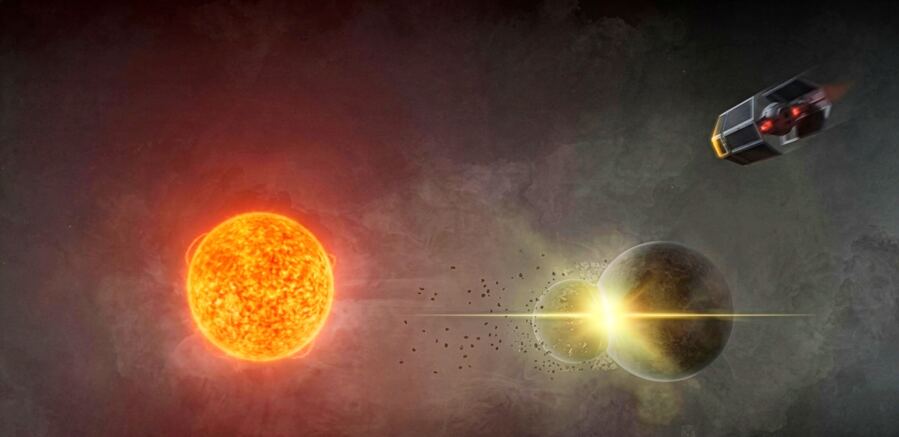
What was going on, Tzanidakis and his collaborators now believe, was a planetary collision. A real one, almost certainly catastrophic, producing enough heat and debris to dim a star across interstellar distances and register in telescopes that weren’t even pointed at it on purpose. The findings, published this week in The Astrophysical Journal Letters, represent one of just a handful of probable planetary impacts ever observed outside our solar system, and perhaps the closest analogue yet to the cataclysm that produced the Earth and its moon roughly four and a half billion years ago.
The clue that cracked it open wasn’t the dimming itself. Three dips in visible light, spaced about 380 days apart, were strange but not inexplicable on their own. The breakthrough came when senior author James Davenport, an assistant research professor of astronomy at UW, suggested the team look at infrared data from the same system. What they found was almost the exact inverse of what they’d seen in optical wavelengths: as the visible light flickered down, the infrared spiked sharply up. Dust, newly formed and still hot, was radiating heat while simultaneously blocking starlight. Something had generated that dust in a hurry.
The picture that emerged from their modelling suggests two planets, probably somewhere in the Earth-to-Mars size range, on a long spiral toward each other. The three preliminary dips likely correspond to a series of grazing encounters, each one scattering dust into the orbital path without producing much heat. Then, sometime around 2021, came the main event. A full collision, two rocky bodies crashing together at tens of kilometres per second, releasing enough energy to heat the resulting debris cloud to roughly 900 kelvin. Hot enough to glow. The infrared signal has barely faded in the four-plus years since.
Location matters here. The debris appears to be orbiting at roughly 1.1 astronomical units from its host star (almost exactly the distance from the sun to the Earth). In our own solar system, that is the zone where the moon-forming impact happened, the zone where liquid water is possible, the zone where complex life (as far as we know) tends to emerge. The researchers cannot say what the Gaia20ehk system will look like in 10 million years, or a hundred million, but the orbital mechanics are at least not ruling out a second act.
That parallel with our own solar system’s history is what makes the discovery more than a curiosity. Giant impacts during the first hundred million years of a solar system’s life are, according to current planet-formation theory, basically routine. Rocky planets get built in stages, the last of which involves repeated violent collisions between bodies that are sometimes the size of Mars. Our moon is thought to be the debris field from one such collision, one that happened to strike at just the right angle to leave behind a large, gravitationally significant satellite rather than simply vaporising both worlds. The question that keeps planetary scientists up at night is whether that outcome was common, or whether our Earth-moon system is a remarkable accident.
To have any hope of answering that, you need more data points. Right now there are very few. Tzanidakis notes that catching this kind of impact in progress requires a rare combination of circumstances: the orbital geometry has to place the debris cloud directly between the star and our line of sight, the collision has to be recent enough that the dust is still present and warm, and someone has to be watching archival data carefully enough to spot the tell. His approach, using decades of continuous sky survey data rather than targeted observations of individual systems, is precisely what Davenport describes as the underpublicised frontier of modern astronomy. Long-duration events, unfolding over years or decades, simply don’t show up in studies looking for short-term variability.
The dust mass Tzanidakis and Davenport calculate from the infrared signature runs to around 4 × 10²⁰ kilograms, roughly in the range of a small icy moon. That’s a conservative lower bound; the distance uncertainty is large (on the order of a thousand parsecs), and the infrared measurements are sensitive only to heated material within a few astronomical units of the star. The initial colliding bodies were almost certainly considerably larger.
Spectroscopic follow-up has so far been inconclusive, partly because the ongoing dust activity makes it difficult to get a clean signal from the star itself. The team used both the Southern Astrophysical Research telescope in Chile and the Southern African Large Telescope for optical spectroscopy, and while the spectra show no signs of active accretion (which would have suggested a younger, T-Tauri type star with a gas disk rather than a mature planetary system), the data quality is limited. What the spectra can rule out, they have; what they can confirm remains frustratingly out of reach.
More data is coming. The Simonyi Survey Telescope at the Vera C. Rubin Observatory, which is beginning its Legacy Survey of Space and Time this year, will monitor hundreds of millions of stars with the cadence and depth needed to catch collisions like this in progress. Davenport’s rough estimate suggests the survey could plausibly turn up a hundred new impact candidates over the next decade. SPHEREx, the recently launched NASA spectrophotometer, has already confirmed that Gaia20ehk remains infrared-bright in its most recent observations, and JWST follow-up could eventually resolve the silicate features in the dust spectrum that would clinch the giant-impact interpretation.
“How rare is the event that created the Earth and moon? That question is fundamental to astrobiology,” Davenport said. “It seems like the moon is one of the magical ingredients that makes the Earth a good place for life. It can help shield Earth from some asteroids, it produces ocean tides and weather that allow chemistry and biology to mix globally, and it may even play a role in driving tectonic plate activity. Right now, we don’t know how common these dynamics are. But if we catch more of these collisions, we’ll start to figure it out.”
For Tzanidakis, the discovery is a proof of concept. Not just for the science, but for the method. Patient, systematic, archival: the kind of astronomy that doesn’t require pointing a telescope at something interesting so much as recognising, after the fact, that something interesting happened to be in the field of view. The universe, it turns out, has been recording its own collisions for decades. You just have to know how to look at the old footage.
DOI / Source: https://doi.org/10.3847/2041-8213/ae3ddc
Frequently Asked Questions
Astronomers at the University of Washington believe two planets orbiting the star collided catastrophically around 2021, producing a massive cloud of hot dust. The cloud orbits the star and periodically passes between it and Earth, dimming the star’s light, while also radiating detectable heat in the infrared. The system has remained in this disrupted, infrared-bright state for more than four years since the likely collision.
The parallels are striking enough to have caught the researchers’ attention. The debris appears to orbit at roughly 1.1 astronomical units from its star, similar to Earth’s distance from the sun, which is the same zone where the moon-forming impact is believed to have occurred in our solar system. The collision pattern also matches theoretical models of giant impacts, including a series of grazing encounters before the main collision event. Whether the debris could eventually form a moon-like body is unknown, and could take millions of years to resolve.
The geometry has to cooperate: the debris cloud needs to orbit in a plane that crosses our line of sight to the star, so it actually blocks some starlight from Earth’s perspective. The collision also needs to be recent enough that the dust is still warm and detectable in the infrared. On top of that, catching the full light-curve evolution requires years of continuous sky monitoring, which most observing programs aren’t designed for. The Vera C. Rubin Observatory’s upcoming survey may change that significantly.
The debris is currently orbiting at around 900 kelvin and slowly cooling. Over time (potentially millions or even hundreds of millions of years) it may either disperse through collisions and radiation pressure, or cool and clump together into a new rocky body. The researchers say it is too early to determine which outcome is more likely, and continued monitoring will be needed as the dust evolves.
If Earth’s large moon is genuinely important for life (stabilising our planet’s axial tilt, driving ocean tides, and possibly plate tectonics), then the frequency of moon-forming impacts is a basic astrobiological variable. Every confirmed planetary collision in another system adds a data point to that distribution. With enough data, it may become possible to estimate how often solar systems like ours produce the specific configuration that led to life here.