

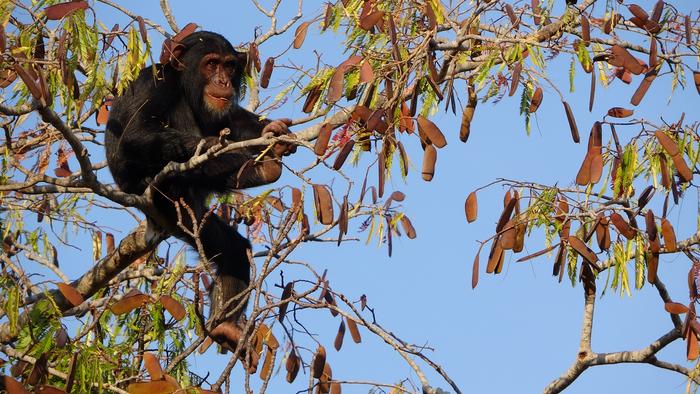
Chimpanzees in Tanzania’s Issa Valley are defying long-held ideas about why our ancestors left the trees.
Despite living in open savannah woodlands, these chimps spend much of their time up in the trees, risking awkward climbs and acrobatic moves to reach fruits, seeds, and leaves perched on thin branches. A new study suggests their high-stakes tree foraging might help explain why early human ancestors kept their climbing traits even after they evolved to walk upright.
Chimps That Climb in the Open
The Issa Valley, with its patchy forest and dry woodland, is thought to resemble the environment where early hominins once lived. Researchers observed that these chimpanzees, like some of their fossil cousins, still climb extensively. They often forage in tall trees with wide crowns, hanging from or walking upright along branches to access food.
“For decades it was assumed that bipedalism arose because we came down from the trees and needed to walk across an open savannah,” said Dr. Rhianna Drummond-Clarke of the Max Planck Institute for Evolutionary Anthropology. “Here we show that safely and effectively navigating the canopy can remain very important for a large, semi-arboreal ape, even in open habitat.”
Foraging in Tough Conditions
During the dry season, Issa chimpanzees switch their focus to woodland foods, especially fruit, seeds, and even a parasitic flower called Pilostyles that grows along terminal branches. To collect these resources, chimps must move carefully through sparse trees with fewer branches and more open space between them.
The researchers measured the size and structure of over 200 trees and analyzed 301 foraging bouts. They found that chimps spent more time foraging in trees that were larger, offered abundant food, and had open crown shapes like umbrellas or upside-down cones.
Key findings include:
- Longer foraging times were linked to trees with abundant food and larger trunks.
- Chimps used suspensory behaviors—hanging beneath branches—especially in open-crowned trees.
- Unripe fruits and hard-to-process seeds were associated with longer foraging sessions.
- Suspension was more likely in trees shaped like umbrellas, even in sparsely vegetated areas.
These behaviors challenge the idea that early hominins left trees simply because the forest disappeared. Instead, even in more open habitats, tree-based foraging remained critical—possibly enough to keep natural selection favoring climbing adaptations.
Lessons for Human Evolution
The findings build on growing fossil evidence suggesting that early bipedal hominins like Ardipithecus and Australopithecus retained features for tree climbing: curved fingers, long arms, and strong shoulders. Fossils alone can’t reveal behaviors, but these living chimps may offer a useful window into how a semi-terrestrial ape survived on a landscape with both trees and grass.
“If Issa Valley chimpanzees can be considered suitable models, suspensory and bipedal behaviors were likely vital for a large-bodied, fruit-eating, semi-terrestrial hominin to survive in an open habitat,” said Drummond-Clarke.
Still Just One Group
While compelling, the study authors acknowledge limits. The data come from a single chimpanzee community during the dry season. More work is needed to test whether other savannah-dwelling chimpanzees show similar patterns year-round, and to better understand how food availability and tree types shape climbing behavior.
Still, the message is clear: if you want the good stuff in the treetops, you need the tools to get there—and that includes some very human-like moves.
Journal: Frontiers in Ecology and Evolution
DOI: 10.3389/fevo.2025.1561078