

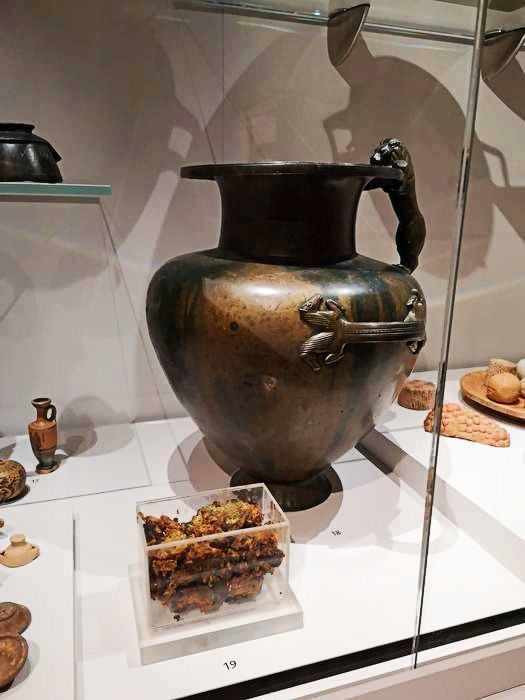
For decades, a sticky residue inside a bronze jar found in an ancient Greek shrine puzzled scientists.
Was it beeswax, animal fat, or something else entirely? Now, a new chemical analysis reveals what may be the oldest surviving honey ever discovered—dating back some 2,500 years to a sacred underground chamber in Paestum, Italy. The findings, published July 30 in the Journal of the American Chemical Society, show that this mysterious substance shares a molecular fingerprint with modern honey, royal jelly, and beeswax, pointing to a long-lost offering once placed before the gods.
The Bronze Jar That Held a Sticky Secret
Back in 1954, archaeologists unearthed a 6th-century BCE shrine in southern Italy. Inside the chamber was an iron bed surrounded by bronze jars, sealed with cork and filled with a paste-like residue. The shrine’s arrangement suggested a sacred offering. But over the next 30 years, three scientific attempts to identify the substance fell short, concluding it was some kind of fat or oil contaminated with pollen and insect fragments.
When one of the jars went on display at the Ashmolean Museum in Oxford in 2019, researchers seized the opportunity to reanalyze its contents using advanced mass spectrometry and protein analysis. The results? Remarkably convincing evidence that the substance was once honey—or at least honeycomb—offered to the gods as a symbol of immortality.
Modern Tools Unlock Ancient Chemistry
The team, led by Luciana da Costa Carvalho and James McCullagh at the University of Oxford, used a multianalytical approach combining gas chromatography, spectroscopy, and proteomics. They focused on a sample taken from deep within the residue to avoid contamination.
- The sample showed a chemical profile nearly identical to modern honey and beeswax.
- Hexose sugars, found in honey but not in beeswax, were present at high levels.
- Royal jelly proteins unique to the Western honeybee (Apis mellifera) were identified in the residue.
- Sugar degradation products were found preserved in layers where the residue had chemically interacted with the copper jar.
“Ancient residues aren’t just traces of what people ate or offered to the gods—they are complex chemical ecosystems,” said da Costa Carvalho in a statement. “Studying them reveals how those substances changed over time.”
A Long-Delayed Confirmation
Why did earlier studies miss the honey? One reason is that those tests focused mainly on lipids and fats, using techniques that couldn’t detect sugar degradation products or trace proteins. Today’s more sensitive instruments, like high-resolution mass spectrometers and ion chromatography systems, allow scientists to find biomarkers even in degraded samples buried for millennia.
The researchers also detected major royal jelly proteins—MRJP-1, MRJP-2, and MRJP-3—which are produced only by honeybees and secreted into honey and larval food. These proteins had never before been recovered from an ancient archaeological residue.
Ritual, Chemistry, and Time
Honey held spiritual meaning in the ancient world. In Greek mythology, bees nurtured baby Zeus, and honey was thought to promote wisdom and immortality. The shrine where this honey was found was likely built for a now-forgotten deity. But its sacred purpose still echoes, thanks to a layer of brown paste and the tools of modern science.
“This kind of work shows how far archaeological science has come,” said the authors, who argue that hypothesis-driven biomolecular analysis may be the key to unlocking many other residue mysteries in museum collections worldwide.
And what about that sticky substance itself? It may no longer be sweet, but it still has a story to tell—one that began in the hands of an ancient beekeeper and ended with a whisper from the gods.
Journal Information
Journal: Journal of the American Chemical Society
DOI: 10.1021/jacs.5c04888
Article Title: A Symbol of Immortality: Evidence of Honey in Bronze Jars Found in a Paestum Shrine Dating to 530–510 BCE