

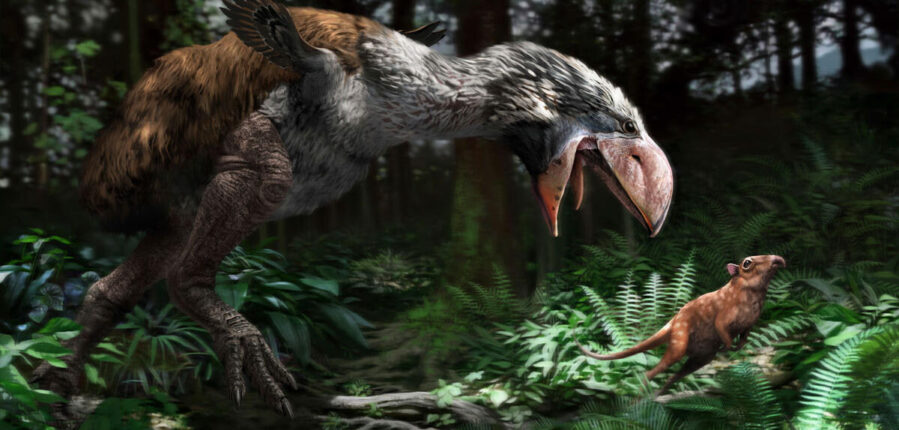
Long after the mighty dinosaurs vanished, Earth became home to an extraordinary parade of colossal creatures that would dwarf most animals alive today.
From 17-ton rhinoceroses to bus-sized snakes and 400-kilogram orangutan cousins, these giants dominated our planet for millions of years. But their impressive size, scientists now reveal, was both their greatest advantage and their ultimate weakness.
New research from French paleontologists and biologists shows that while gigantism offered clear survival benefits in stable environments, these massive creatures were uniquely vulnerable to environmental change. Their stories offer sobering insights for today’s remaining giants, from African elephants to towering redwoods, as they face the unprecedented challenges of modern climate change.
The Age of Forgotten Giants
The Cenozoic Era, which began 65 million years ago and continues today, witnessed an explosion of gigantism unlike anything seen since the dinosaurs. Asia was home to Paraceratherium, a hornless rhinoceros five meters high at the shoulder and nine meters long, weighing 17 tonnes and resembling a cross between an elephant and an okapi. In China’s tropical forests, Gigantopithecus blacki, a cousin of modern orangutans weighing nearly 400 kilograms, towered over the landscape just two million years ago.
South America hosted Megatherium americanum, a six-meter-long ground sloth weighing four tonnes that lumbered across savannas as recently as 8,000 years ago. Even the oceans weren’t immune to this trend toward enormity. Perucetus colossus, weighing at least 80 tonnes, may have been one of the heaviest animals ever to live on Earth when it swam ancient seas 39 to 37 million years ago.
“Shortly after the crisis that led to the extinction of the dinosaurs, the ecological niches they had occupied were rapidly taken over by the survivors,” explains Pierre-Olivier Antoine, a paleontologist at the Institute of Evolutionary Science of Montpellier. This set off an evolutionary “arms race” between prey and predators, with each side growing larger to gain advantages over the other.
Perfect Conditions for Growing Giants
These massive creatures thrived during a period when Earth’s climate was dramatically different from today. During the Paleocene-Eocene Thermal Maximum 56 million years ago, the planet’s average surface temperature was 8°C higher than current levels. Thermal gradients between the equator and poles were far less pronounced, creating a continuity of lush ecosystems from tropical forests to temperate regions where polar ice didn’t exist.
The land was covered with abundant vegetation from pole to pole, creating ideal conditions for supporting large herbivores. “Ecosystems had no difficulty in supporting large numbers of herbivores and providing them with an abundance of food,” Antoine notes. The transition from dense forests to open savannas during the Oligocene period proved especially favorable for massive grazing animals.
The Biomechanics of Being Massive
Supporting a body mass exceeding a tonne requires remarkable anatomical adaptations, research by Alexandra Houssaye at the CNRS MECADEV laboratory reveals. Her team studied “graviportality,” the suite of adaptations that enable organisms to support and move massive body weight, comparing modern rhinoceroses and hippopotamuses to elephants and extinct four-legged dinosaurs.
Despite their enormous weight, hippos and rhinos can still gallop because their limb bones remain inclined relative to one another, keeping their legs bent and enabling rapid movement. “They are necessarily stocky animals, with large joints that can withstand the associated loads,” Houssaye explains. Their internal bone structure strengthens through thickened compact tissue and extended bone trabeculae, boosting both mass and strength.
Elephants and the massive sauropod dinosaurs took a different evolutionary path. By losing the ability to gallop, these species could grow even larger by developing perfectly straight, columnar bones that don’t bend but greatly reduce stress on individual bones. “In excess of five to six tonnes, the optimal adaptation is to switch to columnar bones,” Houssaye concludes.
When Insects Ruled the Skies
Gigantism wasn’t limited to mammals and reptiles. Between 350 and 250 million years ago, during the Carboniferous and Permian periods, giant insects dominated Earth’s forests. The carnivorous dragonfly Meganeura boasted a wingspan reaching 70 centimeters, while some herbivorous insects achieved 35-centimeter wingspans.
These aerial giants thrived under extraordinary atmospheric conditions. “Large flying organisms such as Meganeura are able to sustain flight better when the air is denser,” explains researcher André Nel from the ISYEB institute. Atmospheric pressure exceeded 2 bars, twice today’s levels, while oxygen comprised 35% of the atmosphere compared to 20% today.
The oxygen-rich environment particularly benefited arthropods because their tracheal respiratory system carries oxygen directly to the body’s center. Higher oxygen concentrations allowed them to grow much larger, producing creatures like Arthropleura, a two-meter-long millipede that crawled through Carboniferous forests.
Plant Giants Break All Records
While animals dominated headlines, plants arguably achieved the most impressive gigantism. A 130-meter-high fossil plant holds the record for the largest land organism ever discovered, while some marine algae reach lengths of several hundred meters. Modern eucalyptuses and sequoias regularly achieve heights around 100 meters.
Plants enjoy unique advantages in the size competition. “Animals have a unitary architecture, while plants grow by serial repetition,” explains botanist Tristan Charles-Dominique from the AMAP laboratory. As long as resources remain available, plants continue growing, usually competing with neighbors for sunlight access.
The ultimate plant giant may be Pando, a clonal quaking aspen in Utah with an estimated age between 16,000 and 80,000 years. This single organism consists of 47,000 connected stems covering 43 hectares and weighing approximately 6,000 tonnes. “And there is nothing to suggest it has any intention of stopping,” Charles-Dominique notes with amusement.
The Hidden Costs of Enormity
Despite their impressive appearances, giant organisms face significant evolutionary trade-offs. “Being big comes at a cost. There must therefore be an evolutionary advantage to size,” Houssaye emphasizes. Given the biomechanical, energy, and environmental constraints, giant species adopt a unique life strategy: they take longer to grow, reproduce later, and produce fewer offspring.
This pattern emerges clearly in animals weighing 45 kilograms or more, a threshold that distinguishes smaller species with shorter lifespans and larger broods from true megafauna. Plants follow similar patterns, with large specimens delaying reproduction for extended periods to maximize growth in competitive environments.
“For a plant to become very large, it must continue to explore its surroundings for as long as possible,” Charles-Dominique explains. “Remaining large therefore means staying young and not reproducing over a long period of time, which is not optimal in disturbed environments.”
The Achilles Heel of Giants
This life strategy created a fundamental vulnerability that ultimately doomed many giant species. “Giant species turn out to be highly successful in stable conditions, but not very resilient when it comes to environmental crises and fluctuations, of which they are the first victims,” Antoine warns.
Their size, which provided advantages in stable environments, became a liability when conditions changed rapidly. Slow reproduction rates, late maturation, and high resource requirements made these species unable to adapt quickly to environmental shifts. Many of the Cenozoic giants disappeared as climates changed and new competitors emerged.
The pattern repeated throughout Earth’s history. Giant Carboniferous insects declined as atmospheric oxygen levels dropped and new competitors appeared, including small gliding reptiles, pterosaurs, and eventually birds. “These animals decreased in size with each successive group,” Nel observes, until they finally vanished alongside non-avian dinosaurs.
Modern Giants Face New Challenges
Today’s remaining giants occupy a precarious position. The world’s last large animals including African elephants, Asian megafauna, and towering trees in rainforests and savannas are concentrated in tropical regions. These areas were historically buffered from the climate changes that began 20,000 years ago following the Last Glacial Maximum.
However, these same tropical refuges now face the frontlines of current global warming. The rapid pace of modern climate change may exceed the adaptive capacity of species that evolved their gigantism during millions of years of stable conditions.
The fossil record suggests that environments capable of supporting giants require specific combinations of abundant resources, stable climates, and limited disturbance. As human activities fragment habitats and accelerate climate change, these conditions become increasingly rare.
Lessons from Earth’s Colossal Past
The rise and fall of ancient giants offers crucial insights for conservation efforts today. Their evolutionary success stemmed from exploiting stable environments with abundant resources, but this same specialization made them vulnerable to change. Modern giants face similar trade-offs between size advantages and adaptability.
Understanding these patterns helps explain why large species consistently rank among the most endangered today. Their biological characteristics, successful for millions of years, become liabilities in rapidly changing environments. Conservation strategies must account for these inherent vulnerabilities while working to preserve the stable conditions these remarkable creatures require.
As researchers continue studying the colossal organisms of the past, their stories fuel both admiration for nature’s creative power and concern for today’s giants with feet of clay. The challenge ahead lies in learning from these ancient lessons to protect the remaining giants that still grace our planet.