Why Mammals Keep Evolving to Eat Ants—Over and Over Again

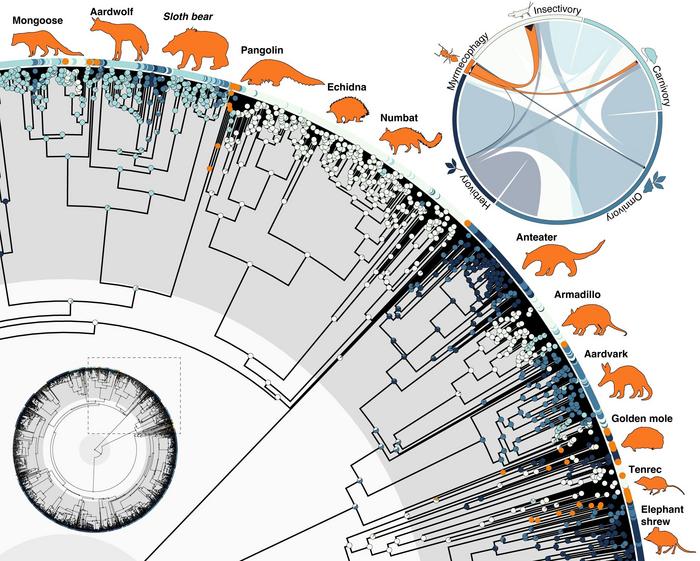
The extreme appetite for ants and termites has independently emerged in mammals at least 12 separate times over the past 66 million years, according to new research that reveals one of evolution’s most unusual dietary obsessions. Scientists at New Jersey Institute of Technology traced this specialized feeding strategy across thousands of mammal species, discovering that the rise of social insects after the dinosaur extinction triggered a cascade of evolutionary adaptations in mammals worldwide.

Published in Evolution, the comprehensive study analyzed dietary data from 4,099 mammal species to understand how and when this peculiar eating habit—called myrmecophagy—developed across different animal lineages following the dramatic ecosystem changes that occurred after non-avian dinosaurs disappeared.

Extreme Dietary Commitment Requires Major Changes

Only about 20 mammal species today qualify as true myrmecophages—animals that have evolved to eat ants and termites exclusively. These specialists include giant anteaters, aardvarks, and pangolins, all of which have developed remarkable adaptations: elongated sticky tongues, specialized claws, modified stomachs, and reduced or missing teeth.

The commitment required is staggering in terms of daily consumption. A numbat must consume approximately 20,000 termites daily to meet its energy needs, while an aardwolf can hunt up to 300,000 insects in a single night—a testament to how energy-poor these tiny prey items are.

“There’s not been an investigation into how this dramatic diet evolved across all known mammal species until now,” explained Phillip Barden, the study’s corresponding author and associate professor of biology at NJIT. “This work gives us the first real roadmap, and what really stands out is just how powerful a selective force ants and termites have been over the last 50 million years.”

Social Insects Became Abundant After Dinosaur Extinction

The research team traced ant and termite colony evolution back 145 million years to understand when these insects became viable as a primary food source. During the Cretaceous period, ants and termites represented less than 1% of Earth’s insects, far too scarce to support specialist feeders.

The situation changed dramatically following the K-Pg extinction event that eliminated non-avian dinosaurs. Ants and termites expanded rapidly in the reshuffled ecosystems, reaching modern abundance levels around 23 million years ago when they comprised 35% of all insect specimens.

Key Evolutionary Patterns Discovered:

  • Myrmecophagy evolved once in each major mammal group: monotremes, marsupials, and placentals
  • All specialist ant-eaters descended from insectivorous or carnivorous ancestors
  • Insectivorous species made the transition three times more often than carnivores
  • Only one known reversal occurred: elephant shrews switching back to omnivory
  • Eight of twelve evolutionary origins are represented by single species today

Carnivore Family Shows Surprising Adaptability

One unexpected finding emerged from the Carnivora family, which includes dogs, bears, and weasels. This group accounts for about 25% of all myrmecophagy origins, despite the dramatic shift required from eating vertebrates to consuming thousands of tiny insects daily.

“That was a surprise. Making the leap from eating other vertebrates to consuming thousands of tiny insects daily is a major shift,” Barden noted. “Part of the predisposition may lie in certain physiological features or dentition that are more malleable for handling a social insect diet.”

The researchers compiled dietary information from nearly a century of natural history records, conservation reports, and taxonomic descriptions to create their comprehensive database. They categorized species into five dietary groups and mapped these onto a time-calibrated mammal family tree using statistical models to reconstruct ancestral diets.

Evolutionary Dead End or Competitive Advantage?

The study revealed that once mammals commit to myrmecophagy, they rarely diversify or switch back to conventional diets. This specialization creates evolutionary constraints—eight of the twelve origins are represented by only single species, suggesting limited diversification potential.

However, this apparent limitation might actually represent an advantage in our changing world. As climate change favors species with massive colonies, including invasive social insects like fire ants, specialist feeders may find themselves well-positioned for future success.

“In some ways, specializing on ants and termites paints a species into a corner,” Barden observed. “But as long as social insects dominate the world’s biomass, these mammals may have an edge—especially as climate change seems to favor species with massive colonies.”

Today, ants and termites number over 15,000 species with a combined biomass exceeding all living wild mammals, making them one of the most successful groups on Earth and ensuring a continued food supply for their specialized predators.


Discover more from Wild Science

Subscribe to get the latest posts sent to your email.

Leave a Comment