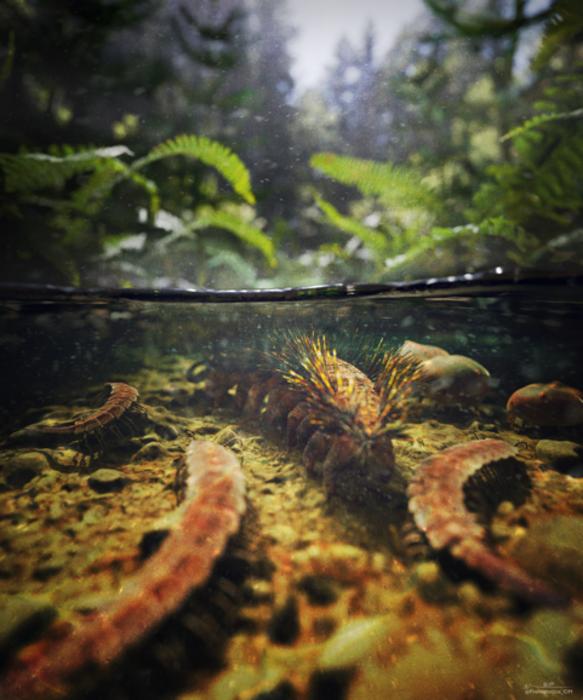
Armored Worm Reveals a Hidden Chapter in Animal Evolution

In a stunning reversal of more than a century of misidentification, researchers have revealed that a fossil long thought to be a caterpillar, millipede, or marine worm is actually a lobopodian—an ancient, soft-bodied relative of modern arthropods. Even more surprising, it lived in freshwater, not the ocean. This makes Palaeocampa anthrax the first known nonmarine lobopodian and the youngest of its kind ever discovered.

A Fossil Misfiled for 160 Years

Originally described in 1865 from Illinois’ Mazon Creek deposits and France’s Montceau-les-Mines, Palaeocampa had baffled paleontologists for decades. But in a new study published in Communications Biology, a team led by Harvard-trained paleontologist Richard Knecht reclassifies it as a freshwater lobopodian—a group of leggy, worm-like creatures known mostly from Cambrian marine environments like the Burgess Shale.

Using advanced imaging and spectroscopy on over 40 specimens from museum collections around the world, the team identified telltale lobopodian features: ten pairs of annulated legs, a head shield, and a dense coat of nearly 1,000 bristle-like spines arranged in symmetrical bundles. These spines, some twice as long as the body’s width, are unlike anything seen in marine relatives.

Spiny Armor With a Chemical Twist

What set Palaeocampa apart wasn’t just its defensive armor, but the discovery of chemical residues preserved at the tips of those spines. Fourier-transform infrared spectroscopy (FTIR) revealed that these tips had a distinct organic signature consistent with aldehydes—common chemical deterrents used by modern invertebrates.

  • Spines contain internal septa and serrated ridges, suggesting both mechanical and chemical defense
  • FTIR analysis confirmed distinct chemical composition at spine tips
  • Spine tips may have secreted toxic fluid under stress

“This marks the first evidence of chemical defense in any lobopodian,” the authors write, noting that the toxin likely wasn’t injected but passively secreted in response to danger.

Freshwater Life in a Coal Forest

Half of the known Palaeocampa fossils come from Montceau-les-Mines, a tropical inland site surrounded by coal forest, with no evidence of marine influence. The other half were found at Mazon Creek, which contains a mix of terrestrial, freshwater, and marine fossils. Combined, these suggest Palaeocampa inhabited freshwater habitats and may have been at least partially amphibious.

Its closest known relative is Hadranax augustus, a Cambrian species from Greenland that lacked spines and lived in deep marine settings. That evolutionary gap—nearly 200 million years—underscores the rarity and significance of the new find.

Rewriting the Lobopodian Story

Most known lobopodians are preserved in Cambrian marine deposits, leading scientists to assume they were ocean-dwellers. But Palaeocampa changes that narrative. Its armored body, freshwater adaptations, and chemical defenses open the door to the possibility that lobopodians had already begun diversifying into new ecological niches well before their extinction.

This discovery, made possible by reexamining fossils stored in museums for over a century, underscores the enduring scientific value of old collections. In Knecht’s words, “Sometimes, the biggest discoveries are the ones waiting to be looked at again.”

Journal: Communications Biology
DOI: 10.1038/s42003-025-08483-0


Discover more from Wild Science

Subscribe to get the latest posts sent to your email.

Leave a Comment