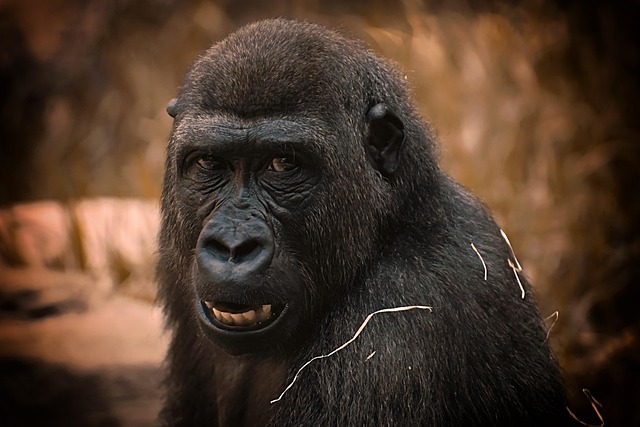
Female gorillas don’t just follow the rules of the hierarchy—they challenge them when it suits their needs.
A new study based on 25 years of observations reveals that aggression among female gorillas is not simply about dominance, but about strategy. Whether it’s pregnancy, lactation, or group dynamics, gorillas modulate their aggression depending on their circumstances—sometimes even daring to confront higher-ranking rivals. The findings, published July 23 in eLife, suggest that individual needs and social environments shape the way gorillas compete, providing rare insight into the evolution of risk-taking behavior.
Gorillas Don’t Always Punch Down
In most social animals, aggression flows down the hierarchy: the strong dominate the weak. And indeed, this held true for most of the 6,871 aggressive interactions recorded across five gorilla groups in Uganda and Gabon. But nearly 42% of the time, aggression was directed up the social ladder—from lower-ranking females to more powerful ones.
That’s a surprisingly high rate compared to other animals, and it defies the assumption that high-risk aggression is rare. According to lead author Nikos Smit, a postdoctoral scientist at the Max Planck Institute for Evolutionary Anthropology and the University of Turku, “We found that both an individual’s needs and its social environment shape its aggression towards individuals of different ranks, as predicted by risk-taking theory.”
What Drives a Gorilla to Take That Risk?
The answer, it seems, lies in energy and opportunity. Pregnant females—especially those in the final trimester—were the most likely to confront higher-ranking groupmates. Lactating females also displayed aggression toward more powerful peers, but to a lesser extent. This difference, the authors suggest, may reflect a mother’s need to protect her infant by avoiding retaliation.
Group composition played a role too. When there were more males in a group, females were bolder. Perhaps male protection allows them to take risks with less fear of reprisal. Conversely, when female numbers swelled, gorillas aimed their aggression downward, toward lower-ranking rivals—safer targets in a competitive crowd.
Key findings from the 25-year study:
- 42% of female-female aggression was directed up the social hierarchy
- Pregnant gorillas in their third trimester targeted higher-ranking females more than any other group
- More males in the group increased aggression toward powerful rivals
- More females led to safer, downward-directed aggression
- Lactating females balanced energy needs with infant safety
Gorillas Adapt Their Aggression to Fit the Situation
These nuanced strategies reflect more than just brute instinct. The researchers suggest female gorillas use what they call “aggression heuristics”—simple decision-making rules shaped by both internal needs and external conditions. When energy demands are high, or when social support is available, gorillas calculate the risk and reward of aggression and sometimes choose the bolder option.
“Overall, our results confirm that an individual’s circumstantial needs and their social environment may influence their decision to engage in riskier behaviours,” said senior author Martha Robbins, group leader at the Max Planck Institute for Evolutionary Anthropology.
What This Tells Us About Risk and Social Rules
The study challenges the idea that animal hierarchies are rigidly enforced. Instead, they can be bent—or poked at—when the conditions are right. This mirrors patterns seen in other species, including humans, where individuals under pressure or with fewer options sometimes act boldly in pursuit of resources.
From chimpanzees to crayfish to paper wasps, animals take calculated risks when the stakes are high. This research adds gorillas to that list, showing that even in stable social systems, individuals are willing to test the limits.
A Final Note from the Forest
If you ever find yourself watching a group of gorillas, don’t just look at who’s on top. Look at who’s making moves—and why. Beneath the quiet canopy of Bwindi or Loango, a silent calculus plays out. And sometimes, the underdog makes the boldest play of all.
Journal: eLife
DOI: 10.7554/eLife.107093.2
Article title: Risk-taking incentives predict aggression heuristics in female gorillas
Publication date: July 23, 2025
Discover more from Wild Science
Subscribe to get the latest posts sent to your email.