
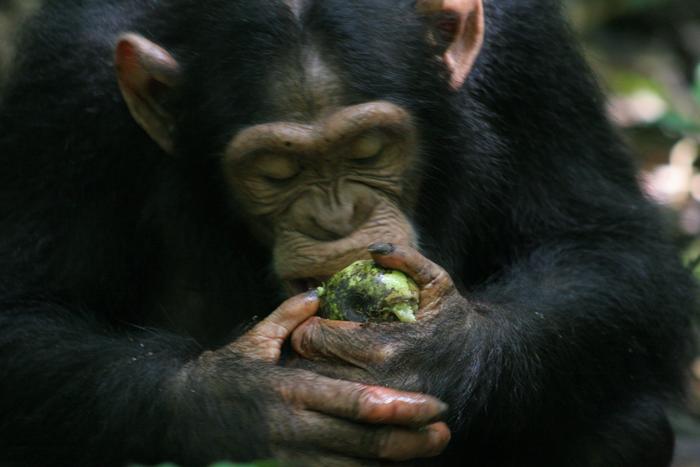
How ‘Scrumping’ Apes May Have Given Us a Taste for Alcohol
Before humans brewed their first beer or raised a glass in celebration, our ancestors may have been tipsy on a much humbler vintage: fermented fruit scavenged from the forest floor. Now, scientists have given this ancient behavior a name—”scrumping”—and a provocative new hypothesis to go with it.
Coined by researchers at Dartmouth College and the University of St Andrews, “scrumping” refers to the act of gathering, and sometimes stealing, ripe fruit that has fallen to the ground. For apes, these windfalls are more than a convenient snack; they are often rich in natural alcohol, the result of microbial fermentation. In a paper published July 31 in BioScience, the researchers argue that scrumping may have been a key evolutionary pressure, shaping not only primate diets and behavior, but the very enzymes that allow humans to metabolize alcohol.
“We never bothered to differentiate fruits in trees from fruits on the ground,” said Nathaniel Dominy, a biological anthropologist at Dartmouth and senior author of the study. “But that difference may have mattered a great deal to evolution.”
Dominy and his colleagues set out to rectify that oversight. They reviewed feeding observations of chimpanzees, gorillas, and orangutans, cross-checking the height at which the animals fed with the typical growing height of the fruits consumed. The results revealed a striking pattern: African apes regularly eat fallen fruit, while Asian orangutans largely avoid it.
That divergence maps neatly onto a genetic one. In 2015, researchers identified a single amino acid mutation in the enzyme ADH4—responsible for breaking down ethanol—that appeared in the common ancestor of humans and African apes. The change supercharged the enzyme’s ability to metabolize alcohol, boosting its activity by a factor of 40. Orangutans, which split from the lineage earlier, never acquired it.
The implications are profound. Efficient alcohol metabolism would have allowed early apes to exploit an abundant but risky food source without becoming incapacitated. Ground-foraging, in turn, might have reduced dangerous tree-climbing and offered a strategic advantage over monkeys, who specialize in unripe fruit still hanging in the canopy.
The researchers also see echoes of this behavior in human culture. “A fundamental feature of our relationship with alcohol is our tendency to drink together,” said Catherine Hobaiter, a co-author and primatologist at St Andrews. “Whether it’s a shared bottle or a communal feast, that sociality may have deep evolutionary roots.”
Indeed, scrumping may not only explain our tolerance for alcohol, but our rituals around it. Feasting, celebration, communion—all might stem, in part, from primates gathering around fruiting trees, taking advantage of nature’s accidental fermentation.
And while the term “scrumping” has quaint English origins—it once described the stealthy gathering of apples from orchards—it now carries a scientific payload. The researchers hope that, like “meme” or “symbiosis,” it will take hold because it captures something essential that language had overlooked.
“Sometimes we don’t realize what’s missing until we name it,” Dominy said. “If the term is useful, it will stick. That’s natural selection at work.”
Journal: BioScience
DOI: 10.1093/biosci/biaf102
Discover more from Wild Science
Subscribe to get the latest posts sent to your email.