
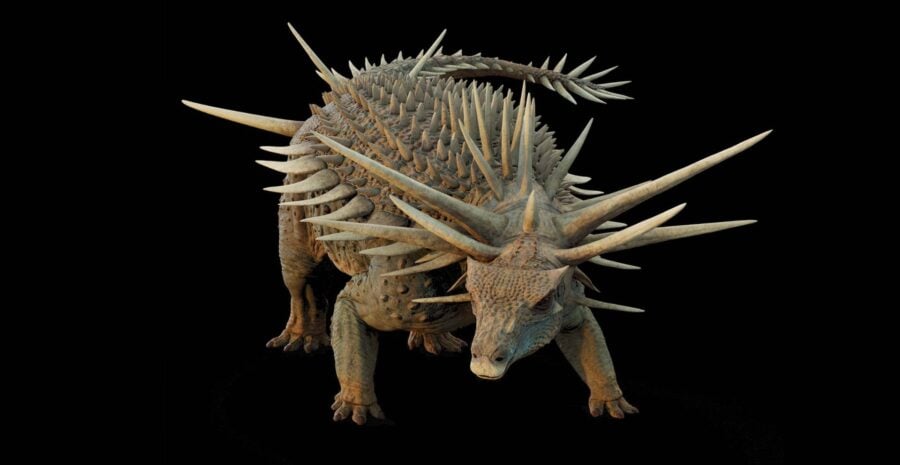
The world’s strangest dinosaur just got stranger. Newly unearthed fossils of Spicomellus afer from Morocco reveal a creature clad in bone spikes from head to tail, some measuring nearly a meter long. The discovery, led by researchers from the Natural History Museum in London, the University of Birmingham, and Moroccan collaborators, shows that ankylosaurs had developed elaborate defenses far earlier than previously thought.
A Dinosaur Unlike Any Other
Back in 2019, paleontologist Susannah Maidment acquired a single rib with spikes fused directly to its surface—an anatomy so bizarre that some doubted whether it belonged to an ankylosaur at all. But after the species was formally described in 2021, expeditions near Boulemane, Morocco, yielded a jackpot: much more of the skeleton. What the team found was astonishing. This animal was bristling with spikes everywhere—hips, sides, tail, and especially its neck, where a collar of spikes jutted outward like lances.
“Spicomellus is one of the strangest dinosaurs that we’ve ever discovered. It’s utterly unlike any other found anywhere else in the world.” — Prof. Richard Butler, University of Birmingham
The largest spikes stretched 87 centimeters, and when clothed in keratin sheaths, they would have been even longer. Imagine a slow-moving tank, but bristling with outward-facing spears. That was Spicomellus.
The Oldest Armored Dinosaur
The fossils date to 165 million years ago, making Spicomellus the earliest known ankylosaur. Until now, scientists thought such elaborate armor only appeared much later. Its bones also hint at a tail weapon—vertebrae fused into a stiff “handle” structure that usually supports a club, previously thought to be exclusive to later Cretaceous ankylosaurs. That means ankylosaurs were experimenting with some of their signature defenses right from the beginning.
This changes the timeline. “To find such elaborate armour in an early ankylosaur changes our understanding of how these dinosaurs evolved,” says Maidment. “It shows just how significant Africa’s dinosaurs are, and how important it is to improve our understanding of them.”
Spikes That Broke the Rules
Normally, spikes and plates in reptiles grow in the skin as osteoderms. But not in Spicomellus. Many of its spikes were fused directly to the bones themselves, including the ribs. That fusion is unprecedented in the animal kingdom. Muscles normally attach to rib surfaces, but the spikes obstructed those surfaces, leaving scientists unsure how the dinosaur even moved.
“Frankly, we have very little idea about how this dinosaur would have moved at all.” — Prof. Susannah Maidment, Natural History Museum
The design seems impractical, almost self-defeating. Yet Spicomellus survived, meaning the armor worked—likely a deterrent against Jurassic predators. Its fortress of bone and keratin may have made attack too costly, even if the animal moved awkwardly.
A Global Story With African Roots
Spicomellus is the first named ankylosaur from Africa, filling a glaring gap in the fossil record. Its presence suggests ankylosaurs had already spread across the globe by the Middle Jurassic. The find also underscores how little we know about Gondwanan dinosaurs. If one armored dinosaur in Morocco looked like this, what else lies buried under North African rock?
The team published their findings in Nature Ecology & Evolution, calling Spicomellus “absolutely bizarre” but also deeply informative. The spiky skeleton proves that ankylosaurs began their evolutionary arms race far earlier than scientists had guessed.
Takeaway? Dinosaurs didn’t just evolve armor. Sometimes, they went all in, turning their bodies into walking fortresses bristling with weapons. Spicomellus was proof—spectacular, strange proof—that evolution sometimes errs on the side of overkill.
Journal: Nature Ecology & Evolution
DOI: 10.1038/s41559-021-01553-6
Discover more from Wild Science
Subscribe to get the latest posts sent to your email.