
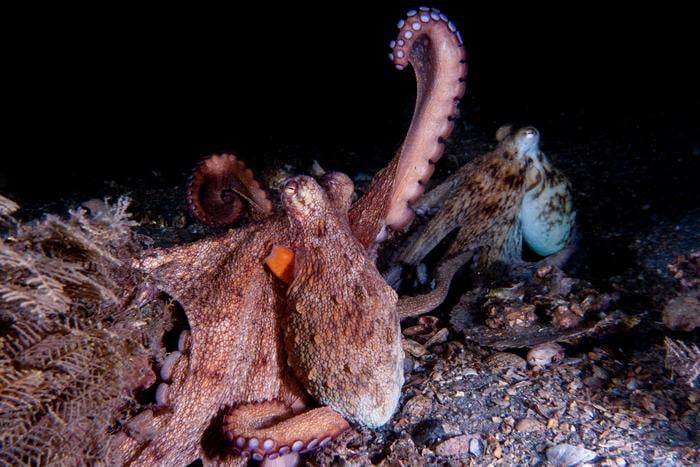
Marine researchers have captured the most comprehensive catalog ever assembled of how octopuses wield their eight arms in the wild, documenting nearly 4,000 arm movements from 25 creatures across six diverse underwater habitats spanning the Caribbean to Spain.
The findings, published this week in Scientific Reports, reveal that octopus arms operate with a sophistication that makes human hands look clumsy by comparison. Each arm can perform 12 distinct actions using just four fundamental deformations: bending, shortening, elongating, and twisting.
“I’ve been trying for a long time to work out the natural behavior of cephalopods in their natural habitat,” said Roger Hanlon, senior scientist at the Marine Biological Laboratory in Woods Hole, who led the study.
What makes this research particularly striking is where it took place. Unlike previous laboratory studies, researchers recorded octopuses in their actual homes, from sandy seafloors to complex coral reefs. The creatures spent roughly 80 percent of their time hiding in dens, emerging only once or twice daily to hunt. Finding them required detective work – following food debris trails back to their lairs, then waiting patiently for the residents to appear.
Arms That Think for Themselves
The study reveals that octopus behavior relies more on touch than sight. Each arm contains approximately 100 suckers packed with sensory organs that Hanlon describes as chemical-tactile geniuses.
“Each sucker is a chemo-tactile genius, the equivalent of the human nose, lips and tongue all wrapped into one,” Hanlon explained.
This sensory sophistication allows octopuses to accomplish tasks that would challenge engineers designing flexible robots. The front arms primarily handle exploration and investigation, while the back arms focus on locomotion and support. Yet any arm can perform any task when needed, creating remarkable redundancy.
The researchers discovered that different regions of each arm specialize in specific movements. Bending occurs mostly at the tips, while lengthening and shortening happen closer to the body. This regional specialization reflects the underlying muscle architecture, where different muscle groups dominate various arm sections.
Implications Beyond Biology
The research carries practical implications for robotics and rescue operations. The U.S. Office of Naval Research partly funded the study, hoping to develop flexible robotic arms for search and rescue missions. Engineers envision soft, serpentine appendages that could navigate through collapsed buildings to deliver supplies to trapped survivors.
The octopuses demonstrated abilities that current robots cannot match. During hunting, they coordinate multiple arms simultaneously for complex maneuvers like the “parachute attack,” where they spread their arms wide to envelop prey. For camouflage, they manipulate objects while moving to mimic drifting seaweed or rolling rocks.
The study documented 15 different behaviors built from combinations of 12 arm actions. Simple behaviors like grasping food involved just one or two actions, while complex locomotion required eight to eleven coordinated movements across multiple arms.
Researchers found no preference for left versus right arms, suggesting the nervous system treats arms as coordinated pairs rather than independent units. This finding aligns with recent discoveries of nerve cords connecting arms positioned two spaces apart, potentially enabling sophisticated inter-arm communication.
The work builds on decades of octopus research but represents the first systematic catalog of wild arm behaviors. Previous studies either focused on laboratory settings or examined isolated movements rather than complete behavioral sequences.
For the robotics community, the findings offer a biological blueprint for designing truly flexible machines. Current soft robots can bend and stretch, but lack the sensory integration and coordinated control that make octopus arms so effective. The hierarchical organization revealed in this study – from basic deformations to complex behaviors – could inform new approaches to robot design and control.
The research also highlights the remarkable adaptability that allows octopuses to thrive in diverse marine environments. Their behavioral flexibility, combined with extraordinary camouflage abilities, makes them successful predators across habitats ranging from open sandy plains to intricate coral gardens.
As engineers continue developing soft robotics for medical procedures, manufacturing, and exploration, the octopus arm remains an aspirational model. This comprehensive field study provides the detailed behavioral data needed to translate biological inspiration into technological innovation.
Scientific Reports: 10.1038/s41598-025-88308-3
Discover more from Wild Science
Subscribe to get the latest posts sent to your email.