
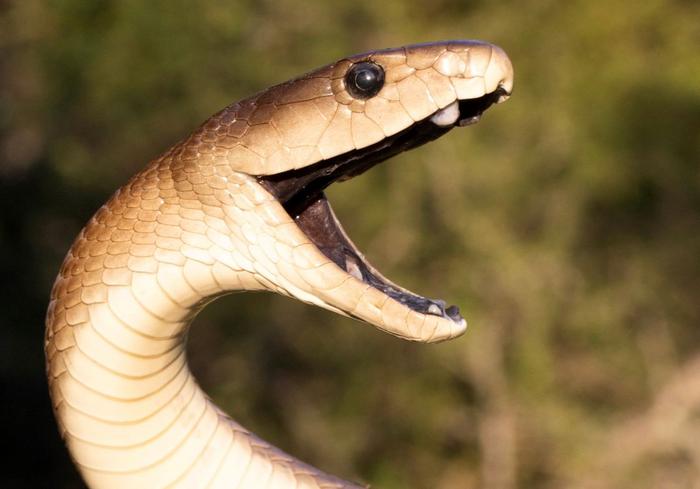
Doctors treating mamba snake bite victims have long puzzled over a disturbing pattern: patients who initially improve after receiving antivenom sometimes deteriorate again, their muscles seizing in painful, uncontrolled spasms. Now researchers at The University of Queensland have uncovered why this happens, revealing that three of the four mamba species deploy a two-pronged neurological attack that current treatments cannot fully counter.
The discovery centers on how Black Mambas, Western Green Mambas, and Jameson’s Mambas inject venom that attacks the nervous system at two different points simultaneously. While antivenoms successfully neutralize one type of paralysis, they inadvertently unmask a second, equally dangerous effect that had been hiding beneath the first.
“If you’re bitten by 3 out of 4 mamba species, you will experience flaccid or limp paralysis caused by postsynaptic neurotoxicity,” said Professor Bryan Fry from UQ’s School of the Environment. “Current antivenoms can treat the flaccid paralysis but this study found the venoms of these three species are then able to attack another part of the nervous system causing spastic paralysis by presynaptic toxicity.”
A Chemical Weapon With Two Stages
The venom initially blocks nerve signals from reaching muscles, producing what researchers call flaccid paralysis – the loss of muscle tone and movement. Antivenom effectively treats this postsynaptic effect by preventing toxins from blocking acetylcholine receptors. But once that first wave of toxicity is neutralized, a second mechanism emerges. The venom simultaneously overstimulates the presynaptic system, causing excessive release of neurotransmitters that trigger violent muscle contractions.
Researchers had previously believed only the Eastern Green Mamba possessed this dual capability. The new findings show that three of the four mamba species wield this coordinated neurological assault, though the effects appear in different sequences depending on the species.
PhD candidate Lee Jones, who conducted the experimental work, tested venom from all four mamba species using chick biventer cervicis nerve-muscle preparations. The results confirmed that while antivenoms neutralized flaccid paralysis effectively, they failed to protect against the spastic-paralysis effects in most cases.
“What we were not expecting to find was the antivenom unmasking the other half of the venom effects on presynaptic receptors,” Jones said.
The research team examined venoms from the Black Mamba (from both Kenya and South Africa), Western Green Mamba, Eastern Green Mamba, and both subspecies of Jameson’s Mamba. They tested three commercially available antivenoms used across sub-Saharan Africa, where mamba bites account for roughly 30,000 deaths annually among an estimated 500,000 total snake envenomings.
Geographic Variation Complicates Treatment
Adding another layer of complexity, the researchers discovered significant geographic variation in Black Mamba venom. Populations from Kenya and South Africa showed different neutralization patterns when exposed to the same antivenoms, suggesting that venom composition varies by region even within a single species.
This finding has immediate clinical implications. Antivenoms are typically developed using venom from specific snake populations, and if those populations differ substantially from snakes in other regions, the treatments may prove less effective. The geographic variation observed in Black Mambas likely extends to other mamba species as well, though this remains to be tested.
Molecular phylogenetic analysis revealed that both spastic-paralysis and flaccid-paralysis toxins evolved in the mamba lineage’s last common ancestor. All four species share the same toxin types, meaning the differences in venom effects between species result from varied expression levels of these toxins rather than the evolution of entirely new compounds.
The Western Green Mamba venom proved the most effectively neutralized by all three tested antivenoms, despite not being included in the immunizing mixture for two of them. This high neutralization rate suggests strong conservation of toxin structures across mamba species.
For clinicians managing mamba bite victims, the research offers a sobering message: administering antivenom may trade one form of paralysis for another. Patients who regain muscle function after treatment may subsequently develop fasciculations and spastic paralysis as the presynaptic effects emerge from beneath the neutralized postsynaptic toxicity. The study confirms observations from case reports, including a 2021 incident in the Czech Republic where a patient bitten by a captive Black Mamba experienced persistent fasciculations despite receiving two doses of antivenom.
Professor Fry emphasized that the findings should directly inform clinical practice and antivenom development. Specialized antivenoms targeting both postsynaptic and presynaptic toxins could dramatically improve survival rates and outcomes for victims of mamba bites. The research represents what Fry calls translational venom research – work that bridges laboratory discovery and bedside treatment.
The experimental work, conducted in collaboration with Monash Venom Group, employed chicken nerve-muscle preparations to assess how venoms affected neuromuscular transmission over 60-minute periods. This approach allowed researchers to observe both the immediate flaccid paralysis effects and the delayed emergence of spastic paralysis after antivenom administration.
Toxins: 10.3390/toxins17100481
Discover more from Wild Science
Subscribe to get the latest posts sent to your email.