
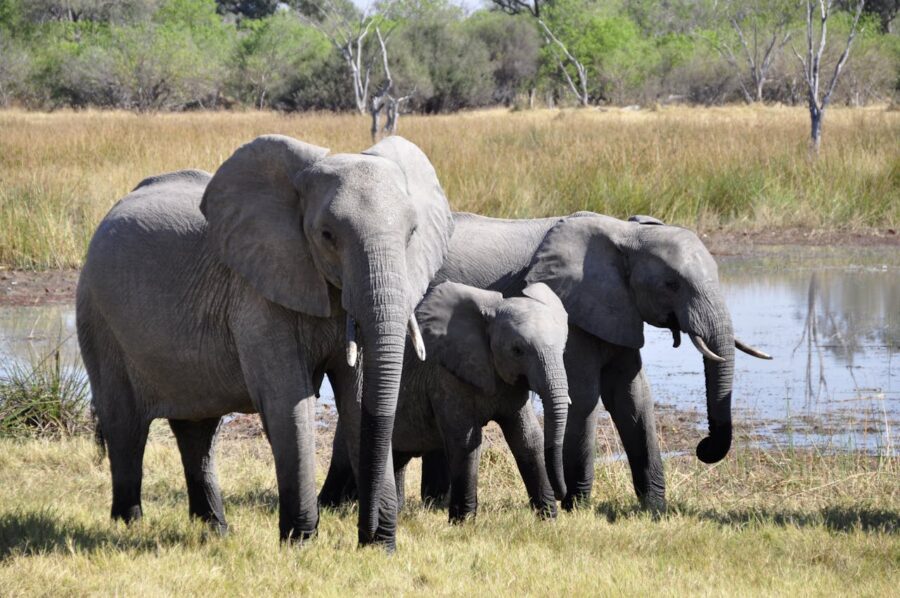
Scientists in Thailand have discovered that Asian elephants pay remarkably close attention to how humans position their bodies, but not quite in the way you might expect. The finding suggests these intelligent giants aren’t just responding to our presence—they’re analyzing whether we’re actually looking at them before deciding to communicate.
Hoi-Lam Jim, a researcher at Kyoto University, set up an experiment in northern Thailand that resembled a peculiar game of “Mother May I?” Ten captive female elephants were given opportunities to request food from a human experimenter who positioned herself in different ways: facing toward the elephant, facing away, body turned but head swiveled backward, and various other awkward configurations that would make a yoga instructor proud.
The elephants weren’t fooled by half-measures. They gestured most enthusiastically when both the experimenter’s body and face pointed directly at them. When the human stood with her back turned, the elephants barely bothered to gesture—treating the situation almost as if no human was present at all. This wasn’t simply about noticing a person nearby; it was about recognizing genuine attention.
Bodies Trump Faces in Elephant Communication
Here’s where it gets interesting: body orientation mattered more than face orientation, but only when the face was also pointing in the right direction. An experimenter standing sideways with her face turned toward the elephant got more gestures than one facing completely away, but the real action happened when everything aligned.
“We were surprised to find that the elephants did not gesture simply because a human was present,” says Jim.
The elephants apparently need multiple visual cues working together before committing to communication. This makes evolutionary sense when you consider that elephant vision isn’t particularly sharp compared to, say, a hawk’s. The larger surface area of a human body is simply easier to detect from a distance than the subtle features of a face. For a species that relies primarily on sound and smell—with brain regions for those senses dwarfing their visual cortex—they’re surprisingly attentive to visual signals when the stakes involve food.
This research mirrors earlier findings with African savanna elephants, suggesting that this ability crosses species lines despite millions of years of evolutionary separation. Asian and African elephants split from a common ancestor roughly 5 to 7 million years ago, around the same timeframe that separated humans from chimpanzees. Yet both elephant species seem to have retained or independently evolved this sensitivity to human attention.
Reading Humans Might Be a Survival Skill
The practical implications extend beyond captive elephants begging for mangoes. Wild elephants in Africa have demonstrated an ability to distinguish between ethnic groups based on clothing color and garment scents, showing more fear toward the Maasai—pastoralists who frequently come into conflict with elephants—than toward the agricultural Kamba people. If elephants can read human body orientation from a distance, it could help them assess threats more effectively in their natural habitats.
The study had its limitations. All participants were female elephants accustomed to human contact, which may not represent how wild elephants would behave. Some had participated in cognitive research before, potentially making them more attuned to experimental setups. And at least one elephant (named Bo) outsmarted the entire apparatus by simply walking around the volleyball net barrier to grab the food directly.
“After conducting doctoral work on how elephants form reputations, I wanted to test whether Asian elephants understand when humans are paying attention to them,” says corresponding author Hoi-Lam Jim.
The researchers used a “zero-inflated Poisson” statistical model—fancy terminology for accounting for the fact that elephants sometimes just stood there doing nothing, which happened 46 percent of the time. The elephants also seemed to catch on across repeated sessions, gesturing less frequently as they figured out they’d get fed regardless of their efforts. Smart cookies, these elephants.
What makes this research particularly valuable is how it expands our understanding beyond primates, the usual suspects in studies of visual attention. Great apes have long been known to modify their behavior based on whether humans are watching them. Now we know that elephants, despite their different sensory priorities and evolutionary history, share this sophisticated awareness. The team plans to investigate other aspects of Asian elephant cognition next, including cooperation and delayed gratification—basically testing whether elephants can resist eating one marshmallow now for two marshmallows later.
For mahouts and zookeepers who work with elephants daily, none of this may come as shocking news. But having scientific confirmation that elephants are actively monitoring our body language adds another layer to our understanding of these complex animals. They’re not just aware we’re there. They’re checking whether we’re paying attention to them before bothering to start a conversation.
Scientific Reports: 10.1038/s41598-025-16994-3
Discover more from Wild Science
Subscribe to get the latest posts sent to your email.