
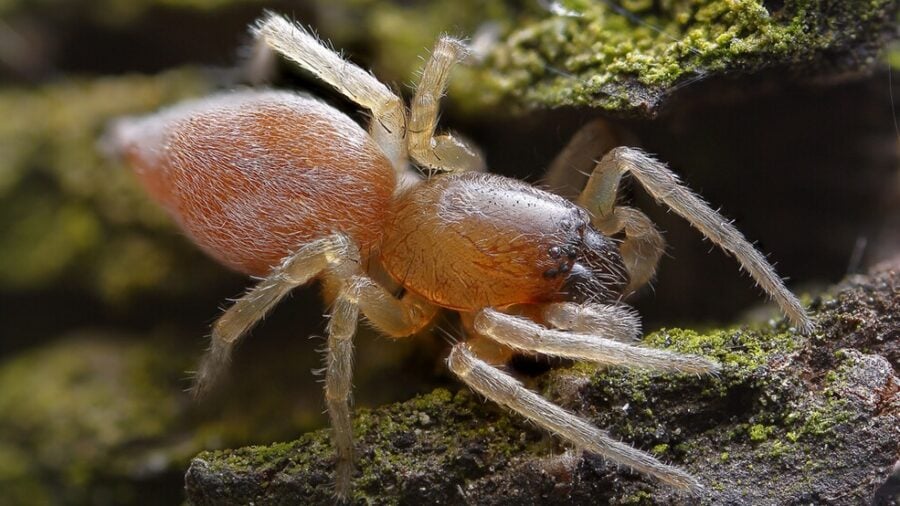
Most spiders shut down when temperatures slip below freezing, but Clubiona spiders keep hunting through subzero nights in European orchards, an improbable winter endurance that depends on potent antifreeze proteins flowing through their bodies.
In work published November 19, 2025 in The FEBS Journal, researchers from Queen’s University in Ontario and collaborators in Czechia analyzed these winter-active spiders using mass spectrometry, ice affinity purification, and AlphaFold2 modeling. They uncovered two hyperactive antifreeze proteins, each about 30 kilodaltons, that bind to ice crystals, prevent their growth, and allow juvenile Clubiona to stay active in temperatures that immobilize nearly every other arthropod in the orchard ecosystem.
A Molecular Trick That Locks Ice In Place
The team collected spiders on subzero days from a pear orchard near Brno, Czechia. Juveniles were tucked into silk retreats wedged in tree bark or resting inside cardboard trunk wraps. When the scientists exposed spider homogenates to freezing conditions under a microscope, the ice formed perfect hexagonal crystals that held their shape, refusing to grow despite the cold. Only when the temperature dropped far past the freezing point did the crystals erupt in sharp dendritic bursts, a classic signature of hyperactive antifreeze proteins binding the basal plane of ice.
“The ability of Clubiona and other winter-active spiders to continue to fend off pests in freezing temperatures is particularly important for perennial agriculture, as they could potentially be used to decrease reliance on insecticides, and therefore also combat insecticide resistance,” said corresponding author Peter Davies, PhD, of Queen’s University in Ontario, Canada.
At full strength, the spider extracts depressed the freezing point by more than 4 degrees Celsius, a level of thermal hysteresis usually reserved for the most powerful insect antifreeze proteins. Even after a 20 fold dilution, the activity only dropped by half. Ice affinity purification pulled nearly all of that activity into the frozen fraction in each round, confirming the proteins bind ice with exceptional efficiency.
A Beta Solenoid Built Through Convergent Evolution
Mass spectrometry revealed a family of antifreeze proteins with eight repeating motifs and small sugar modifications at specific sites. When the researchers modeled the proteins with AlphaFold2, they found a long beta solenoid structure capped by a broad, flat surface dotted with threonine and serine. This surface matched the architecture that beetles and moths use for freeze avoidance, yet the spider sequences showed no detectable homology. Nature had rebuilt the same molecular solution from entirely different raw materials.
“The ability of Clubiona and other winter-active spiders to continue to fend off pests in freezing temperatures is particularly important for perennial agriculture, as they could potentially be used to decrease reliance on insecticides, and therefore also combat insecticide resistance,” said corresponding author Peter Davies, PhD, of Queen’s University in Ontario, Canada.
Transcriptome data indicated at least three Clubiona species were present in the orchard sample, with C. pallidula most abundant. The researchers also found AFP gene variants and a tangle of polymorphisms that help explain the broad mass peaks observed in their protein assays. When they expressed one AFP isoform in bacteria and allowed it to fold and oxidize fully, the recombinant protein reproduced the same ice shaping behavior seen in native extracts.
For growers, these findings matter. In winter, pear psyllids begin reproducing while most predators disappear, but Clubiona spiders keep hunting. Their antifreeze proteins are what make that possible. By supporting these spiders with simple trunk shelters and microhabitat improvements, orchard managers may gain a natural, winter-resilient tool against pests that are increasingly resistant to chemical control.
FEBS Journal: 10.1111/febs.70323
Discover more from Wild Science
Subscribe to get the latest posts sent to your email.