

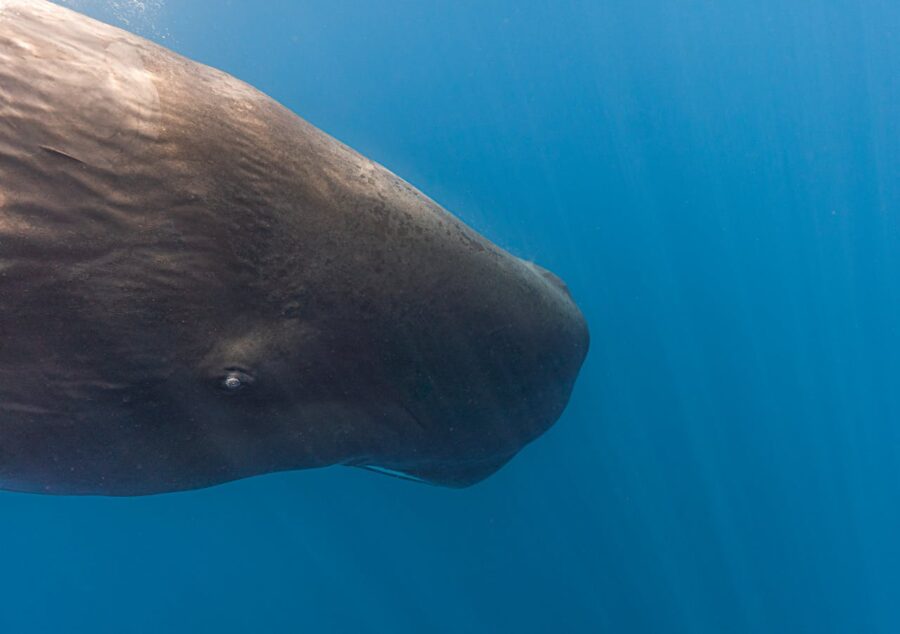
Sperm whales may shape their clicks into something closer to speech than code. New research from UC Berkeley linguists and Project CETI suggests their calls contain vowel like structures with a human style complexity that challenges long held assumptions about animal communication.
In a new acoustic and computational linguistics study in the journal Open Mind, published November 2, 2025, Gašper Beguš and colleagues in UC Berkeley’s Department of Linguistics and Project CETI analyzed more than a thousand tagged recordings of sperm whale codas, the rhythmic click sequences whales use to communicate. By focusing on the spectral shapes of those clicks, they uncovered two recurring vowel like patterns and several diphthong like sweeps across individual codas, revealing a layer of structure far richer than timing alone.
For decades, whale codas were thought to operate like an underwater telegraph, defined by how many clicks each coda contained and the spacing between them. That view held that meaning, if it existed, lived mostly in rhythm. But when the team stripped away timing and examined each click as a resonant event, the picture shifted. Codas sorted neatly into two spectral types, one with a single resonant peak and one with two, echoing the difference between human vowels like “a” and “i.” Just as striking, those patterns stayed consistent across many whales and across different coda types.
The distinction is easiest to see in the spectrograms. Remove timing, zoom into the lower 10 kilohertz, and some codas burn with a single bright band while others split cleanly into two. Within each coda the pattern holds click after click, an internal regularity that would be unlikely if depth changes or body motion were driving the effect. In some cases, the spectral peak even glides upward or downward across a single coda, forming diphthong like trajectories similar to the vowel shifts humans create by adjusting tongue and throat shape.
From Morse Code To Whale Vowels
This spectral layer shifts the frame for what codas are and how whales might use them. Instead of simple timed pulses, codas may be composite signals built from both duration features and vowel like filter shapes.
“In the past, researchers thought of whale communication as a kind of morse code,” said Berkeley Linguistics Professor Gašper Beguš, who is the linguistics lead at Project CETI. “However, this paper shows that their calls are more like very, very slow vowels. This suggests a complexity that approaches human language.”
The team demonstrates this pattern across whales with names like Pinchy, Fork, and TBB. In one exchange, Pinchy produces a run of 1 plus 1 plus 3 codas, some with the a type vowel and some with the i type. Another whale answers with the same rhythmic pattern but alternates its own spectral vowel. What first looks like repetition becomes, with spectral detail restored, a kind of back and forth built from distinct acoustic elements. Because these patterns are visible even in non focal whales recorded at a distance, the researchers argue that whales likely hear these differences as well.
The stability of these spectral types within each coda is one of the most vivid findings. In the raw spectrograms, an a type coda looks like a stack of identical pulses, each carrying the same single resonant frequency. An i type coda shows two stable bands across the entire coda. The uniformity is visually striking enough that once seen, the difference is impossible to miss.
Diphthongs add another layer. Some codas open with a higher resonant peak that slides downward click by click. Others do the opposite, starting low and climbing. These shifts do not match changes in depth, head angle, or roll, and can reverse direction between consecutive codas. That behavior points not to physics but to active articulatory control, likely through subtle adjustments of the air filled structures inside the whales’ nasal complex.
AI As A Tool For Listening In
The connection to artificial intelligence emerges from how the idea first surfaced. Before any of the manual acoustic analysis, Beguš trained a generative adversarial network, or GAN, to imitate sperm whale codas. The model learned on its own to treat certain spectral cues as meaningful, even though no human had labeled them. That unexpected behavior pointed the researchers toward spectral structure as a promising line of inquiry.
Once the team revisited the recordings using established tools like linear predictive coding, the AI generated hint snapped into place. The vowel like patterns were real, repeated across individuals, and robust to movement and recording artifacts. In that sense, AI served not as a translator but as a hypothesis engine, narrowing the search space and sending human analysts back to the sound with new questions.
“This work is so important because it helps you relativize your own position as a human,” said Beguš. “We exchange inner worlds through speech, through vowels and consonants. This is a small step towards understanding the inner worlds of animals, their cultures and their intelligences.”
The stakes are steep. If sperm whales can combine timing, pitch like intervals, vowel like formants, and diphthong like trajectories, their communication system may be one of the most structurally complex outside humans. No one yet knows whether these acoustic features carry referential meaning, or whether whales use them to mark social identity, emotional state, or something else entirely. But the presence of these building blocks suggests that the capacity for linguistic like structure may not be a human monopoly.
That possibility ripples beyond science. Understanding how whales share information raises questions about animal rights, conservation, and the assumptions built into our laws about who gets recognized as a communicator. As the Project CETI team moves closer to deciphering whale dialogue, the boundaries separating human language from the rest of the animal world may need to shift as well.