
Key Takeaways
- The Formosan legless lizard, described in 1930 as Dopasia formosensis, lost its type specimen leading to taxonomic confusion for 80 years.
- Researchers designated a neotype to restore legal stability, revealing that two distinct-looking lizards were actually the same species in different life stages.
- The newly detailed description of the species emphasizes its unique features, such as movable eyelids and behavior during mating and nesting.
- The lizard is currently protected under Taiwanese law, highlighting the importance of accurate identification for conservation efforts.
- Research findings provide valuable data for studying related species in East Asia and address the historical impact of losing a single specimen.
The specimen arrived in Japan sometime before the Second World War. It was a small, limbless reptile collected in Taiwan, formally described by the zoologist Kishida in 1930 and given the species name formosensis, after Formosa, the old Portuguese name for the island. And then, somewhere in the chaos that followed, it vanished. The type specimen, the physical reference object against which all future identifications would be measured, was gone. For the next eight decades, that disappearance created a problem that turned out to be surprisingly difficult to untangle.
Without a type specimen, a species name becomes legally unstable. In taxonomy, the rules are unambiguous: if you cannot point to a specific physical object that defines what the name means, the name itself may not hold. So Dopasia formosensis, the Formosan legless lizard, drifted into taxonomic limbo.
The practical consequence was that Taiwan’s legless lizards ended up folded under a different name, Dopasia harti, a mainland Chinese species described earlier and still possessing its original type specimen. For most of the 20th century, that was simply how things stood. Nobody looked particularly hard at the question, partly because legless lizards are, by any measure, extremely difficult to find. They live under leaf litter and humus in the moist mid-elevation forests of central and northern Taiwan, surfacing rarely, leaving almost no trace. Researchers know they are out there largely because of roadkill data submitted to a citizen science network, the Taiwan Roadkill Observation Network, rather than anything resembling systematic field surveys.
Si-Min Lin at National Taiwan Normal University decided to resolve the confusion, and the solution was formal but fiddly: designate a neotype. This is a freshly collected specimen that takes on the legal role of the lost original, giving the name an anchor in the physical world again. The team went further than just the paperwork, though. In reworking the species account from scratch, they found they had stumbled into several long-standing misidentifications that ran rather deeper than the naming problem alone.
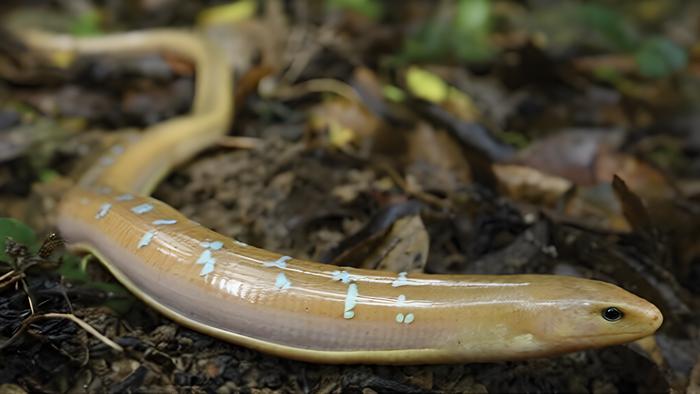
The most striking concerned colour. In field reports and natural history collections, two broadly distinct-looking animals had been turning up in the same geographic range, one with a plain pale bronze body, the other marked with vivid blue spots along its flanks. The conventional assumption was that these represented separate taxa, perhaps separate species. Lin’s team confirmed they are the same animal at different life stages. The blue spots are a form of sexual dichromatism, a secondary sexual signal produced only in fully mature males. Females stay bronze-brown throughout their lives; young males do too, acquiring the blue markings only once they reach sexual maturity. The “two lizards” were, in reality, one species at different points of its development.
Legless lizards and snakes have evolved similar body shapes independently, but several features distinguish them. Legless lizards have moveable eyelids (snakes cannot blink), visible external ear openings, and a lateral fold along the body wall. If you can find something that looks like a snake but blinks at you, it is almost certainly not a snake.
In zoological nomenclature, a species name is legally anchored to a physical “type specimen,” the reference object that defines what the name applies to. Without it, the name becomes unstable and other, better-documented names can take precedence. Designating a neotype, a freshly collected specimen that assumes the role of the lost original, restores that legal stability and allows the species name to stand.
Yes. The blue spots appear only in fully mature adult males and function as a sexual signal. Females and immature males remain a plain pale bronze throughout their lives. The two colour forms had long been suspected to represent distinct species, but genetic and morphological analysis confirmed they are the same animal at different life stages and sexes.
It is currently listed as a protected species under Taiwanese law, which suggests populations are considered vulnerable enough to warrant legal protection. How threatened it is in practice remains somewhat unclear, partly because the animals are so secretive that population size is genuinely hard to estimate. Much of what researchers know about the species’ distribution comes from roadkill reports submitted by the public, not formal surveys.
That kind of misidentification is more common in herpetology than outsiders might expect. Reptile taxonomy has a long history of splitting species along colour lines, only to discover later that the colour in question is age-dependent, sex-dependent, or simply geographically variable. In this case, the confusion had persisted for long enough that it had become embedded in the literature.
The physical description the team assembled is a good deal more detailed than anything previously on record. Adult males reach roughly 175 to 230 millimeters in body length; the tail, notably, can be almost twice as long again as the body itself. A useful field character, and one that helps distinguish these animals from the snakes they are so commonly mistaken for, is the presence of moveable eyelids. No snake can blink; legless lizards can. They also have small but visible external ear openings and a longitudinal groove running along each side of the body (the lateral fold) that allows the skin to expand during breathing and when females are gravid. None of these features are dramatic, exactly, but together they make a legless lizard identifiable if you know to look.
The behavioural picture that emerges from historical records and citizen science observations is richer than the animal’s obscurity might suggest. Females have been documented guarding their egg clutches, remaining close to the eggs until the young hatch, which is not typical of most squamates and hints at a more complex social repertoire. Male combat, meanwhile, involves a ritualised sequence that begins with both animals circling each other with mouths open and bodies flattened, an escalating display that eventually gives way to actual biting and what the published record describes as rotational rolling as each male tries to gain dominance over the other. For an animal most people have never heard of and almost nobody has seen alive, the behavioral catalogue is unexpectedly elaborate.
Conservation status adds some urgency to the clarity the new study provides. The Formosan legless lizard is currently listed as a protected species under Taiwanese law, which means that misidentifying it or mischaracterising its range has real consequences for how that protection is applied. If the species boundaries are wrong, surveys designed to detect it may be counting the wrong things, or counting the same things twice. Lin’s team says that “through these efforts, we aim to provide a more stable framework for future taxonomic, ecological and conservation studies of this overlooked lizard group.”
The data from the study, including genetic sequences, morphological measurements, and the citizen science locality records, has been made publicly available. The hope is that researchers working on related Dopasia species elsewhere in East Asia will be able to use the Taiwanese data as a comparative baseline, since several populations across southern China, Vietnam, and the Ryukyu Islands remain only partially characterised.
It is worth pausing on what the loss of a single museum specimen in wartime Japan meant for the next 80 years of taxonomy. One object, gone, and the downstream consequence was a decades-long identity crisis for an entire species, compounding as the wrong name propagated through reports and databases. The neotype designation is, in a sense, just a bureaucratic correction. But the work Lin’s team did around it, the genetics, the morphology, the sexual dimorphism analysis, amounts to something closer to a proper introduction. Taiwan has a legless lizard that is genuinely its own, with a name to match. The blue-spotted males are out there right now, somewhere under the forest floor, almost certainly unaware that the paperwork has finally caught up with them.
DOI: 10.3897/zookeys.1270.173752
Discover more from Wild Science
Subscribe to get the latest posts sent to your email.