
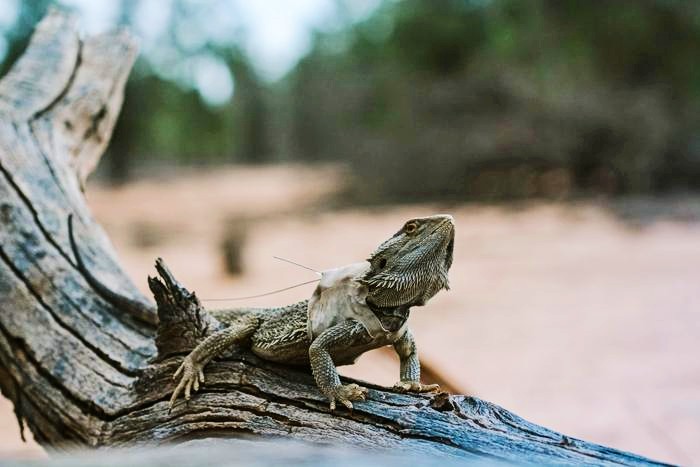
Fitness trackers attached to wild bearded dragons have revealed a counterintuitive finding that challenges assumptions about animal survival. The fastest lizards were actually more likely to die than their slower counterparts, according to a year-long study that monitored 40 Australian central bearded dragons in their natural habitat.
Researchers from the University of Melbourne fitted the lizards with tiny accelerometers and temperature sensors, creating what amounts to reptilian fitness trackers. The devices recorded body temperature and movement data as the animals navigated their daily lives in a 140-square-kilometer nature reserve near Cunnamulla, Queensland.
Speed Paradox Emerges from Data
The study’s most striking revelation came when scientists examined how locomotive performance related to survival outcomes. During the spring breeding season, when predation pressures peak, eight of 27 tracked lizards died. Seven showed clear signs of predation from birds or mammals.
The data revealed a clear pattern: lizards with higher maximum speeds faced significantly greater mortality risk. This relationship held true for both males and females, though the effect proved more pronounced in females.
“What we believe is happening is that speedy lizards are engaging in riskier behaviours, such as moving around more openly and frequently, making them vulnerable to predators like birds and cats,” explained lead researcher Dr. Kristoffer Wild. “We found that increased risk was especially pronounced during spring, so this would make sense with dragons moving around a lot more looking for mates.”
Thermoregulation Mastery Confirmed
The study validated that bearded dragons excel at behavioral thermoregulation—the practice of moving between sunny and shaded areas to maintain optimal body temperature. As cold-blooded reptiles, they depend entirely on external heat sources for essential functions like growth, digestion, and reproduction.
“Our study confirmed that these dragons are indeed masters at optimising behaviour according to seasonal shifts in air temperature,” Wild noted. “Data showed the lizards strategically moving between sunny spots and shady retreats in a delicate balancing act called behavioural thermoregulation.”
The sophisticated tracking revealed that lizards maintained remarkably consistent optimal temperatures around 36.6°C across all seasons and between sexes, despite varying environmental conditions.
Key Findings from the Study:
- Higher locomotive performance correlated with increased mortality risk
- Optimal body temperature remained constant at 36.6°C regardless of season
- Thermoregulation effectiveness varied significantly between spring and winter
- Males showed better survival rates than females during breeding season
- Spring activity levels peaked as mating behaviors intensified
Laboratory vs. Real-World Performance
The findings challenge the traditional assumption that faster animals enjoy better survival prospects. Previous laboratory studies typically show positive correlations between speed and fitness, but this field research captured the complex realities of predation risk and territorial behavior.
The study employed advanced technology including two-photon microscopy and 3D skin analysis systems to generate field-based thermal performance curves—a significant departure from controlled laboratory conditions where variables like predation and food availability are eliminated.
“These findings highlight an important ecological reality – what is measured in controlled lab environments doesn’t always reflect what is happening in real-world environments,” Wild emphasized. “This research reminds us that in the wild, survival isn’t just about physiology, but is deeply intertwined in the interplay with behaviour, predation risk and environmental variability.”
Implications for Understanding Animal Behavior
The research, published in the Journal of Animal Ecology, represents the first time scientists have generated in-situ thermal performance curves using accelerometer data from wild ectotherms. The approach offers new insights into how animals balance competing demands for thermoregulation, reproduction, and survival.
The study’s design incorporated multiple technological innovations, including custom-fitted backpack harnesses that housed GPS loggers, temperature sensors, and two-axis accelerometers. Each device weighed less than 5% of the lizard’s body mass to minimize behavioral interference.
Female lizards showed particularly interesting patterns, maintaining higher preferred body temperatures than males but demonstrating less effective thermoregulation during the critical spring breeding period. This sex difference may reflect the additional energetic demands females face during reproduction.
The research highlights how climate change might affect ectothermic animals by altering the energy costs of maintaining optimal body temperatures. As environmental conditions become more variable, these behavioral trade-offs could become increasingly important for species survival.
Discover more from Wild Science
Subscribe to get the latest posts sent to your email.