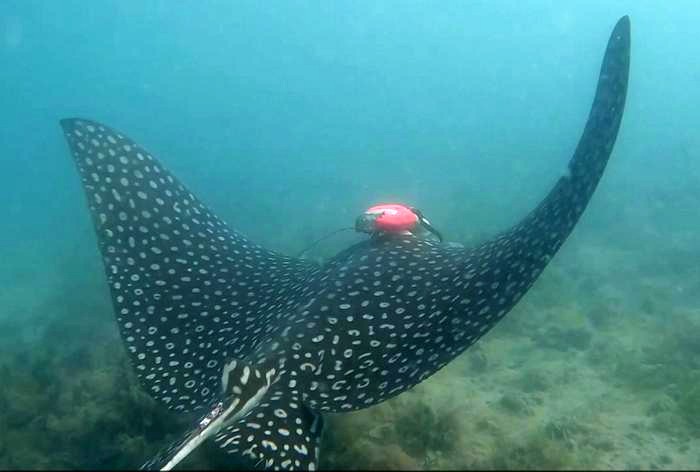
Biologging has cracked open a new window into the hidden world of stingrays. In a pioneering study, researchers at Florida Atlantic University have successfully deployed the first multi-sensor tags on whitespotted eagle rays (Aetobatus narinari), revealing their feeding strategies, habitat use, and behavioral patterns in unprecedented detail. These findings are crucial for understanding the ecological roles of these elusive, shell-crushing predators—and for protecting them in a changing ocean.
Cracking Clams and Breaking Barriers
Unlike sharks or turtles, stingrays have been largely left out of biologging research. Their smooth skin and lack of dorsal fins make attaching equipment notoriously difficult. But FAU’s custom tag—equipped with a video camera, motion sensors, microphone, satellite tracker, and acoustic beacon—solves that problem with a clever attachment system using suction cups and soft spiracle straps.
The tags remained secure even in strong currents, with some lasting up to 60 hours—the longest known retention for external tags on pelagic rays. And what they captured was astonishing.
From Buried Clams to Behavioral Maps
In one deployment, a wild ray was recorded digging into sediment, crunching armored prey, and swimming through multiple habitats, including reefs and seagrass meadows. These behaviors were detected not just by video, but by motion and sound—feeding events left distinctive spikes in acceleration data and audio signatures as the ray crushed clam shells.
Using machine learning, the team trained a model to recognize behaviors like “swimming,” “browsing,” and “digging” based on sensor data alone. The model achieved an overall accuracy of 80.6%, suggesting simpler tags may eventually detect key behaviors without video.
Notable Findings
- Spiracle strap attachment increased tag retention time threefold.
- Shell-crushing was detectable through both accelerometry and acoustics.
- Machine learning classified feeding-related behaviors with high precision.
- Tag data revealed differences between wild and captive feeding strategies.
- Footage included social interactions, not just foraging.
“We’re Beginning to Map Out Entire Behavioral Landscapes”
“We’ve shown that complex behaviors – like the crunching of clams – can be identified using sound and movement data alone, even without video,” said Cecilia M. Hampton, corresponding author and Ph.D. student at FAU Harbor Branch. “It’s not just about observing feeding – we’re beginning to map out entire behavioral landscapes, from foraging strategies to social dynamics.”
Senior author Matt Ajemian added, “Our goal was to create a system that could be applied in seconds, stay on during natural behaviors, and collect rich, multi-dimensional data.”
Future Rays of Insight
With further refinements, the tags could be adapted to other ray species and potentially used for weeks at a time. The data could help turn rays into “mobile surveyors” of ocean health, providing insight into benthic ecosystems and how marine animals adapt to environmental change.
This research was supported by the National Science Foundation and Harbor Branch Oceanographic Institute Foundation.
Journal: Animal Biotelemetry
DOI: 10.1186/s40317-025-00416-2
Discover more from Wild Science
Subscribe to get the latest posts sent to your email.