
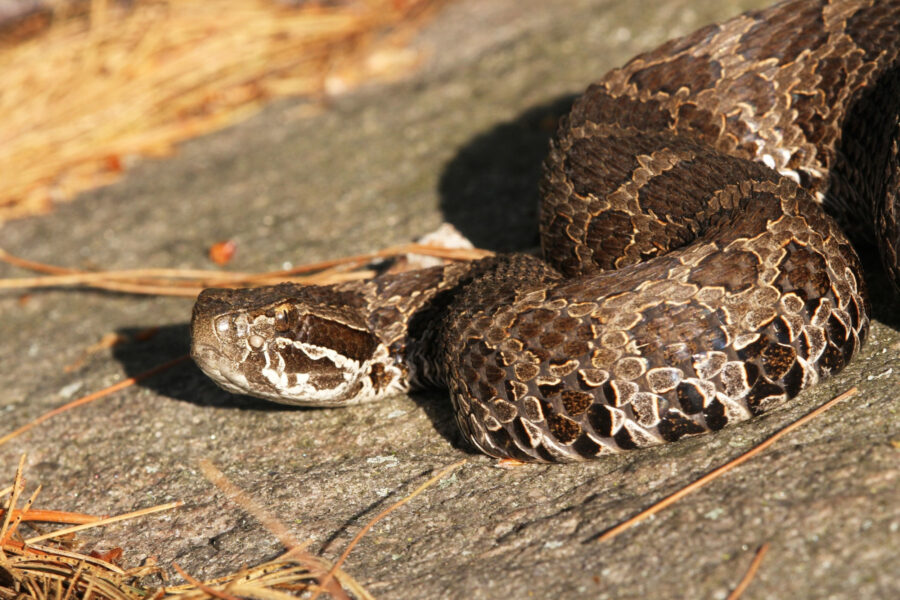
Moving animals from large, healthy populations to boost the survival of endangered ones has long been a staple of wildlife conservation.
But new research on the Eastern massasauga rattlesnake suggests this practice, called assisted gene flow, may introduce more harmful genetic mutations than beneficial ones. The findings raise questions about how much of a species’ long-term resilience is due to genetics alone, and how much comes from ecological conditions that give struggling populations room to rebound.
Genomics Puts a Conservation Strategy to the Test
Researchers from The Ohio State University examined the full genomes of 152 Eastern massasauga rattlesnakes across the United States and Canada. They compared two large, genetically diverse donor populations with three small, inbred populations in Ohio that are on the brink of disappearing.
By tallying up single-nucleotide polymorphisms, or SNPs, in genes linked to either adaptive traits or damaging effects, the team calculated what would happen if donor snakes were moved into recipient populations. They found that while the influx would increase adaptive genetic variants by about one-third, it would also raise harmful variants by more than that — with many being small-effect mutations that could still accumulate over time.
“We have a little bit of a paradox here. The genetic analysis says genetic rescue is maybe not good, or at best, it’s a wash,” said H. Lisle Gibbs, senior author of the study.
Key Findings from the Study
- Donor snakes could increase adaptive variants in recipient populations by 32–36 percent.
- They would also add 31–39 percent more harmful mutations, many of them low-impact but numerous.
- Only about 7 percent of adaptive variants showed signs of being locally adapted to a specific region, suggesting low risk of disrupting local adaptation.
- Masking of harmful recessive mutations in the first generation could offset some risks, but not enough to outweigh the added mutation load.
Ecology Still Matters
Despite the genetic caveats, assisted gene flow has a strong track record in real-world conservation, often boosting population numbers in the short term. Gibbs notes that the positive demographic effects — simply having more individuals — may buy time for a species to adapt, especially if habitat conditions are favorable.
This aligns with a growing view among conservation biologists that ecological factors, such as habitat quality and availability of prey, can be just as important as genetic diversity in determining whether a population thrives after intervention.
Not Just About Snakes
While this study focused on Eastern massasauga rattlesnakes, the statistical methods developed by Gibbs and lead author Samarth Mathur could be applied to any species where genome data are available. That means conservationists could better balance the benefits of new adaptive genes against the risk of introducing harmful ones before moving animals.
“This isn’t just about snakes,” Gibbs said. “It’s about big populations and small populations, and so we think the result is general.”
Balancing Risks and Benefits
The researchers emphasize that genetics are only one part of the decision-making process. For highly isolated populations with no natural migration, translocation may still be the only option to prevent extinction. But they recommend weighing the genetic risks alongside ecological, political, and logistical factors.
The takeaway: assisted gene flow can be a valuable tool, but it is not a one-size-fits-all solution. Understanding the genetic baggage that comes with each rescue attempt could make the difference between a short-term boost and a long-term setback.
Journal: Molecular Ecology
DOI: 10.1111/mec.70014
Discover more from Wild Science
Subscribe to get the latest posts sent to your email.