
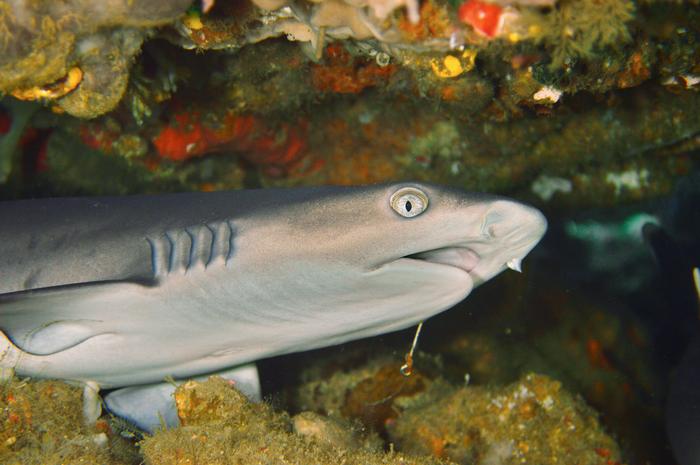
For at least 45 million years, global shark and ray diversity has been sliding downhill, not climbing, and today’s crisis looks less like a blip than a long, slow collapse.
In a new fossil analysis published in the journal Scientific Reports, an international team led by Manuel A. Staggl at the University of Vienna assembled a high resolution record of neoselachians, the group that includes modern sharks and rays and their closest extinct relatives, spanning roughly the last 100 million years. Using sampling standardised data from 49,750 fossil occurrences representing 503 genera, they show that neoselachian diversity peaked in the warm Eocene about 45 million years ago, then entered a long term decline that continues to the present, even though earlier work had suggested diversity was stable or increasing.
That deep time perspective reframes today’s conservation emergency. These predators have survived multiple mass extinctions, including the asteroid impact that wiped out non-bird dinosaurs, yet more than one third of modern sharks and rays are now threatened with extinction. The new study suggests that the long slide in diversity is tightly tied to the loss and reshaping of the shallow coastal habitats that once fueled their evolution.
A Fossil Record That Upends The Comfortable Story
“Cartilaginous fish, which include today’s sharks and rays, have existed on our planet for over 400 million years. They have survived several mass extinction events during this time, yet today, over a third of neoselachians (i.e. modern sharks and rays) are at risk of extinction,” explains Manuel Staggl. “To develop effective conservation measures, we must understand which environmental factors have influenced their diversity in the past.”
The team reconstructed genus level diversity across the Cenozoic, the last 66 million years, and asked two linked questions: how did diversity and faunal composition change through time, and what environmental forces best explain those patterns. Contrary to earlier suggestions that the end Cretaceous extinction dealt sharks and rays a devastating blow, the new sampling standardised curves show only a mild dip after the asteroid impact 66 million years ago, followed by a strong radiation that culminated in an Eocene peak.
From that high point, genus diversity declined and never fully recovered. The pattern holds across sharks and batoids (rays and their relatives), and even when the authors split the dataset into ecological groups such as coastal, benthic, and deep sea sharks. Two major faunal shifts during the Miocene, about 16 and 12 million years ago, mark large turnovers in which the mix of genera changed without restoring past levels of richness.
To understand why, the researchers compared their diversity curves to a suite of abiotic and biotic variables, including continental fragmentation, flooded continental area, sea level, temperatures, atmospheric CO₂, and the diversity of key plankton groups. Statistical models point to a consistent story. The strongest abiotic drivers of neoselachian diversity and faunal turnover were how fractured the continents were, and how much of their margins were flooded by shallow seas.
When plate tectonics broke continents into smaller pieces and created more continental margins, shallow, heterogeneous habitats proliferated. These species rich coastal zones and epicontinental seas acted as diversification engines, especially for coastal sharks and many rays. As flooded shelf areas shrank through the Cenozoic, overall diversity followed.
Deep sea sharks tell a slightly different but related tale. Their diversity rose as deep ocean temperatures cooled, and the authors suggest that many lineages may have escaped warming surface waters by shifting to greater depths or higher latitudes. Even there, however, the long term imprint of changing ocean geography and climate is clear in repeated turnovers of deep sea faunas.
Coastal Habitats, CO₂, And The Conservation Clock
“Our study shows that marine conservation is not just about fishing quotas, we need to adopt a broader perspective that considers entire habitats and the climate system,” concludes palaeobiologist Staggl.
One of the more counterintuitive findings involves atmospheric CO₂. Moderate CO₂ levels in the past appear to have supported higher shark and ray diversity, likely by boosting photosynthesis in algae and seagrass meadows and energising the food webs that sustain large predators. But the same modelling and previous work by the group show that excessively high CO₂ becomes harmful to marine ecosystems as a whole, contributing to ocean acidification and ecosystem disruption.
In other words, there is a sweet spot. Past neoselachians seem to have benefited when CO₂ was high enough to drive productivity, but not so high that chemistry and temperature changes overwhelmed physiological limits and degraded habitats. Today’s rapid, human driven CO₂ increase is pushing the system into the dangerous side of that curve.
The fossil record also highlights how crucial shallow coastal habitats are for shark and ray evolution. The more diverse and extensive these shallow marine environments were, the more new species emerged. That historical dependence is alarming in light of current trends. Coastal development, pollution, warming, and unsustainable fishing are all eroding exactly the kinds of habitats that once made sharks and rays so successful.
Highly specialised species, such as deep sea sharks adapted to stable, cold conditions, face a different but equally stark problem. In the past, environmental changes unfolded over millions of years, giving lineages time to migrate or adapt. The present biodiversity crisis, driven by overfishing, habitat destruction, and rapid climate change, is unfolding far faster than those deep time shifts. For many specialists, there may be no time, or no place, left to move.
Taken together, the deep time analysis points to two clear conservation priorities. First, protect and restore diverse shallow coastal habitats, including reefs, seagrass meadows, and other structurally complex nearshore systems that act as nurseries and feeding grounds. Second, cut CO₂ emissions to limit ocean warming and acidification that threaten both coastal and deep sea communities.
By showing that shark and ray diversity has been declining since long before industrial fishing, the work does not let humanity off the hook. Instead, it underscores how modern pressures stack dangerously on top of a long running downward trend, pushing a once resilient lineage toward a tipping point.
Scientific Reports: 10.1038/s41598-025-25653-6
Discover more from Wild Science
Subscribe to get the latest posts sent to your email.