
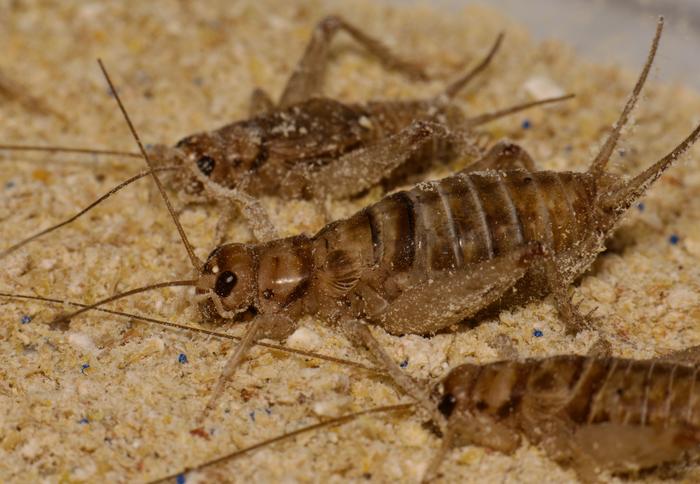
Tropical house crickets raised in Ottawa, Canada, happily gobbled polyethylene microplastics mixed into their feed, treating them much like normal food. The work appears in Environmental Science & Technology and followed the insects for seven weeks as they grew roughly 20 times heavier without obvious stunting despite chronic plastic exposure.
The team used fluorescent plastic beads between about 38 and 425 micrometers across to see which sizes the crickets could eat. They found that a bead only started showing up in guts and droppings once the insect’s mouthparts had grown large enough to fit it, and that crickets kept eating those particles for life once they crossed that threshold. The study, led by Canadian researchers and publicized by the American Chemical Society, suggests generalist insects may act as inadvertent grinders that turn environmental microplastics into even more mobile and biologically reactive nanoplastics.
Crickets in the study belonged to the species Gryllodes sigillatus, a common “house cricket” often used in physiology and ecotoxicology experiments because it is easy to rear and will eat a broad range of foods. Microplastics, defined here as plastic particles between 1 micrometer and 5 millimeters in size, are increasingly recognized as pervasive contaminants in soils and biosolid fertilizers, which can contain up to several milligrams of plastic per gram. That means ground-dwelling insects foraging on decaying plant material and organic amendments are likely to encounter plastic particles that overlap in size with the seeds, grains, or detritus they normally consume.
Cricket Mouth Size Sets Plastic Threshold
To probe how body size shapes plastic ingestion, the researchers reared crickets from early juvenile stages on diets containing fluorescent polyethylene beads spanning a range of size classes from tens to several hundred micrometers. They measured head and mouthpart dimensions across development and compared these traits with the sizes of plastic particles recovered from the gut and frass, allowing them to pinpoint when a given bead size became ingestible.
Adult crickets offered a choice between uncontaminated feed and food containing small or large microplastics did not preferentially select the plastic-free diet and, in fact, increased their intake of the contaminated feed over time. Growth trajectories showed that, under the bead concentrations tested, plastic ingestion did not markedly reduce body mass gain, unlike some previous work with fibrous microplastics that reported slower growth in this same species.
“Crickets would only consume beads when their mouth size was larger than the microplastic,” Marshall W. Ritchie said.
Once a particle size crossed that anatomical threshold, crickets continued swallowing those beads throughout their life, indicating they did not learn to avoid the plastic even with prolonged exposure. The authors argue that such behavior, combined with generalist feeding habits, means many terrestrial insects are unlikely to distinguish plastic from similarly sized food particles in real-world settings like fields treated with microplastic-laden biosolids.
From Microplastics To Nanoplastics
By dissecting digestive tracts and analyzing excreted material under microscopy, the team found that ingested beads often emerged substantially smaller, consistent with mechanical grinding in the cricket gut. Earlier work with the same species has shown size reductions of up to roughly 1000-fold during digestion, yielding particles at or near the nanoplastic range, which are more difficult to track and may move more readily through tissues and food webs.
In the new study, small microplastics around 38 micrometers were more likely to pass through the gut largely intact, while larger beads on the order of 425 micrometers underwent more extensive fragmentation once crickets were big enough to eat them. Interestingly, as the insects grew and their mouthparts and digestive capacity changed, the extent of fragmentation of a given bead size declined, suggesting that early life stages may be especially potent generators of nanoplastics from large microplastic particles.
“Larger microplastics were more extensively biofragmented once ingested, highlighting the potential for insects to act as environmental grinders of plastic,” Heath A. MacMillan said.
The findings carry implications for how regulators and waste managers think about plastic particle sizes entering terrestrial ecosystems, particularly agricultural soils that host abundant insect communities. If generalist insects routinely ingest plastics as soon as their mouthparts allow and then break those particles into smaller fragments that can disperse in soil or move up food chains, policies focused only on visible litter or coarser microplastics may underestimate the generation of smaller, harder-to-detect particles. The authors suggest that linking plastic size distributions to the body sizes of common invertebrates could help predict which species act as key conduits for microplastics and nanoplastics in different habitats.
Environmental Science & Technology study
Discover more from Wild Science
Subscribe to get the latest posts sent to your email.