

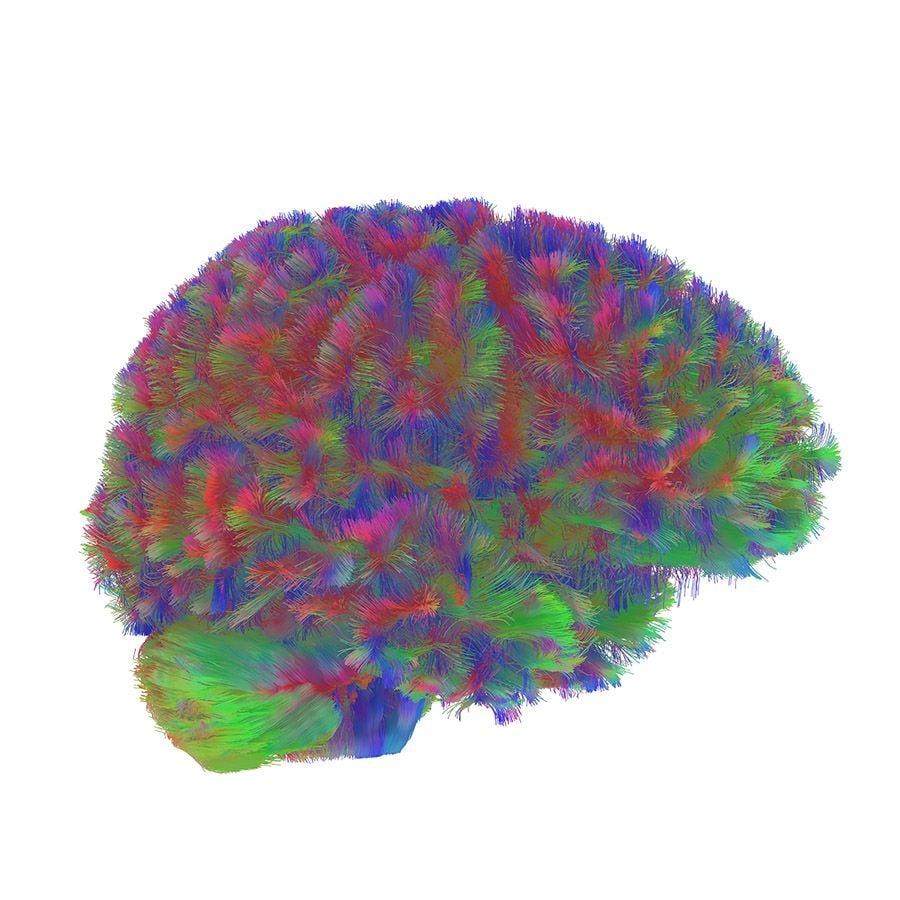
The idea of a brain that simply matures then gradually fades does not hold up. Scientists at the University of Cambridge say our wiring moves through five distinct eras, each separated by sharp turning points at ages 9, 32, 66, and 83.
The claim comes from MRI diffusion scans of 3,802 people, spanning birth to age 90. The team tracked how water moves through brain tissue, a way of following the paths that connect one region to another. They fed twelve measures of network organization into a manifold learning model and watched the trajectory twist through a mathematical space. Wherever the line bent hard, that is where a new phase began.
“We know the brain’s wiring is crucial to our development, but we lack a big picture of how it changes across our lives and why. This study is the first to identify major phases of brain wiring across a human lifespan.”
Infancy through age 9
The first era is dominated by pruning. Babies arrive with dense webs of synapses that get cut back, leaving the stronger connections intact. Gray and white matter grow quickly. Cortical thickness peaks. The folds of the cortex settle into stable patterns. It is an enormous amount of change, yet the overall wiring shows a steady slide in global integration. Local clustering, oddly enough, becomes a better marker of age than anything else.
Then comes the first big turn around age 9. It appears suddenly in the manifold. The timing lines up with a clear rise in cognitive capacity and a higher risk of certain mental health conditions. You can feel the shift even without mathematics. It is the moment when childhood narrows and the long slope toward adolescence begins.
A long adolescence, ending late
The second era runs from 9 to 32, which is a surprisingly generous definition of adolescence but one the data support. White matter thickens, connections get more efficient, and the network becomes both globally streamlined and locally specialized. Small world structure rises year after year. These changes pull the manifold path in a consistent direction until it suddenly pivots again.
“Around the age of 32, we see the most directional changes in wiring and the largest overall shift in trajectory, compared to all the other turning points,” said Dr Alexa Mousley, who led the work. “Based purely on neural architecture, we found that adolescent like changes in brain structure end around the early thirties.”
The sharpness of that shift is striking. Nothing else in the lifespan shows a bend as dramatic. It suggests that whatever adolescence means biologically, it finishes much later than cultural categories tend to admit.
Adulthood settles in
From 32 to 66, the brain enters its longest stretch. Things quiet down. Integration begins to fall. Segregation increases. The measures that best predict age become local instead of global, with clustering and local efficiency pulling more weight. It is not a stagnant period, but the noise of rapid development fades. This stability mirrors what other studies describe as the plateau of intelligence and personality.
The sixties turn and its aftermath
Around 66, the curve changes again, although not with the punch seen at 32. The combined principal components that summarize segregation, integration, and centrality all shift at once. No single metric makes the case alone. You have to look at the whole pattern to see it.
The researchers interpret this as the end point of gradual reorganization. White matter begins to weaken. Health conditions that affect the brain, such as hypertension, become more common. The network grows more modular. Communities of tightly linked regions peel off from each other. The system is still functional, sometimes impressively so, but it is holding its shape differently.
The final turn arrives near 83. This one is subtle. The correlation between age and topology weakens. Only subgraph centrality stays meaningfully tied to age, and in relatively few regions. Global communication continues to decline. The system leans more on specific nodes, especially in occipital and somatosensory areas. The sample is smaller here, so the picture is softer at the edges, but the trend suggests that in late life the brain is governed less by age and more by individual variation.
Windows of vulnerability and change
The five eras mark windows where the brain appears to be most reshaped, most sensitive, or most exposed. Learning differences in childhood. Vulnerabilities in adolescence. Stability across decades of adulthood. Then the long turn into aging, with its quieter but persistent reorganizations.
“Many neurodevelopmental, mental health and neurological conditions are linked to the way the brain is wired. Indeed, differences in brain wiring predict difficulties with attention, language, memory, and a whole host of different behaviours.”
The study offers a new frame. Instead of one smooth arc, the lifespan becomes a series of terraces. Each phase runs with its own logic. Each turn redirects what comes next. Understanding those turning points may help explain why some brains follow one trajectory and others deviate at critical moments.
Journal: Nature Communications
Title: “Topological turning points across the human lifespan“